
How do your cells decide which bodily parts to construct? Innovative new technology is assisting us in learning
From brain development to stroke recovery


In just a few days, a single fertilised egg can produce blood, brain, and skin cells. However, how do the earliest cells decide which bodily components to construct? How come certain cells know how to make kidneys while others start making skin right away?
For almost a century, developmental biologists have been working to solve that puzzle, yet many lineage maps still appear to be incomplete sketches.
A team from Australia has now reported a tracking technology called LoxCode, which uses a unique DNA tag to identify each cell in a mouse embryo and track its offspring as tissues develop.
According to Dr. Tom Weber of the Walter and Eliza Hall Institute, "this creates a trackable barcode, allowing us to peer inside this fundamental process with unprecedented detail."
LoxCode tracks every cell from the beginning.
LoxCode creates about 30 billion possible barcodes in a single step by shuffling small DNA cassettes using the Cre recombinase enzyme. As the embryo develops, each label is reliably replicated, allowing researchers to use straightforward sequencing to later reconstruct family trees.
On day 5.5 of pregnancy, while the epiblast is still forming its initial germ layers, the scientists administered the barcode cassette in pilot studies. They read the tags in bulk tissue and at single-cell resolution after recovering foetuses a week later.
"That indicates that fate bias manifests much earlier than textbooks indicate," said Prof. Shalin Naik, head of the laboratory at WEHI. While some clones adhered to limb buds, ectoderm, or blood, others reached every part of the embryo.
The researchers anticipated hidden asymmetries, such as left-versus-right kidney precursors, by feeding the barcode data into an agent-based model. They then verified these predictions empirically. These computer cross-checks increase the certainty that the tags accurately capture biology rather than sequencing noise.
How billions of labels are written by LoxCode
Previous lineage tracing methods relied on CRISPR cuts or viruses, which can harm cells or obscure delicate branches. Resolution was limited since only a few hundred distinct changes were recorded by a single CRISPR recorder over an entire zebrafish.
By employing 13 brief DNA fragments that are organised so that an enzyme known as Cre recombinase can shuffle them in a variety of ways, LoxCode circumvents earlier restrictions. The shuffling ceases when the fragments are smaller and more stable, securing the DNA tag for every cell.
The short length of each DNA fragment makes it simple to read these tags with common genetic sequencing equipment. Because of this, the technique is inexpensive, even for labs with modest funding.
Additionally, the group produced strain 037677, a unique mouse breed that is sold by The Jackson Laboratory. By combining it with another mouse that initiates the barcoding process in particular tissues, researchers can make use of it.
Exposing the embryo's hidden prejudice
It was long believed that pluripotent cells waited for outside cues before choosing their fate. Even though the foetus is still the size of a poppy seed, the new research indicates that many clones already tend towards one germ layer.
For example, epiblast cells positioned close to the early streak that was emerging produced primarily blood and mesenchyme cells, which is consistent with previous dye-label studies but adds single-cell resolution.
On the other hand, brain tissues were preferred by anterior clones, suggesting that location cues result in lineage bias before the onset of gastrulation.
Unexpected asymmetries also surfaced. The first skeletal pattern is seeded by randomness rather than mirror symmetry, as the left limb bud frequently traces back to different founders than the right.
These revelations may help explain why certain congenital conditions only affect one side of the body. Additionally, LoxCode provides reference maps for stem-cell engineers to help steer organoids towards balanced growth.
From brain development to stroke recovery
Researchers are already modifying barcoding to examine immunological development, intestinal regeneration, and tumour recurrence because it functions in live mice.
Using LoxCode to identify progenitors near the damage edge, a neuroscientist at the University of Queensland is tracking how newborn neurons integrate into adult circuits following a stroke.
After months of drug exposure, cancer researchers intend to monitor the emergence of therapy-resistant clones. They aim to identify weaknesses before relapse by tracing each surviving cell back to its earliest barcode.
One day, chemicals that push bad lineages back towards healthy ones could be screened by drug makers. This method naturally connects with single-cell RNA profiles, indicating not just the location of a clone but also the changes in its gene programs as it travels.
The implications for medicine of this
Mistaken cell choices that occur weeks before clinical symptoms are frequently the cause of developmental problems. Using LoxCode to identify progenitors near the damage edge, a neuroscientist at the University of Queensland is tracking how newborn neurons integrate into adult circuits following a stroke.
After months of drug exposure, cancer researchers intend to monitor the emergence of therapy-resistant clones. They aim to identify weaknesses before relapse by tracing each surviving cell back to its earliest barcode.
One day, chemicals that push bad lineages back towards healthy ones could be screened by drug makers. This method naturally connects with single-cell RNA profiles, indicating not just the location of a clone but also the changes in its gene programs as it travels.
The implications for medicine of this
Mistaken cell choices that occur weeks before clinical symptoms are frequently the cause of developmental problems. Researchers can identify the initial wrong turn and create specific therapies with the help of a cellular ancestry map.
Instead of treating tissues one at a time, gene treatments that replace defective DNA in founder cells may be able to fix a complete lineage. Likewise, before surgery, transplant physicians could confirm that lab-grown grafts had the proper mix of cell types.
There will be ethical concerns, particularly if human embryos are ever tagged to the same extent. For the time being, the emphasis remains on mice, where LoxCode has already promised to revolutionise early embryonic patterning textbooks.
About the Creator
Keep reading
More stories from Francis Dami and writers in Futurism and other communities.
Mars's mysterious ridges reveal a surprising past.
A new area with unique rock formations was recently reached by NASA's Mars Curiosity rover. These crisscrossing ridges, called "boxwork patterns," are unlike anything that has ever been observed on the Red Planet, and Curiosity is now getting its first up-close look.
By Francis Dami9 months ago in Futurism
Fluid Loss Additives Market Outlook: Drilling Efficiency Enhancement and Oilfield Services Growth Opportunities
According to IMARC Group's latest research publication, The global fluid loss additives market size was valued at USD 318.42 Million in 2025. Looking forward, IMARC Group estimates the market to reach USD 409.06 Million by 2034, exhibiting a CAGR of 2.82% from 2026-2034.
By James Whitman3 days ago in Futurism
Australia Textile & Apparel Market: Sustainable Fashion, E-commerce Growth & Fabric Innovation
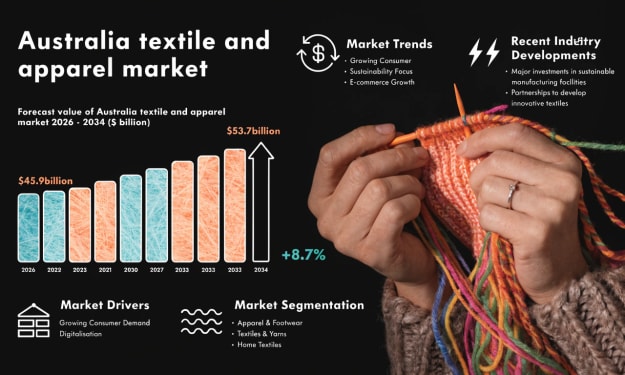
According to IMARC Group, the Australia textile and apparel market reached a value of USD 30.3 Billion in 2025 and is projected to reach USD 45.7 Billion by 2034, growing at a compound annual growth rate (CAGR) of 4.66% during 2026–2034. The market is evolving as consumer preferences increasingly favor sustainable fashion, innovative fabric technologies and digitally driven retail experiences. Rising disposable incomes and changing lifestyle trends are encouraging consumers to spend more on clothing, footwear and fashion accessories. At the same time, growing awareness about environmental sustainability is driving demand for eco-friendly textiles, recycled fabrics and ethically produced garments. The rapid expansion of e-commerce platforms and online fashion marketplaces is also transforming how consumers shop for apparel, enabling brands to reach wider audiences across Australia. As fashion companies adopt new production technologies and sustainable manufacturing practices, the textile and apparel sector is undergoing significant transformation.
By Kevin Cooper2 days ago in Futurism
Becca
"Everything is so... flat." Denille said stupidly as she looked around her new neighborhood. She looked around at the muted desert where even the smallest sign of life seemed to have given up. The plant life was shrubs that were half cooked by the heat and where there should have been a lawn, a mess of white rocks laid glistening in the sun. Even the sky looked stretched thin, like the sun had ironed it smooth. She’d moved from Riverside, where at least there were hills, but here in Barstow, everything felt baked and brittle.
By Sara Wilson7 days ago in Fiction



Comments
There are no comments for this story
Be the first to respond and start the conversation.