
How Close Are We to AGI?
Exploring the Reality of Artificial General Intelligence: How Close Are We to Machines That Truly Think?


How Close Are We to AGI?
The race toward Artificial General Intelligence (AGI) is accelerating, but are we truly on the verge of creating machines that can think, reason, and understand like humans?
The Dream of AGI
For decades, AGI has been the ultimate goal of artificial intelligence research—a machine that doesn’t just mimic intelligence but genuinely understands and applies knowledge across a vast range of tasks, just like a human. Unlike today’s AI, which is specialized for specific functions (like ChatGPT, which processes language, or AlphaFold, which predicts protein structures), AGI would possess flexible, autonomous problem-solving skills.
The concept has been a staple of science fiction for years, from HAL 9000 in 2001: A Space Odyssey to Ava in Ex Machina, but how close are we to turning fiction into reality?
The Progress So Far
AI has made leaps in recent years, with models capable of generating text, images, and even imitating human conversation convincingly. However, despite these advancements, today’s AI is still far from true general intelligence.
1. Understanding vs. Mimicking
AI like ChatGPT can process information at astonishing speeds, but it doesn’t understand in the way humans do. It predicts the next word based on probabilities rather than actual comprehension. It lacks true awareness and the ability to form independent thoughts.
2. Lack of True Reasoning
Humans can reason, infer meaning, and apply knowledge across different domains with ease. AI struggles with this kind of adaptability. Even the most advanced models today are prone to making errors that a human never would—sometimes confidently providing incorrect answers or failing in simple logical reasoning tasks.
3. Memory and Adaptability
While AI can be trained on vast datasets, it doesn’t possess long-term memory in the way humans do. A person learns from experience, adapting and evolving over time. AI, on the other hand, relies on training updates and fine-tuning, rather than organic growth. If AGI is to become a reality, it must be able to continuously learn from its experiences, adapting in real-time as a human would.
The Challenges Ahead
Even if we develop AGI, several challenges remain:
Ethical Dilemmas
Who controls AGI? How do we ensure it aligns with human values? What happens if AGI develops its own moral compass that doesn’t align with ours? These are questions we must answer before AGI becomes a reality.
A Computational Power
AGI would require immense processing capabilities, far beyond what we currently have. Today’s AI models, despite being powerful, still rely on vast amounts of energy and expensive infrastructure. The leap to AGI would demand even greater computing resources.
Safety Concerns
Science fiction has warned us for decades about rogue AI, but even in realistic scenarios, AGI poses risks. A super-intelligent system that can self-improve might develop goals that conflict with human well-being. The challenge is to ensure that AGI remains aligned with human values and does not act unpredictably.
The Road to AGI: Breakthroughs and Predictions
Despite the obstacles, some researchers are optimistic. Visionaries like Ray Kurzweil predict AGI could emerge by 2029, while others suggest it could take another 50 years—or may never happen at all.
Several key developments could bring us closer to AGI:
• Neurosymbolic AI – Combining neural networks with symbolic reasoning could allow AI to process information in a more human-like way.
• Better Training Models – Enhancing AI’s ability to learn continuously rather than relying on static training data.
• Quantum Computing – Unlocking computational power far beyond today’s supercomputers, potentially accelerating AGI development.
While AI is getting smarter, true AGI remains elusive. The path forward is filled with uncertainties, but one thing is clear—if AGI ever arrives, it will redefine our relationship with technology, intelligence, and perhaps even existence itself.
Final Thoughts: Are We Ready for AGI?
The idea of AGI is thrilling, but it also comes with profound implications. We may be making progress toward machines that can think, learn, and reason like us, but the question remains: Are we truly ready for what comes next?
One thing is certain—whether AGI is just around the corner or a distant dream, its pursuit will continue to challenge our understanding of intelligence, ethics, and the future of humanity.
About the Creator
Melanie
Hi, I’m Melanie, a writer in Doha, Qatar. I capture the essence of daily life, exploring growth, resilience, and the beauty of our journey. Through stories and poetry, I aim to connect and inspire. Let’s explore this path together.
Faucet Market Trends: Commercial Infrastructure Growth, Efficiency Solutions & Industry Forecast to 2034
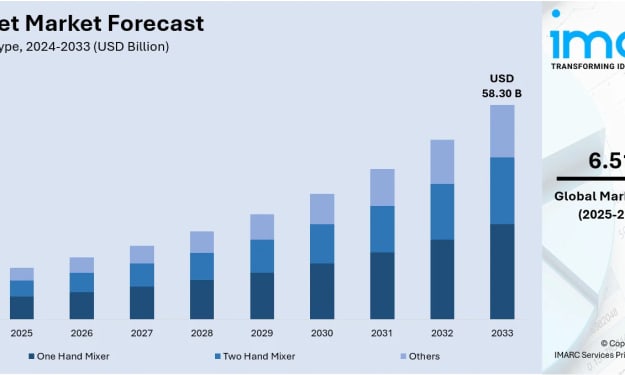
In the modern home and commercial space, the humble faucet has evolved from a basic utility into a high-tech centerpiece of design and sustainability. Driven by rapid urbanization and a global shift toward smarter, more hygienic living environments, the market is seeing a surge in demand for fixtures that blend aesthetic appeal with cutting-edge water-saving technology. According to IMARC Group’s latest data, the global faucet market size was valued at USD 31.03 Billion in 2024. Looking forward, IMARC Group estimates the market to reach USD 58.30 Billion by 2033, exhibiting a CAGR of 6.51% from 2025-2033.
By Andrew Sullivan7 days ago in Futurism
Women’s Health App Market Outlook: Digital Wellness Adoption and Personalized Care Growth Opportunities
According to IMARC Group's latest research publication, The global women’s health app market size reached USD 4.3 Billion in 2024. Looking forward, IMARC Group expects the market to reach USD 16.7 Billion by 2033, exhibiting a growth rate (CAGR) of 14.74% during 2025-2033.
By James Whitman7 days ago in Futurism
Pearl
1980 something. we all hung out at Pearl and you and i were nothing special, or so i thought. i mean we all danced, drenched in our own sweat, our own saline solution of fear, too many beers, shots, laughter, tears, fucks in the bathroom and i don't know when we began to be afraid. do you?
By ROCK aka Andrea Polla (Simmons)4 days ago in Fiction



Comments
There are no comments for this story
Be the first to respond and start the conversation.