
"How China Became a Tech Superpower"
A Strategic Vision from the Top


How China Became a Tech Superpower
In just a few decades, China has transformed from a largely agrarian society into one of the most technologically advanced nations on Earth. Once known for cheap manufacturing and imitation products, China now leads in fields such as artificial intelligence, 5G, quantum computing, and electric vehicles. The question many around the world are asking is: How did China become a tech superpower so quickly?
A Strategic Vision from the Top
China’s rise in technology wasn’t an accident—it was the result of deliberate, long-term planning by its government. The Chinese Communist Party (CCP) has consistently placed science and technology at the core of its national development strategy.
As early as 2006, China launched its Medium- to Long-Term Plan for the Development of Science and Technology, which aimed to reduce reliance on foreign innovation. This was followed by the Made in China 2025 initiative in 2015, targeting global leadership in 10 high-tech sectors including robotics, aerospace, and new energy vehicles.
Unlike Western governments that often shift priorities with each election cycle, China’s centralized governance allows it to focus on long-term technological goals with consistency and massive resource backing.
Government Investment and Support
China pours billions into research and development. In 2023, China’s R&D spending reached over $445 billion—second only to the United States. This includes generous subsidies for tech startups, tax breaks for innovation-focused companies, and funding for public-private partnerships in cutting-edge fields.
Moreover, state-owned banks provide favorable loans to tech companies, while government policy shields them from foreign competition during their early stages. This strategic support has helped companies like Huawei, Tencent, and BYD become global giants.
Tech Giants Driving Innovation
China is home to some of the world’s most influential tech companies. Alibaba revolutionized e-commerce, Tencent transformed mobile communication and gaming, and ByteDance (owner of TikTok) reshaped global social media.
These companies aren’t just copying Western models—they’re innovating. For example, WeChat (by Tencent) is far more than a messaging app; it combines social networking, payments, news, and government services in one platform, becoming an essential tool in everyday Chinese life.
In the AI space, China is rapidly catching up with the U.S., thanks to huge data sets, government support, and a vast pool of engineering talent. Chinese facial recognition firms like SenseTime and Megvii are now global leaders.
A Massive Market and Data Advantage
China’s population of over 1.4 billion provides a huge domestic market for testing and scaling new technologies. With millions of users adopting new apps and gadgets rapidly, Chinese companies can collect vast amounts of data—fueling advances in artificial intelligence, e-commerce personalization, and smart city systems.
Moreover, in China, fewer regulations around data privacy (compared to countries like those in the EU) have enabled faster development and testing of surveillance tech and other data-heavy technologies.
Education and Talent Development
China has made enormous investments in education, especially in STEM (Science, Technology, Engineering, Mathematics) fields. Each year, Chinese universities produce millions of graduates with engineering and computer science degrees. Many Chinese students also study abroad in top global universities, bringing back skills and ideas.
China is also nurturing home-grown talent with tech-focused schools, innovation zones, and "tech cities" like Shenzhen—known as the Silicon Valley of China.
Infrastructure and 5G Leadership
China has built some of the most advanced digital and physical infrastructure in the world. It leads in 5G deployment, with more 5G base stations than the rest of the world combined. High-speed rail, smart cities, and widespread mobile payment systems make everyday life in urban China more tech-driven than in many Western nations.
This infrastructure allows Chinese companies and citizens to adopt and adapt new technologies quickly, giving them a competitive edge.
Military-Civil Fusion and National Security
China’s tech growth is also closely tied to its national security interests. Through a policy known as “military-civil fusion,” the Chinese government encourages collaboration between the private sector and the military to accelerate technological development in areas such as cybersecurity, quantum technology, and space exploration.
This strategy blurs the line between civilian and military innovation, helping China advance in defense technologies and compete with the U.S. for global influence.
Challenges Ahead
Despite its successes, China faces major challenges. U.S. sanctions have targeted key tech sectors—most notably Huawei and the semiconductor industry. China still relies heavily on foreign-made advanced microchips, particularly those produced by Taiwan’s TSMC and U.S. firms.
Additionally, concerns about censorship, surveillance, and lack of political freedom could limit global collaboration and innovation in the long run.
Conclusion
China’s rise as a tech superpower is the result of a unique mix of government planning, massive investment, ambitious entrepreneurs, and a vast domestic market. While challenges remain, the pace and scale of China’s technological advancement are reshaping global power dynamics.
Whether admired or feared, China’s transformation from a developing country to a tech titan is one of the most remarkable stories of the 21st century.
About the Creator
World politics
shares simple and clear updates on global news, leaders, and events. We cover politics, conflicts, and international stories that shape the world. Stay informed and learn something new every day.
Keep reading
More stories from World politics and writers in Futurism and other communities.
Inside the CIA: America’s Secret Intelligence Agency
From Cold War Tactics to Cyber Wars: The CIA’s Global Reach In the shadows of global politics, where nations maneuver not through diplomacy alone but through secrecy, deception, and surveillance, the Central Intelligence Agency (CIA) stands as one of the most powerful and enigmatic institutions in the world. Born from the ashes of World War II and raised during the height of the Cold War, the CIA has evolved from traditional espionage operations to become a digital-age intelligence giant. Its reach extends across borders, ideologies, and technologies—operating in a world where knowledge is power and information can change the fate of nations. As threats have shifted from Soviet missiles to cyberterrorism and AI warfare, so too has the CIA adapted, making it not only a historical cornerstone of American security but also a critical player in today’s global power struggle.
By World politics 10 months ago in The Swamp
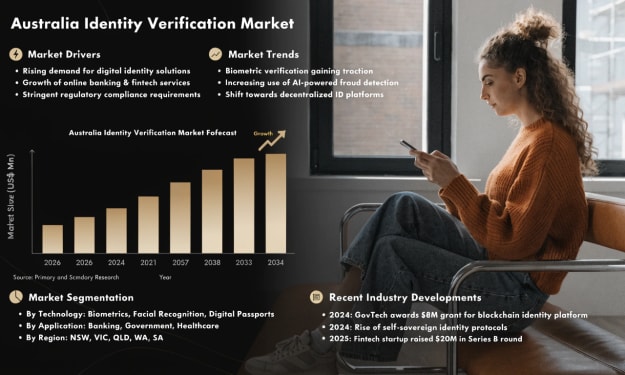
Australia Identity Verification Market: Digital Adoption, Fraud Prevention & Regulatory Compliance
According to IMARC Group, the Australia identity verification market reached USD 315.9 Million in 2025 and is projected to grow to USD 1,005.3 Million by 2034, exhibiting a compound annual growth rate (CAGR) of 13.32% during 2026–2034. The rapid digitization of financial services, e-commerce platforms, and public sector portals across Australia is creating an urgent need for secure, scalable, and compliant identity authentication systems. Increasing concerns regarding cybercrime, identity theft, and data breaches are accelerating investments in biometric technologies, AI-driven verification tools, and automated compliance platforms. As digital transformation deepens across industries, identity verification is becoming a foundational pillar of secure digital infrastructure.
By Kevin Cooper2 days ago in Futurism
Levulinic Acid Market Analysis: Specialty Chemicals, Pharma Applications & Industry Outlook to 2033
The increasing shift toward renewable chemicals, the surge in sustainable agricultural practices, and the growing application of bio-based solvents are fueling the demand for levulinic acid. Supported by green chemistry initiatives, rising investments in carbon-neutral manufacturing, and the expansion of the personal care and pharmaceutical sectors, the market is witnessing significant transformation. According to IMARC Group’s latest data, the global levulinic acid market size was valued at USD 29.7 Billion in 2024. Looking forward, IMARC Group estimates the market to reach USD 42.6 Billion by 2033, exhibiting a CAGR of 3.9% during 2025-2033.
By Andrew Sullivan5 days ago in Futurism



Comments
There are no comments for this story
Be the first to respond and start the conversation.