
How Asteroids Could Become Fuel Stations for Spacecraft
Space

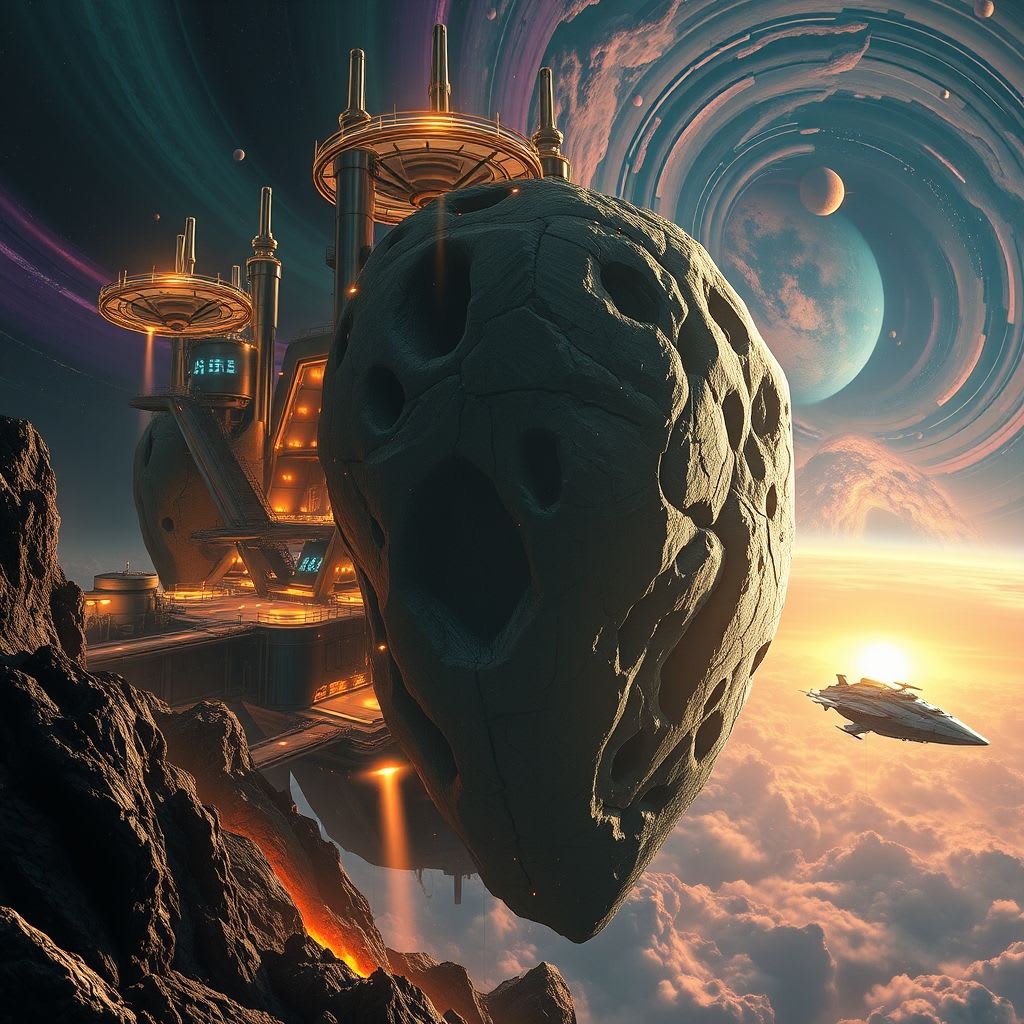
When most people think of asteroids, they imagine lifeless, rugged rocks silently drifting through the vast emptiness of space. But for engineers and scientists of the future, these cosmic boulders are far more than just space debris they could become the gas stations of the Solar System.
It may sound like science fiction, but the concept of turning asteroids into fuel sources for spacecraft is now being discussed as a serious possibility. If humanity is going to explore Mars, the outer planets, and beyond, these rocky waypoints could make the difference between a one-way journey and a thriving interplanetary highway.
Why Asteroids?
Asteroids are rich in valuable resources from metals like nickel and platinum to compounds that could be transformed into life-support essentials and even rocket fuel. Among all these treasures, one substance stands out as the most important for space travel: water.
It might seem strange at first why would a spacecraft need water as fuel? The answer lies in chemistry. Water (H₂O) can be broken down into hydrogen and oxygen through a process called electrolysis. Those two elements, when liquefied, make up one of the most powerful and efficient propellant combinations used in rocket engines today. In fact, the same type of fuel helped launch the Space Shuttle into orbit for decades.
The Idea of Space Fuel Stations
Picture this: a spacecraft is en route to Mars. Instead of carrying all the fuel it needs from Earth which is costly, heavy, and limits design options it makes a planned stop at a small asteroid. There, an automated mining facility is already hard at work. Using drills and heat systems, it extracts ice locked within the asteroid’s rocky surface. Then, powered by solar panels, the station splits the water into hydrogen and oxygen, stores them in cryogenic tanks, and pumps them into the ship’s fuel system.
This approach could revolutionize space travel. Currently, the biggest problem with deep-space missions is that fuel makes up most of a spacecraft’s initial mass. The more fuel you carry, the heavier your ship, and the more fuel you need just to launch it. This creates a vicious cycle. By refueling in space, we could launch lighter, cheaper spacecraft and potentially send them much farther.
Where to Find “Fuel-Rich” Asteroids
Not all asteroids are created equal. Scientists are particularly interested in C-type (carbonaceous) asteroids. These dark bodies are rich in water, either as ice or bound within hydrated minerals. They’re found in the main asteroid belt between Mars and Jupiter, but also among near-Earth asteroids some of which pass relatively close to our planet and would require minimal energy to reach.
The dream scenario is to identify a sizable C-type asteroid with an orbit that makes it accessible as a pit stop for spacecraft traveling to Mars or even the outer planets. A single such asteroid could potentially hold enough water to refuel dozens of missions.
The Challenges
While the idea is promising, it’s far from simple. Mining in space is an entirely different challenge from mining on Earth.
Low Gravity: On an asteroid, gravity is so weak that machinery could simply push itself away when trying to drill. Anchoring systems or harpoon-like devices would be needed to keep equipment steady.
Extreme Temperatures: In space, temperatures can swing hundreds of degrees between sunlight and shadow, which can damage equipment and complicate fuel storage.
Energy Requirements: Extracting water and running electrolysis is energy-intensive. Most designs rely on solar power, which means operations could be slow or require large, efficient solar arrays.
Who’s Working on It?
The idea isn’t just a thought experiment space agencies and companies have been taking early steps. NASA’s OSIRIS-REx mission recently studied asteroid Bennu, a carbon-rich body that might hold water-bearing minerals. Other missions, like Japan’s Hayabusa2, have also brought back asteroid samples for analysis.
Private companies such as Planetary Resources and Deep Space Industries once pitched bold concepts for robotic “space miners” and in-orbit fuel depots. While these ventures faced financial challenges, they pushed the discussion forward and inspired research into the technology.
A New Space Economy
If asteroid refueling becomes a reality, it could transform how we explore the Solar System. Instead of building massive rockets capable of carrying all their own fuel, we could send smaller ships that “hop” from one refueling point to another. Mars missions could be staged from asteroid depots, outer planet probes could be resupplied en route, and even crewed missions to the moons of Jupiter or Saturn could become viable.
In the long term, this could be the foundation for a true space economy, where resources are mined, processed, and consumed entirely off-Earth. That’s a vision in which asteroids once considered dangerous threats to our planet become key enablers of our journey to the stars.
Asteroids have been roaming space for billions of years, remnants from the birth of the Solar System. In the centuries to come, these ancient travelers might play a completely different role: fueling humanity’s leap into the cosmos. If we succeed, the phrase “refueling stop” could one day refer not to a roadside gas station, but to a lonely rock orbiting quietly between the planets our stepping stone to the universe.
About the Creator
Keep reading
More stories from Holianyk Ihor and writers in Futurism and other communities.
The Myths of Planet Nibiru – and Why They’re Not True
Throughout human history, mysterious legends have always found a place in our collective imagination. In recent decades, one of the most persistent modern space myths has been the tale of the mysterious planet Nibiru the so-called “planet of doom” that some claim is destined to collide with Earth and wipe out all life.
By Holianyk Ihor5 months ago in Futurism
About Binding Prometheus
I want to start actively advocating on behalf of my own work, and the most valuable part of my canon is, without a doubt, Binding Prometheus, the play I have been working on since 2019 and only finished in 2023 as part of my MA. The play itself is an amalgamation of a million different inspirations. On one end, it evokes the Ancient Greek myth-play, deriving its own title from the earliest extant work of Western drama we have, Aeschylus’s Prometheus Bound. On the other end, it borrows significantly from the sci-fi bulwarks from over the years, namely Mary Shelley’s Frankenstein and Karel Capek’s Rossum’s Universal Robots. The play could be an episode of Black Mirror, I fear. I don’t know. I’ve only ever seen one episode of Black Mirror.
By Steven Christopher McKnight15 days ago in Futurism
GCC Diesel Genset Market: Power Reliability, Infrastructure Demand & Growth Outlook
According to IMARC Group's latest research publication, GCC Diesel Genset Market size reached USD 1.8 Billion in 2024. The market is projected to reach USD 3.2 Billion by 2033, exhibiting a growth rate (CAGR) of 6.3% during 2025-2033.
By Abhay Rajput7 days ago in Futurism



Comments
There are no comments for this story
Be the first to respond and start the conversation.