
How AI is Revolutionizing Space Exploration: From Mars Terraforming to Autonomous Astronauts
Unpacking the role of artificial intelligence in humanity's quest to conquer the cosmos.


Introduction: The Cosmic Frontier Meets Artificial Intelligence
Space exploration was once the realm of rocket scientists and dreamers. Today, artificial intelligence (AI) is not only helping us reach the stars but also shaping our understanding of what to do once we get there. From tackling the immense challenges of distance and isolation to enabling complex mission planning and discovery, AI is becoming indispensable in our quest beyond Earth. It is transforming space exploration by enabling simulations, mapping distant worlds, and automating tasks that were once impossible.
Mars Terraforming Simulations
What is Terraforming?
Terraforming is the process of altering a planet’s environment to make it habitable for humans. The idea has captured imaginations for decades, with visionaries like Elon Musk proposing ways to make Mars a second home for humanity.
How AI Powers Terraforming Simulations
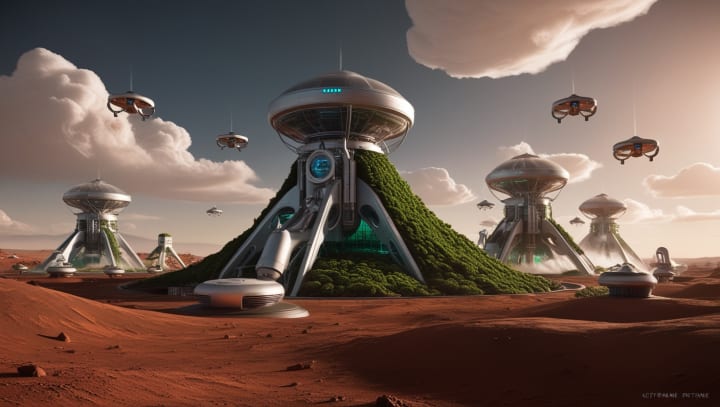
AI plays a pivotal role in simulating the terraforming of Mars. Advanced tools like Mars Aedificator simulate atmospheric changes and climate shifts, offering scientists data on where to melt ice caps or introduce greenhouse gases. NASA has also used machine learning to simulate oxygen production from Martian soil. These tools process massive datasets on Martian atmosphere and soil, generating millions of simulations to predict the best approaches.
Challenges AI Solves in Terraforming
AI helps forecast long-term ecological outcomes, manage energy efficiency for planetary-scale projects, and assess risks like runaway greenhouse effects. It allows researchers to test terraforming methods without putting human lives at risk or relying solely on limited physical prototypes.
Future Possibilities
Could AI design self-sustaining ecosystems on Mars? The answer may be yes. AI could theoretically design enclosed biospheres or autonomous systems that monitor and adjust terraforming progress. Ethical questions remain: should we terraform another planet at all?

AI-Guided Exoplanet Mapping
The Search for Habitable Worlds
Finding Earth-like planets is critical for humanity’s long-term survival. Telescopes like Kepler and James Webb have given us glimpses of possible candidates, but the data is massive and complex.
How AI Enhances Exoplanet Discovery
Machine learning algorithms analyze light spectra and gravitational wobbles to identify exoplanets, detecting subtle patterns that might otherwise be missed. Google’s AI famously discovered previously overlooked exoplanets using Kepler data.
Mapping Alien Environments
Beyond identification, AI reconstructs what these distant planets might look like. Using limited signals, it estimates surface conditions, atmospheres, and even the potential for water or life. AI-generated models of planets like Proxima Centauri b help scientists visualize alien worlds.
Bridging Gaps in Human Understanding
AI identifies anomalies in data that human scientists may miss—like unusual chemical compositions or orbital patterns—enabling better prioritization of follow-up missions and deeper insights into the universe.


Autonomous AI Astronauts or Space Station Maintenance
The Rise of Robotic Explorers
Human spaceflight is risky, expensive, and psychologically taxing. That’s why robotic explorers and AI-powered assistants are becoming vital to modern space missions.
Autonomous AI Astronauts
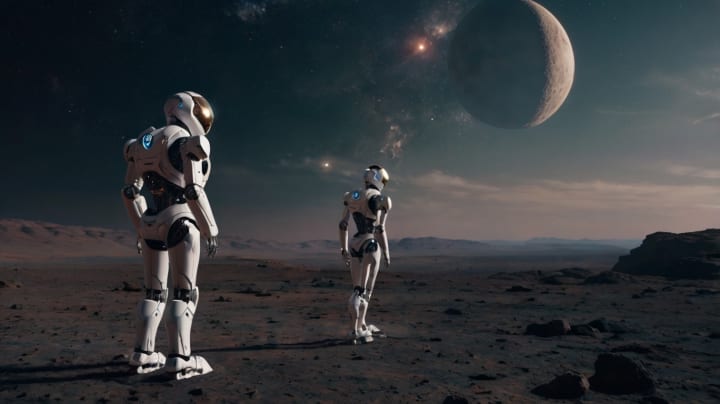
Robots like Perseverance already use AI to navigate Mars autonomously. Future missions may deploy humanoid robots to perform scientific experiments or build infrastructure on the Moon or Mars.
Space Station Maintenance
On the ISS, AI-powered tools like CIMON and NASA’s Astrobees assist astronauts with routine tasks. These systems help reduce workload and increase safety by taking over repetitive or hazardous duties.
Collaborative Missions Between Humans and AI
The future of space exploration is collaborative. AI will act as co-pilots on deep-space missions, providing real-time data analysis and support. By handling calculations, maintenance, and monitoring systems, AI reduces human cognitive load and risk.


Broader Implications of AI in Space Exploration
Economic Impact
Automation reduces mission costs significantly, opening up commercial avenues like asteroid mining or satellite servicing. Private companies are already exploring AI-powered ventures in space.
Scientific Breakthroughs
AI accelerates discoveries in astrophysics, planetary science, and even astrobiology. By making sense of large, complex datasets, it democratizes access to space research.
Ethical Considerations
Who controls AI-driven space tech? Governments, corporations, or a mix of both? The risks of AI malfunctions in critical missions—and their implications—demand international dialogue and regulation.


Conclusion: Humanity’s Next Giant Leap
From simulating the terraforming of Mars to discovering new exoplanets and assisting astronauts, AI is reshaping the way we explore space. These technologies not only help us understand the cosmos but also hold a mirror to our own limitations—and possibilities.
With AI as our partner, the stars may no longer feel so far away.
“The Earth is the cradle of humanity, but one cannot live in the cradle forever.” — Konstantin Tsiolkovsky
About the Creator
Dishmi M
I’m Dishmi, a Dubai-based designer, writer & AI artist. I talk about mental health, tech, and how we survive modern life.
Subscribe for healing advice, human stories & future thoughts!
Reader insights
Outstanding
Excellent work. Looking forward to reading more!
Top insights
Expert insights and opinions
Arguments were carefully researched and presented
Eye opening
Niche topic & fresh perspectives
Heartfelt and relatable
The story invoked strong personal emotions
Masterful proofreading
Zero grammar & spelling mistakes
About Binding Prometheus
I want to start actively advocating on behalf of my own work, and the most valuable part of my canon is, without a doubt, Binding Prometheus, the play I have been working on since 2019 and only finished in 2023 as part of my MA. The play itself is an amalgamation of a million different inspirations. On one end, it evokes the Ancient Greek myth-play, deriving its own title from the earliest extant work of Western drama we have, Aeschylus’s Prometheus Bound. On the other end, it borrows significantly from the sci-fi bulwarks from over the years, namely Mary Shelley’s Frankenstein and Karel Capek’s Rossum’s Universal Robots. The play could be an episode of Black Mirror, I fear. I don’t know. I’ve only ever seen one episode of Black Mirror.
By Steven Christopher McKnight13 days ago in Futurism
GCC Automotive Lead-Acid Battery Market: Aftermarket Expansion, Cost Efficiency & Sustainability Outlook
According to IMARC Group's latest research publication, GCC Automotive Lead-Acid Battery Market reached USD 402.43 Million in 2024. The market is projected to reach USD 535.74 Million by 2033, exhibiting a growth rate (CAGR) of 2.97% during 2025-2033.
By Abhay Rajput7 days ago in Futurism
Where's the Glory?
In breaking news, rehabilitated Republican Senator Johnnie Johnson (Pronouns: HE, HIM, HIS) called a press conference from the Men’s room of the New Orleans Louis Armstrong International Airport, Concourse B, across from the Ignatius Reilly’s Lucky Dog stand. The Senator had just returned from a sexual reorientation rehabilitation program in Memphis, TN after being publically disgraced at a Buckee’s Truckstop restroom soliciting sex from an undercover cop three months ago. He is a founding member of the Reformed Christians for Christ, a conservative, pro-family and ex-gay advocacy group. In the spirit of being reborn, Senator Johnson invited reporters to marvel at his plans for a major remodeling of airport bathrooms.
By Cathy Schieffelin7 days ago in Humor


Comments
There are no comments for this story
Be the first to respond and start the conversation.