
Historic Discovery! Lightning Spotted on Mars for the First Time
Astrology


For decades, Mars has fascinated humanity as a cold, dusty desert world, shaped by ancient rivers and violent storms long vanished. But a new discovery has electrified the scientific community—literally. According to a groundbreaking report from planetary researchers, lightning has been detected on Mars for the first time in recorded history.
This discovery challenges long-held assumptions about the Red Planet’s atmosphere, its weather systems, and even its potential to support microscopic life. More importantly, it opens a brand-new chapter in humanity’s understanding of our mysterious neighbor.
---
A Flash in the Martian Dark
The historic detection was made using a combination of orbiting satellites and surface rovers. For years, scientists believed that Mars was too dry and its atmosphere too thin to produce lightning. With atmospheric pressure less than 1% of Earth’s and only traces of water vapor, electrical storms seemed almost impossible.
But the impossible has now become real.
NASA’s MAVEN orbiter and the European Space Agency’s ExoMars Trace Gas Orbiter both detected sharp electromagnetic pulses—the signature fingerprint of lightning discharges—during a dust storm in the planet’s equatorial region.
At nearly the same time, ground instruments from the Perseverance rover picked up a brief but unmistakable ‘crack’ of atmospheric electricity.
What began as a strange anomaly quickly became undeniable: Mars can produce lightning.
---
How Lightning Happens on a Dry Planet
Lightning on Earth usually comes from storm clouds heavy with water droplets or ice crystals. The collision between these particles creates electrical charges that eventually discharge as lightning bolts.
But Mars is not Earth.
Scientists believe the Martian lightning is generated differently:
1. Electrified Dust Storms
Mars is famous for storms that can grow to cover the entire planet. When millions of dust grains rub together in these storms, they build up static electricity—the same principle as rubbing a balloon on your hair, but on a global scale.
2. Extreme Atmospheric Friction
Even in Mars’ thin air, fast-moving dust can create electric fields strong enough to spark electrical discharges.
3. Localized Water Ice
Some regions may contain tiny amounts of atmospheric water ice, especially at night or during winter seasons. These particles might enhance charge separation, increasing the odds of lightning.
This combination may occasionally create the perfect electrical storm—literally.
---
A Discovery With Huge Implications
The detection of lightning is far more than a scientific curiosity. It has deep implications for future exploration and for understanding Mars as a dynamic planet.
1. Proof the Martian Atmosphere Is More Active Than We Thought
Mars was believed to be largely “dead” from a weather perspective. Lightning proves the atmosphere is capable of complex electrical behavior we didn’t expect.
2. Implications for Future Human Missions
Electrical storms could affect:
communication equipment
power systems
sensitive electronics
astronaut safety
NASA and SpaceX must now prepare for potential electrostatic hazards on Mars.
3. A Boost for the Search for Life
Lightning on Earth helps create chemical reactions that form organic molecules—the building blocks of life. If similar reactions occur on Mars, even rarely, it could help explain traces of methane and other organic compounds found in the Martian soil.
Lightning might be a key ingredient in Mars’ ancient or present chemical processes.
---
Why This Took So Long to Detect
The main reason lightning wasn’t detected earlier is simple: it’s extremely rare.
Dust storms are common, but the specific conditions needed to produce electrical discharges seem to occur only in the most intense and localized storms. Additionally, lightning on Mars is:
weaker than Earth’s
much shorter in duration
often hidden behind thick clouds of dust
It took the combined power of satellites, ground rovers, and precise instrumentation to catch just a few split-second flashes.
Scientists compare it to “hearing a pin drop during a rock concert.”
---
Rewriting the Textbooks
The discovery forces scientists to revisit fundamental questions:
How often does Martian lightning occur?
Can it trigger chemical changes in the soil or atmosphere?
Could it influence future terraforming?
Did ancient Mars have more frequent electrical storms when it had oceans?
In the coming years, space agencies will likely send new instruments specifically designed to study Martian lightning—something no one thought necessary before.
---
Public Reaction: Awe, Excitement, and a Bit of Humor
Social media erupted with reactions:
“Mars has lightning now? What’s next, Martian thunderstorms?”
“Great, first we find water, now lightning… Mars is slowly becoming Earth 2.0.”
“Plot twist: Zeus moved to Mars.”
Memes aside, the discovery captured global imagination. Humanity suddenly feels one step closer to Mars—not as a dead world, but as a lively, evolving planet with surprises still hidden beneath its rusty surface.
---
A Glimpse Into Mars’ Electric Future
Lightning on Mars may be rare, faint, and fragile—but its discovery marks a turning point in planetary science. It reminds us that even after decades of study, Mars remains a world of mystery, capable of shocking us—literally and scientifically.
As exploration continues, one thing is clear:
Mars is not done surprising us.
And the next flash of discovery might be even brighter.
About the Creator
About Binding Prometheus
I want to start actively advocating on behalf of my own work, and the most valuable part of my canon is, without a doubt, Binding Prometheus, the play I have been working on since 2019 and only finished in 2023 as part of my MA. The play itself is an amalgamation of a million different inspirations. On one end, it evokes the Ancient Greek myth-play, deriving its own title from the earliest extant work of Western drama we have, Aeschylus’s Prometheus Bound. On the other end, it borrows significantly from the sci-fi bulwarks from over the years, namely Mary Shelley’s Frankenstein and Karel Capek’s Rossum’s Universal Robots. The play could be an episode of Black Mirror, I fear. I don’t know. I’ve only ever seen one episode of Black Mirror.
By Steven Christopher McKnight11 days ago in Futurism
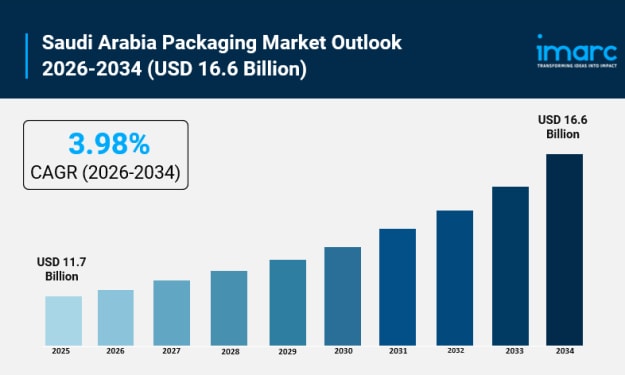
Saudi Arabia Packaging Market: FMCG Demand, Lightweight Solutions, Innovation Drive & Vision 2030
According to IMARC Group's latest research publication, Saudi Arabia packaging market size reached USD 11.7 Billion in 2025. The market is projected to reach USD 16.6 Billion by 2034, exhibiting a growth rate of 3.98% during 2026-2034.
By Jeffrey Wilsonabout 3 hours ago in Futurism


Comments
There are no comments for this story
Be the first to respond and start the conversation.