
Hidden Structures Beneath the Pyramids of Egypt,Vast underground city
The Discovery That Could Change History: Hidden Structures Beneath the Pyramids of Egypt


The Discovery That Could Change History: Hidden Structures Beneath the Pyramids of Egypt
For centuries, historians and archaeologists have debated the true purpose of the pyramids of Egypt. Were they merely grandiose tombs for pharaohs, or did they serve a much greater function? A groundbreaking new discovery could provide answers that challenge our understanding of ancient civilizations. Using advanced radar technology, Italian researcher Corrado Malanga and Scottish scientist Filippo Biondi have uncovered a network of hidden structures beneath the Pyramid of Khafre in Giza. Their findings suggest that the pyramids might not be simple burial sites but part of an ancient and sophisticated architectural system whose purpose remains a mystery.

A Discovery That Changes Everything
The Great Pyramid of Giza and its neighboring pyramids have long been considered marvels of engineering. Built over 4,500 years ago, these colossal structures have fascinated scholars, engineers, and conspiracy theorists alike. Traditional Egyptology holds that the pyramids were constructed as tombs for the pharaohs, filled with treasures to accompany them into the afterlife. However, new evidence suggests that these structures may have had a more advanced and possibly technological purpose.
Malanga and Biondi’s research, conducted using Synthetic Aperture Radar (SAR), has revealed something previously unknown: beneath the Pyramid of Khafre lies a series of hidden structures that could redefine what we know about ancient Egyptian engineering.
What Lies Beneath the Pyramid of Khafre?
The researchers discovered five small interconnected structures beneath the pyramid, each connected by tunnels with geometric patterns. These formations suggest a highly sophisticated architectural design, something far more complex than what we would expect from a civilization using basic tools.
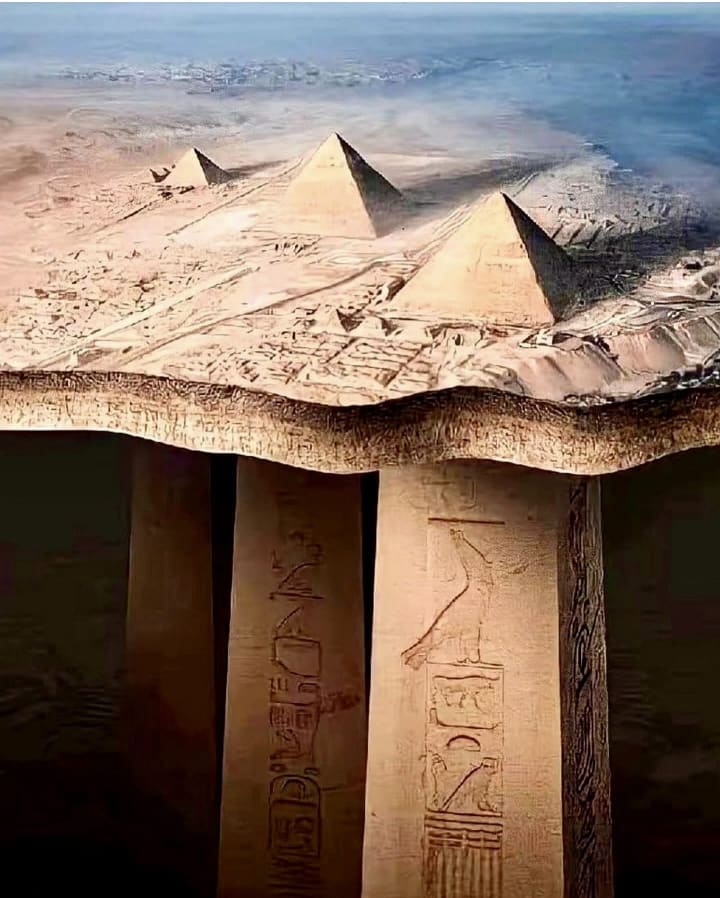
However, the most shocking discovery was what they found deeper underground:
Eight enormous cylindrical structures, each with spirals surrounding them, descending to a depth of 648 meters (2,126 feet).
These cylinders are divided into two groups of four, aligned perfectly from south to north, indicating a high level of precision and planning.
At the base of these cylinders, two massive cube-shaped structures, each measuring approximately 80 meters (262 feet) per side, were detected.
Radar scans suggest that these structures continue extending downward for up to 2 kilometers (1.24 miles), hinting at an entire underground system beneath the pyramid.
An Ancient Civilization with Advanced Knowledge?
The presence of these underground structures has raised major questions. If the pyramids were simply tombs, why would there be such a deep, sophisticated network beneath them? The level of symmetry and complexity found in the underground formations suggests an understanding of architecture, mathematics, and engineering that far exceeds what we previously believed possible for ancient civilizations.

Could this be evidence of a lost advanced civilization? Or does it indicate an unknown function of the pyramids, possibly connected to energy, water systems, or even technology that has been lost to history?
Some alternative historians have long speculated that the pyramids were not tombs at all, but rather energy generators, astronomical observatories, or even communication devices. This new discovery fuels these theories and demands further investigation.

The Controversy: Egyptology vs. New Science
Unsurprisingly, this discovery has been met with significant controversy. Many mainstream Egyptologists, including the well-known former Minister of Antiquities Dr. Zahi Hawass, have dismissed the findings, calling them "completely false" and accusing the researchers of promoting pseudoscience.
According to traditional Egyptologists, there is no evidence that the pyramids served any purpose beyond funerary monuments. Critics argue that radar scans can be misinterpreted, and without physical excavation, it is impossible to confirm the nature of these structures.
However, proponents of the discovery argue that dismissing new findings simply because they challenge established beliefs is unscientific. If the evidence suggests something unexpected, should we not explore it further?
Could There Be More Hidden Structures?
The Great Pyramid of Giza, along with the Pyramids of Khafre and Menkaure, has been extensively studied, yet new discoveries continue to emerge. In recent years, thermal imaging scans have revealed anomalies within the pyramids, suggesting the presence of hidden chambers.
One particularly intriguing possibility is that the structures detected by Malanga and Biondi could be part of a much larger underground city, possibly stretching beneath the entire Giza Plateau. Some ancient texts and local legends speak of tunnels, hidden rooms, and a vast underground network that has remained undiscovered for thousands of years.
Ancient Technology or Extraterrestrial Influence?
As with any major discovery that challenges historical narratives, speculation has arisen regarding the true origins of the pyramids and their underground structures. Some researchers believe that the complexity and precision of these formations suggest the involvement of an unknown technology.
Could this be evidence of a lost advanced human civilization that predates known Egyptian history? Some alternative theorists have suggested that these underground structures may have been built by a civilization far older than the Egyptians, possibly tens of thousands of years ago.
Others propose an even more controversial idea: extraterrestrial influence. The perfect geometric alignment, the depth of the structures, and the unknown purpose of the cylinders have led some to speculate that the pyramids might be remnants of an ancient extraterrestrial project. While there is no direct evidence to support this claim, the sheer magnitude of the discovery invites us to reconsider what we think we know about human history.
What Happens Next?
Despite the controversy, the discovery of these underground structures is one of the most significant archaeological findings in recent history. The next step will require physical exploration, but this presents a major challenge.
Excavating beneath the pyramids is extremely difficult due to their size and the risk of structural damage.
The Egyptian government has been reluctant to permit large-scale excavations in the past, particularly when it comes to theories that contradict mainstream Egyptology.
Further radar scanning and ground-penetrating analysis could help confirm the depth and composition of these structures.
If further research confirms the existence of a massive underground system beneath the pyramids, it could change everything we know about the origins of civilization, the purpose of the pyramids, and possibly even humanity’s lost past.
Final Thoughts: Are We Ready for the Truth?
For decades, scholars have operated under the assumption that the pyramids were built with basic tools and manpower. However, discoveries like this challenge that narrative and force us to ask:
Were the ancient Egyptians far more advanced than we ever imagined?
Did they inherit knowledge from an even older civilization?
Is there a hidden chapter of history waiting to be uncovered beneath the sands of Egypt?
While skeptics argue that extraordinary claims require extraordinary evidence, closing our minds to new possibilities could mean ignoring one of the greatest discoveries of all time. Whether this underground system turns out to be a lost technological marvel, a forgotten burial network, or something entirely beyond our understanding, it is clear that the pyramids still hold secrets waiting to be revealed.
Perhaps the real question is: Are we ready to accept the truth, no matter what it may be?
References
Baines, J., & Malek, J. (2000). Atlas of Ancient Egypt. Oxford: Oxford University Press.
Hawass, Z. (2006). The Secret of the Great Pyramid: How One Man's Obsession Led to the Solution of Ancient Egypt's Greatest Mystery. HarperCollins.
Lehner, M. (1997). The Complete Pyramids: Solving the Ancient Mysteries. Thames & Hudson.
Goodman, D., & Piro, S. (2013). GPR Remote Sensing in Archaeology. Springer.
Scaife, C. W. (2004). "Ground Penetrating Radar and Its Applications in Archaeology." Journal of Archaeological Science, 31(6), 845-852.
Exotic Wonderspaces. (2025). "Impresionante Hallazgo: ¡Colosal! Descubrimiento en la Pirámide de Kefrén."
About the Creator
JONATAN DAVID VEGA
Hello Welcome! I am Jonatan Vega
Iam self-published mexican author living Sacramento,California
My Instagram: @JonatanVega_writesbooks
My published books in lulu.com
www.lulu.com/spotlight/JonatanVega
Amazon: Jonatan Vega
Keep reading
More stories from JONATAN DAVID VEGA and writers in Futurism and other communities.
The James Webb telescope captured images of the farthest planet in the solar system,Neptune, where seven of its 14 moons can be seen.
Neptune, discovered in 1846, is thirty times farther from the Sun than Earth and orbits in one of the darkest parts of the solar system.
By JONATAN DAVID VEGA12 months ago in Futurism
Saudi Arabia Construction Market: Mega Projects, Vision 2030 & Growth Outlook
Saudi Arabia's construction market is experiencing a transformation unlike anything seen in the region's modern history. Vision 2030 has turned what was once a petroleum-dominated economy into a massive construction laboratory, with projects spanning luxury tourism, smart cities, cultural heritage, and infrastructure modernization. According to IMARC Group's latest data, the Saudi Arabia construction market size was valued at USD 101.4 Billion in 2025. Looking forward, IMARC Group estimates the market to reach USD 138.4 Billion by 2034, exhibiting a growth rate (CAGR) of 3.52% from 2026-2034.
By Shubham Sharma 3 days ago in Futurism
Vibration Monitoring Market Outlook: Predictive Maintenance Adoption and Industrial Automation Growth Opportunities
According to IMARC Group's latest research publication, The global vibration monitoring market size reached USD 1.74 Billion in 2025. Looking forward, IMARC Group expects the market to reach USD 2.84 Billion by 2034, exhibiting a growth rate (CAGR) of 5.39% during 2026-2034.
By James Whitman4 days ago in Futurism


Comments
There are no comments for this story
Be the first to respond and start the conversation.