
Halal Food Market Trends: Rising Muslim Population, Global Trade & Forecast to 2034
How rising Muslim population growth, expanding halal certification standards, and cross-border trade are driving sustained expansion in the global halal food market

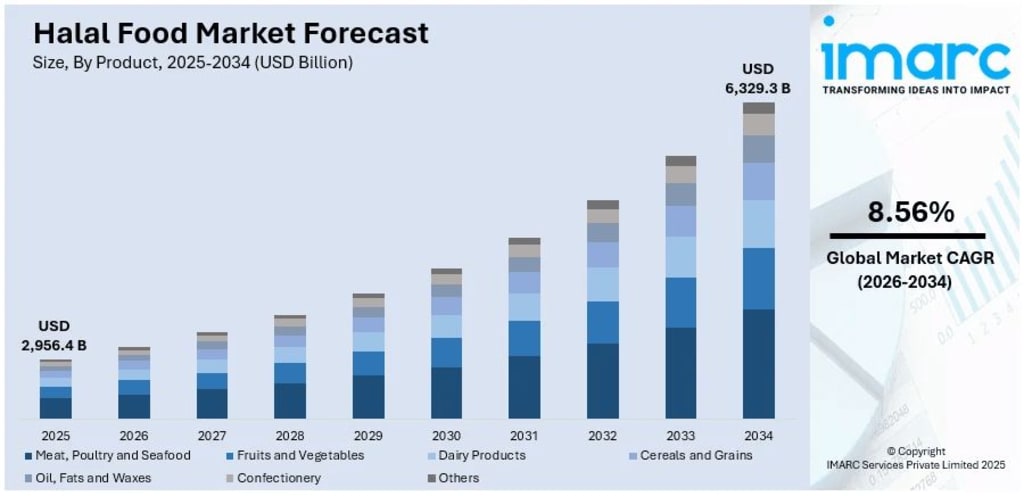
Growing global Muslim population, rising awareness of halal certification standards, and increasing interest from non-Muslim consumers in ethically sourced food are driving steady expansion in the halal food market, supported by e-commerce growth, mainstream retail adoption, and government-backed halal infrastructure development worldwide. According to IMARC Group's latest data, the global halal food market size was valued at USD 2,956.4 Billion in 2025. Looking forward, IMARC Group estimates the market to reach USD 6,329.3 Billion by 2034, exhibiting a CAGR of 8.56% from 2026-2034. Asia-Pacific currently dominates the market, holding a market share of over 48.5% in 2025.
Halal food has moved well beyond serving just Muslim consumers. It now represents a mainstream segment driven by transparency, ethical sourcing, and rigorous quality standards that appeal to health-conscious buyers of all backgrounds. Meat, poultry, and seafood account for 50.3% of the market by product type, reflecting the central role of protein in halal consumption. Traditional retailers hold 51.7% of the market by distribution channel, though e-commerce is growing fast projected to expand at 15% annually as online platforms and delivery apps make certified products more accessible. Asia-Pacific's 48.5% regional share reflects the concentration of Muslim populations in Indonesia, Malaysia, India, Pakistan, and Bangladesh, where halal is not a niche preference but a standard requirement embedded in daily life.
Halal Food Market Growth Drivers:
- Rapid Muslim Population Growth Expanding Core Consumer Base
The global Muslim population is projected to reach 2.2 billion, with Indonesia alone accounting for 231 million Muslims over 13% of the worldwide total. In the U.S., the Muslim population stands at around 3.5 million and is expected to double by 2050, according to Pew Research. This demographic shift is creating steady, predictable demand for halal-certified products across categories. In cities like Dearborn, Houston, and New York, entire supply chains have been built around halal butchers, grocery stores, and restaurants. As disposable income rises within Muslim communities, particularly in Asia-Pacific and the Middle East, spending is shifting toward premium, organic, and specialty halal products rather than just basic staples.
- Non-Muslim Consumers Driving Market Expansion Beyond Religious Use
Halal is no longer just a religious requirement it is increasingly viewed as a quality signal. According to a 2024 Halal Research Council report, 30% of halal purchases in urban U.S. markets come from non-Muslims, drawn to the rigorous standards around animal welfare, minimal additives, and hygienic processing. Halal certification ensures meat is sourced from humanely treated animals and processed in clean, transparent facilities, which resonates with consumers prioritizing ethical sourcing. This crossover appeal is particularly strong among millennials and Gen Z, who are willing to pay more for products aligned with sustainability and animal welfare values. The segment is now attracting mainstream retailers like Walmart and Costco, which have expanded halal offerings significantly in recent years.
- Government Support and Infrastructure Investment Building Export Capacity
Governments across Muslim-majority countries are treating halal as a strategic economic sector. In September 2024, the UAE government increased domestic halal chicken production by 17% through feed subsidies, technology upgrades, and new facility construction, according to USDA data. Dubai is building what is planned to be the world's largest logistics hub for foodstuffs, aimed directly at expanding halal export capabilities. Malaysia's JAKIM certification body has become a global standard, while Indonesia has established halal industrial parks to support production at scale. These are not small pilot programs they represent billions in infrastructure investment designed to position halal as a major pillar of food security and economic growth across the Islamic world.
Halal Food Market Trends:
- E-Commerce and Digital Platforms Expanding Access in Underserved Markets
Online sales of halal products are growing at roughly 15% annually, according to industry estimates. Platforms like HalalWorld and specialized sections within major delivery apps are making certified products accessible in areas where physical halal stores are scarce. The global e-commerce sector is projected to reach USD 183.8 trillion, and halal is carving out a growing share of that. This is particularly important in Western markets where Muslim populations are geographically dispersed and traditional retail penetration is limited. Digital platforms also solve trust issues around certification by providing traceability, verified supplier information, and customer reviews all of which matter when religious compliance is involved.
- Ready-to-Eat and Convenience Foods Expanding Product Range
The halal market is moving beyond fresh meat. In June 2024, Al Islami Foods launched "Original Tempura Nuggets" a fully cooked, air fryer-friendly, high-protein ready meal made from halal chicken without added hormones. In November 2024, Deli Halal introduced a new line of halal-certified sliced deli meat in New England, targeting the convenience segment. In June 2024, Saffron Road launched four new frozen meals: Korean Fire-Roasted Chicken, Vegetable Bibimbap, Drunken Noodles, and Fire-Roasted Adobo Chicken all certified halal and gluten-free. These products are designed for busy households and appeal to both Muslim and non-Muslim consumers looking for clean-label, convenient meals. The shift toward convenience foods is helping halal penetrate mainstream grocery chains and foodservice channels.
- Strategic M&A and Private Investment Consolidating Market Leadership
The sector saw significant consolidation activity in 2024 and 2025. In August 2024, GoodLife Foods acquired Pure Ingredients, a German halal frozen food manufacturer, creating a combined company producing innovative frozen snacks and meal components across Europe. In January 2025, Isla Délice Group acquired Gürkan, a premium German beef brand, bringing total sales to over EUR 155 million. In October 2025, MBRF partnered with HPDC to create Sadia Halal, positioned as the largest halal chicken company in the world. In February 2025, Unilever established a Halal Research Center in Indonesia with the goal of becoming a global innovation hub for halal-certified foods. These moves reflect institutional confidence in the sector's long-term growth trajectory and the strategic value of scale in certification, production, and distribution.
Recent News and Developments in Halal Food Market
- February 2025: Unilever established a Halal Research Center in Indonesia, aiming to create a global innovation hub for halal-certified foods. The investment underscores Unilever's commitment to strengthening its position in Muslim-majority markets and reflects the growing importance of halal as a strategic category within the global food industry, particularly in Southeast Asia where Muslim populations are concentrated and halal compliance is embedded in consumer expectations.
- January 2025: Isla Délice Group acquired Gürkan, a premium German halal business specializing in the beef product Pastirma, increasing the group's total sales to over EUR 155 million. The acquisition reflects Isla Délice's strategy to expand its footprint in European markets and diversify its product portfolio beyond traditional halal meat categories into specialty and value-added segments.
- November 2024: Deli Halal, a Kansas-based manufacturer of halal meat and cheese products, launched a new line of halal-certified sliced deli meat in New England. The launch addressed growing demand for convenient, ready-to-eat halal products in mainstream retail channels, particularly in regions with growing Muslim populations and increasing awareness of halal standards among non-Muslim consumers.
- June 2024: Saffron Road, a division of The American Halal Company, launched four new frozen food products Korean Fire-Roasted Chicken, Vegetable Bibimbap, Drunken Noodles, and Fire-Roasted Adobo Chicken all certified halal and gluten-free. The launch reflected the company's strategy to expand its product range beyond traditional halal offerings into globally inspired, convenience-focused meals targeting both Muslim and mainstream health-conscious consumers.
Note: If you require specific details, data, or insights that are not currently included in the scope of this report, we are happy to accommodate your request. As part of our customization service, we will gather and provide the additional information you need, tailored to your specific requirements. Please let us know your exact needs, and we will ensure the report is updated accordingly to meet your expectations.
About the Creator
Suhaira Yusuf
I specialize in Consumer Insights, focusing on transforming detailed market data into strategic business solutions that accelerate growth and improve customer engagement.
Keep reading
More stories from Suhaira Yusuf and writers in Futurism and other communities.
Bunker Fuel Market Trends: LNG Adoption, Decarbonization Efforts & Forecast to 2034
Expanding global maritime trade, stringent environmental regulations, and rising adoption of cleaner fuel alternatives are driving steady growth in the bunker fuel market, supported by port infrastructure expansion, IMO sulfur cap compliance, and increasing investment in LNG bunkering facilities worldwide. According to IMARC Group's latest data, the global bunker fuel market size was valued at USD 168.59 Billion in 2024. Looking forward, IMARC Group estimates the market to reach USD 268.92 Billion by 2033, exhibiting a CAGR of 5.06% during 2025-2033. Asia-Pacific currently dominates the market, holding a market share of 45.6% in 2024.
By Suhaira Yusuf6 days ago in Futurism
Self-Care Medical Devices Market: Remote Monitoring Tools, Digital Health Integration & Market Forecast
According to IMARC Group's latest research publication, the global self-care medical devices market size reached USD 27.5 Billion in 2025. Looking forward, IMARC Group expects the market to reach USD 45.0 Billion by 2034, exhibiting a growth rate (CAGR) of 5.65% during 2026-2034.
By sujeet. imarcgroup5 days ago in Futurism
Autonomous Vehicle Market: Electric & Autonomous Convergence, Sustainable Transport & Market Forecast
According to IMARC Group's latest research publication, global autonomous vehicle market size reached USD 109.0 Billion in 2024. Looking forward, IMARC Group expects the market to reach USD 1,730.4 Billion by 2033, exhibiting a growth rate (CAGR) of 31.85% during 2025-2033.
By sujeet. imarcgroup4 days ago in Futurism



Comments
There are no comments for this story
Be the first to respond and start the conversation.