
GPS Tracking Device Market Size and Forecast 2025–2033: AI, Telematics, and Smart Mobility Drive a US$ 7.51 Billion Future
How AI-powered tracking, government mandates, and fleet digitalization are reshaping global location intelligence

Global GPS Tracking Device Market Outlook
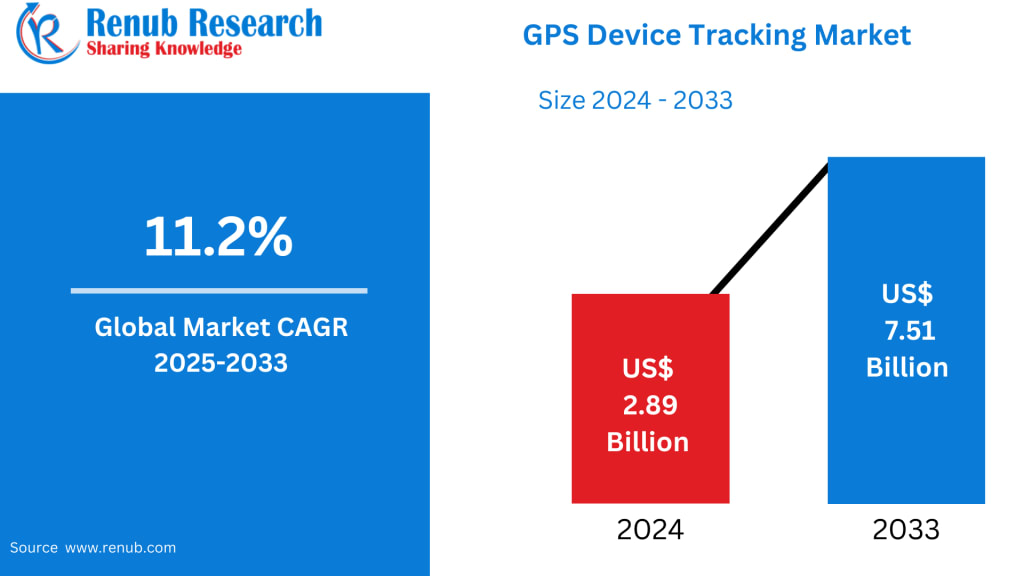
The global GPS tracking device market is undergoing a transformative expansion as industries, governments, and consumers increasingly rely on real-time location intelligence to improve safety, efficiency, and decision-making. According to Renub Research, the GPS Tracking Device Market is projected to grow from US$ 2.89 billion in 2024 to US$ 7.51 billion by 2033, registering a strong CAGR of 11.2% from 2025 to 2033.
This steady growth reflects the rapid integration of AI-powered telematics, IoT connectivity, and cloud-based analytics into GPS tracking systems. From managing fleets and monitoring assets to ensuring personal safety and enabling autonomous vehicles, GPS tracking devices are now a critical component of the global digital infrastructure.
As urbanization accelerates, logistics networks expand, and compliance regulations tighten, GPS tracking is no longer a luxury—it is becoming a necessity across multiple sectors.
Understanding the GPS Tracking Device Industry
A GPS tracking device is an electronic gadget that uses signals from the Global Positioning System (GPS) to determine the precise location of an object, vehicle, or person in real time. These devices contain GPS receivers that communicate with multiple satellites to calculate geographic coordinates, which are then transmitted to a central platform for monitoring and analysis.
Modern GPS tracking devices are compact, easy to install, and increasingly connected with mobile apps, dashboards, and enterprise software systems. They are widely used in:
Fleet management
Logistics and supply chain operations
Asset monitoring
Personal and pet tracking
Healthcare and elderly care
Security and surveillance
Autonomous and unmanned vehicles
The GPS tracking device market includes hardware, software, and service ecosystems designed to meet diverse industry needs. With continuous innovation in AI, ML, and IoT, GPS devices are evolving from simple trackers into intelligent mobility solutions.
Key Drivers Fueling Market Growth
1. AI-Powered GPS Tracking Systems Transform Safety and Efficiency
The growing integration of artificial intelligence (AI) is one of the most powerful forces driving the GPS tracking device market. AI enables devices to analyze driving behavior, predict risks, and generate actionable insights from real-time data.
According to the International Organization of Motor Vehicle Manufacturers (OICA), road accidents cause 1.35 million deaths and nearly 50 million injuries annually, with 90% of incidents occurring in developing countries. AI-enabled GPS systems help address this crisis by detecting:
Harsh braking and acceleration
Speeding and unsafe driving patterns
Route deviations and risky zones
Proximity to other vehicles and obstacles
These capabilities allow fleet managers and authorities to intervene early, prevent accidents, and improve overall road safety. As AI adoption increases, GPS tracking systems are becoming predictive, preventive, and proactive rather than reactive.
2. Government Mandates and Compliance Requirements
Government regulations worldwide are accelerating GPS adoption, particularly in commercial transportation and logistics. A prominent example is India’s AIS-140 regulation, which mandates GPS-based vehicle tracking systems for public and commercial transport vehicles.
These mandates aim to:
Improve passenger safety
Monitor driver behavior
Reduce fuel consumption and emissions
Enable real-time emergency response
Ensure compliance with Intelligent Transportation System (ITS) standards
Beyond transportation, GPS tracking is increasingly required for asset surveillance, border control, infrastructure monitoring, and environmental compliance, making regulatory frameworks a major growth catalyst.
3. Rising Adoption of Unmanned and Autonomous Vehicles
The expansion of autonomous vehicles, drones, and unmanned transport systems is creating new demand for advanced GPS tracking technologies. These vehicles rely heavily on precise location data, real-time monitoring, and navigation intelligence to operate safely.
For instance, Pony.ai, a leading robotaxi company, has received approval to operate fully autonomous ride-hailing services in Guangzhou, China, and has already completed over 200,000 paid autonomous rides globally. Such deployments significantly increase the need for high-accuracy GPS tracking integrated with AI and sensor systems.
As autonomous mobility scales globally, GPS tracking devices will remain a core enabling technology.
Challenges Facing the GPS Tracking Device Market
1. Privacy and Data Security Concerns
Despite strong growth, the industry faces mounting concerns around data privacy and cybersecurity. GPS devices continuously collect sensitive location data, raising fears of unauthorized access, misuse, and surveillance.
Regulatory frameworks such as GDPR in Europe and CCPA in the United States require companies to implement:
User consent mechanisms
End-to-end encryption
Secure data storage
Regular security audits
Compliance is often costly and complex, especially for small and mid-sized vendors. Failure to meet these standards can result in legal penalties and loss of customer trust.
2. Integration with Legacy Systems
Many enterprises struggle to integrate GPS tracking data with existing ERP, CRM, and fleet management platforms. The lack of standardized APIs and interoperability often leads to:
Higher implementation costs
Deployment delays
Operational inefficiencies
To overcome this, GPS solution providers are increasingly developing flexible, cloud-based platforms and open APIs that enable seamless integration across enterprise ecosystems.
Regional Market Overview
North America GPS Tracking Device Market
North America remains a mature and technologically advanced market, driven by strong demand from logistics, law enforcement, transportation, and personal safety sectors. The U.S. leads adoption due to early integration of IoT, AI, and telematics solutions.
Enterprises use GPS tracking to improve route optimization, reduce fuel costs, and enhance asset visibility. However, strict data privacy regulations continue to influence product design and deployment strategies.
United States Market
In the U.S., GPS tracking devices are widely used in fleet management, personal vehicles, pets, and high-value asset tracking. Integration with mobile apps, smart home systems, and cloud analytics is increasing adoption among consumers and enterprises alike.
United Kingdom GPS Tracking Device Market
The UK market is growing steadily, supported by expanding logistics operations and regulatory emphasis on safety and compliance. GPS devices integrated with 5G, IoT, and real-time analytics are helping businesses improve efficiency and decision-making.
India GPS Tracking Device Market
India represents one of the fastest-growing GPS tracking markets globally. Government mandates like AIS-140, combined with booming logistics and e-commerce sectors, are driving large-scale adoption.
AI-enabled GPS tracking is gaining traction in transportation, healthcare, school buses, and personal safety applications, making India a key growth engine for the global market.
United Arab Emirates GPS Tracking Device Market
The UAE market is expanding due to its strong focus on smart city initiatives, logistics modernization, and digital infrastructure. Integration of GPS tracking with 5G networks and IoT platforms is enabling real-time monitoring, predictive maintenance, and smart fleet operations.
Market Segmentation Overview
By Type
Standalone GPS
Advanced Trackers
OBD Devices
By Application
Vehicle Tracking
Asset Tracking
Personal Tracking
By End Use
Automotive
Aerospace & Defense
Healthcare
Transportation
Others
Regional Outlook
North America: United States, Canada
Europe: France, Germany, Italy, Spain, United Kingdom, Belgium, Netherlands, Turkey
Asia Pacific: China, Japan, India, Australia, South Korea, Thailand, Malaysia, Indonesia, New Zealand
Latin America: Brazil, Mexico, Argentina
Middle East & Africa: South Africa, Saudi Arabia, United Arab Emirates
Competitive Landscape and Key Players
The global GPS tracking device market is moderately fragmented, with a mix of established technology providers and emerging innovators. Key players focus on AI integration, cloud platforms, and scalable solutions to strengthen their market position.
Major companies covered include:
Verizon Wireless
Concox Information Technology Co. Ltd.
CalAmp Corp.
ORBCOMM Inc.
Sierra Wireless Inc.
Atrack Technology Inc.
SpyTech Inc.
Queclink Wireless Solutions Co. Ltd.
Each company is actively investing in product innovation, partnerships, geographic expansion, and data analytics capabilities to maintain competitiveness.
Future Outlook: The Road Ahead for GPS Tracking Devices
The future of the GPS tracking device market is closely tied to the evolution of smart mobility, connected infrastructure, and autonomous systems. As devices become smarter and more integrated, GPS tracking will evolve into a holistic location intelligence ecosystem rather than a standalone solution.
From predictive analytics to AI-driven automation, the next generation of GPS tracking devices will enable safer roads, more efficient supply chains, and smarter cities worldwide.
Final Thoughts
With a projected market size of US$ 7.51 billion by 2033, the global GPS tracking device market is positioned for sustained, long-term growth. The convergence of AI, IoT, telematics, and regulatory support is transforming GPS tracking into a strategic tool across industries.
While challenges around privacy and integration remain, ongoing innovation and regulatory alignment will continue to unlock new opportunities. As location intelligence becomes central to digital transformation, GPS tracking devices will play an increasingly vital role in shaping the future of mobility and connected operations.
About the Creator
Sushant. Renub Research
I’m Sushanta Halder, Digital Marketing Manager at Renub Research with 15+ years in SEO, content, PPC & lead generation. Passionate about data-driven growth strategies.
Keep reading
More stories from Sushant. Renub Research and writers in Futurism and other communities.
Graphics Processing Unit (GPU) Market Size and Forecast 2025–2033
Graphics Processing Unit (GPU) Market Overview The Graphics Processing Unit (GPU) market is entering a historic growth phase, driven by the global surge in artificial intelligence (AI), machine learning (ML), high-performance computing (HPC), and immersive digital experiences. According to Renub Research, the global GPU market is expected to reach US$ 592.18 billion by 2033, growing from US$ 63.22 billion in 2024, at a remarkable CAGR of 28.22% from 2025 to 2033.
By Sushant. Renub Researchabout 6 hours ago in Futurism
About Binding Prometheus
I want to start actively advocating on behalf of my own work, and the most valuable part of my canon is, without a doubt, Binding Prometheus, the play I have been working on since 2019 and only finished in 2023 as part of my MA. The play itself is an amalgamation of a million different inspirations. On one end, it evokes the Ancient Greek myth-play, deriving its own title from the earliest extant work of Western drama we have, Aeschylus’s Prometheus Bound. On the other end, it borrows significantly from the sci-fi bulwarks from over the years, namely Mary Shelley’s Frankenstein and Karel Capek’s Rossum’s Universal Robots. The play could be an episode of Black Mirror, I fear. I don’t know. I’ve only ever seen one episode of Black Mirror.
By Steven Christopher McKnight22 days ago in Futurism
Medical Ceramics Market: Rising Implant Procedures, Material Innovation & Market Expansion
According to IMARC Group's latest research publication, the global medical ceramics market size reached USD 11.8 Billion in 2024. Looking forward, IMARC Group expects the market to reach USD 17.4 Billion by 2033, exhibiting a growth rate (CAGR) of 4.34% during 2025-2033.
By Andrew Sullivan7 days ago in Futurism
So You Decided To Become a Nurse Practitioner:
So you decided to become an "Advanced Practice" nurse. Congratulations!... is what I would say if this was a good idea. Grad school? In this economy? What were you thinking? Likely it was something along the lines of either 1) “I've seen these other chucklefucks do it— Why can't I?” or even 2) “I've got a nice career, I should shake it up. I miss feeling like I have no clue what I'm doing.”
By Sandor Szabo6 days ago in Fiction




Comments
There are no comments for this story
Be the first to respond and start the conversation.