
I climbed up. Up stairs. Up ladders. The rooms got smaller and the corridors grew tighter. The sheets of metal that lined the walls disappeared as I entered spaces where no one was meant to be, revealing layers of tangled wires and pipes that ceaselessly hissed and whirred to keep us all alive. At the end of humanity’s turn in the universe I felt guilty that even these machines should strain themselves to see us limp into another tomorrow.
I continued my ascent. Hallways became crawlspaces and doors became man-sized valves. No one was supposed to be here, as evidenced by the lack of lights and signage to guide my way but ‘up’ was a simple direction to follow. I was inside the “intake” now, or rather I’d been in it for the last mile or so by my guess. This massive smokestack-like structure was what we all depended on to breathe. After the cities had swallowed the Earth and every last inch of color in the world with it, the air turned to poison. Most of humanity had choked on their sin of “planet-cide,” and those of us left traded living in cities on the surface for living in the city under it. Of course, I was born some time after that; after it was made illegal to have kids, but before everyone was made sterile.
The intake is what kept the dwindling population of this extinctual city alive. It was the main apparatus of what was essentially a giant AC unit that sucked what cleanliness was left out of the atmosphere, extending higher as needed to stay above the toxins we left behind. It seemed we were determined to take the Earth with us, but I suppose that doesn’t surprise me. It was that same vanity that allowed us to poison our only life raft in the cosmos in the first place. But here I am, climbing higher to the top of the intake to shut it down. Maybe I was plagued with my own brand of vanity to think that I could decide, or expedite rather, the fate of humankind on my own, but I felt in my core that the Earth needn’t share the same fate as its leeches.
I’d be lying if I said my decision to shut down the intake had nothing to do with her, and there was no point in lying now. I probably wouldn’t be here now if my wife, Em, hadn’t passed away. She made me happy, but perhaps more astounding was that she almost made life worth living. We were as happy as we could be but it’s funny how, when you take away a few things like children and the promise of tomorrow, you find your capacity for joy is terminally crippled. Still, I loved her and I know she wouldn’t stop me if she were here now.
Em was happier than most. I mean, she wasn’t special in that she was immune to the weight of the doom we all shared, no. But she could smile. She could find a reason to smile, even. She was my ray of sunshine, which sounds funny considering I’ve never seen the sun. For generations, the only light we saw was the timed brightening and dimming of city lights to simulate normalcy. Even though that was our life, Em was maybe the only person I’d ever watched walk from one place to another as if without being slowed by lead bones. And when she reached her destination, the air around her didn’t stale like it did around other people. For once, there was someone I wanted to talk to, and conversation was fast becoming a rarity, if not oddity, in the city anymore.
Then she died. I wanted to do anything but what you were supposed to do with the body, but laws are laws. So, I took her to the nearest corpse disposal stall. Burial wasn’t an option because space was everything, even since mandatory sterilizations. Cremation wasn’t an option either since propane was too valuable to be spent burning the dead. As such, the only thing you could do was deposit your loved one into a receptacle in a stand on just about any street corner and listen to the woosh as they got sent away, presumably to be jettisoned on to the Earth’s surface. People in the city weren’t allowed to keep very many personal belongings, as I said, space was an issue. But in what was perhaps the last vestige of legal sentimentality, one could melt down something of the recently deceased to be made into a single keepsake at the same stand you sent them away. I had deposited Em’s ring and a single picture frame of hers into the receptacle. There were a few choices, most of which were uninspired pieces to remember someone by, so I went with the most popular: a heart shaped locket. The machine spat the locket out into a collection bin. As if a part of some callous joke, the locket contained a small portrait of Em’s lifeless face that the machine had snapped from inside before launching my wife away. That’s when I knew that this wasn’t a life worth clinging to.
After that, I applied to become an “air conditioner.” That’s what we called the men and women who worked on the intake. It was a vigorous vetting process in which I had to go through months of psychological evaluation to make sure that I wouldn’t be so inclined as to shut the machine off. You see, there were so-called terrorists out there who had thought as I do now, and they made my employers and the powers that be more than a little nervous. My wife’s passing was something of a red flag that should’ve disqualified me for the job, maybe forever, but by this point in humanity’s sad story everybody had lost somebody, and labor was in short supply.
Nobody was here to stop me now as I made my way to the top. Everything from a half-mile up above the surface was self-automated and it was more than discouraged to get curious about the upper levels. All the labor was required around the base of the machine which formed a peer-checked, honor-code system of security. Still, part of me felt that the lack of trouble it took to get this far was something of a dare for anybody who’d had the same idea as me to see it through.
As I wrapped my fingers around the next rung on the steel ladder before me, I suddenly became aware of how cold it was to the touch. I must be high in the sky at this point, above even where the husks of the old skyscrapers reached. Last I had checked, the intake had climbed some twenty thousand feet into the atmosphere, which would explain why I had lost track of time along the way. I kept climbing, some stretches of ladder feeling humorously long as I stopped several times to catch my breath. The bars became colder, the air felt thinner, and the beating of wind against metal panels that inched closer to my back became louder.
It was not a place meant for people, but I was okay with that.
Eventually, I ascended into a small enclosure. There was a tiny, grated floor with enough space to maybe lay down in, but not enough to roll one way or the other. In the middle of the floor, one last ladder stood. Despite its black and yellow stripes, it looked at me unthreateningly, indifferently. There were no warnings of any sort on it or in sight. Nothing about the room gave any input into which way I ought to proceed. However, I noticed that a single glass case sat empty upon one of the walls. It was a housing for an oxygen mask, a mask which I found laying by the ladder. Someone had been here before. I sat in that room for some time with the mask staring back at me. I’m not sure why I waited, I didn’t feel any less strongly about my convictions. Perhaps what I felt I must do was something that deserved to be considered. After what felt like an hour, I fastened the mask to my head and climbed.
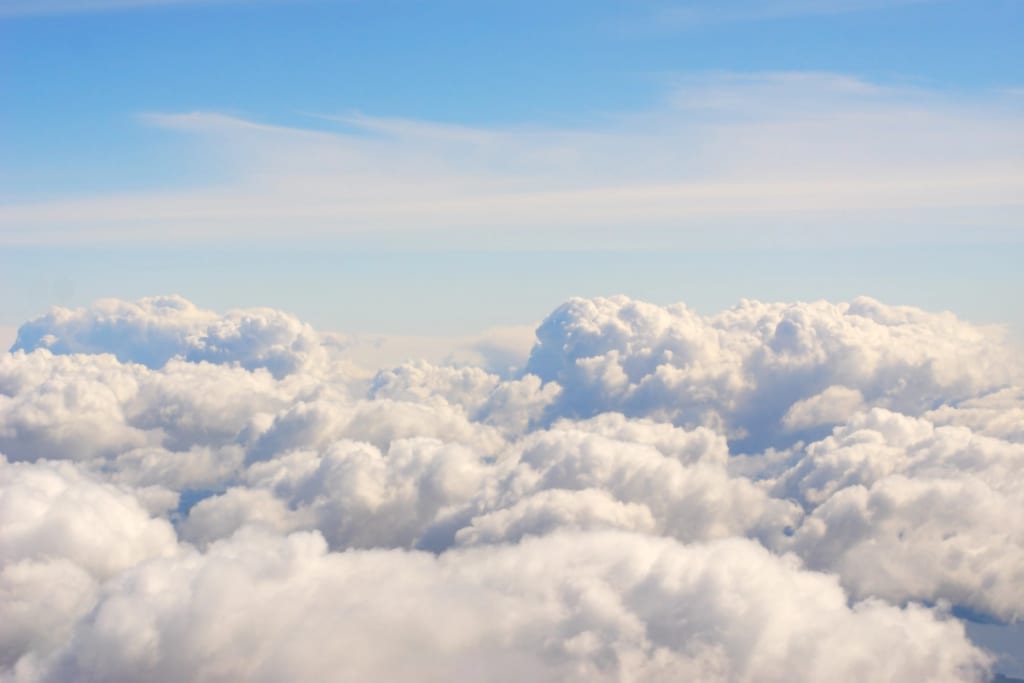
I pushed open the latch above me and was stunned. As I clung to the ladder looking up like some mole out of its hole, I saw stars. The wind was fierce as its edgeless force relentlessly shaved the opening I was to climb through. When I did pull myself through, the wind whistled less, but howled more. I found myself on a grated terrace that encircled the mouth of the intake, facing the setting sun. The view was simple, to say nothing of the spectacle that it was. The sun lay on the horizon, orange and alive, nestled into the very border of a sea of clouds. For as far as I could see, in every direction, a blanket of clouds rolled towards me. I looked down over the railing to see massive tufts of orange hued cloud break against the intake’s enormous girth. Above me was nothing but air, clean air. The orange of the sun’s warmth graded into deeper and deeper purples until directly above me sat a bowl of stars whose white glistened through even the bold hues of the sky that shielded the Earth.
It was a beautiful sight. It was a beautiful planet. Humanity was lost.
We had squandered our every opportunity, our every resource, and now we had the audacity to take, as our dying breath, the last bit of air from the Earth’s lungs so that we can go last. I’m no scientist and I couldn’t say what chance this planet has at correcting our mistakes, but if it has a chance, then the machine must turn off. While the Earth lay on her deathbed, the majesty that she could produce in a single moment with a sliver of the day’s last light was all the proof I needed to know that she was the one who deserved another day of life.
I began looking for the manual shut off switch. Seeing as how the intake had a diameter of about one hundred miles, I imagined my search could take a while. As I was walking along the metal balcony, glancing the sunset, certain in my course of action, I saw something glisten off the railing. It was a heart shaped locket tied to the railing, dancing in the wind. As I walked further, I saw another one. Eventually, there were lockets littered along the railings and affixed wherever there was a nut or bolt jutting from the intake. They increased in frequency until finally I reached a single box on the outside ledge that sat atop the railing. From the box dangled a dozen or more heart shaped lockets, each sporting a different blend of colors unique to the items it took to forge them. For some reason, maybe determination, it hadn’t hit me until now that I was far from the first person to make this journey. By the looks of it, dozens, maybe hundreds of men and women had lost someone and found their way up here to end the futility once and for all. I opened the box and found a note inside, taped down excessively to avoid blowing away. It read:
I hope you find the courage that I could not.
-Maxwell Heimlinger
I recognized the name because it was the engineer who designed the intake. Taking one last look at the Earth, having met it only a few moments ago, I pushed the single button inside the console and removed my mask, tasting the fresh air for the first time, dangerously thin as it was.
About the Creator
Keep reading
More stories from writers in Futurism and other communities.
About Binding Prometheus
I want to start actively advocating on behalf of my own work, and the most valuable part of my canon is, without a doubt, Binding Prometheus, the play I have been working on since 2019 and only finished in 2023 as part of my MA. The play itself is an amalgamation of a million different inspirations. On one end, it evokes the Ancient Greek myth-play, deriving its own title from the earliest extant work of Western drama we have, Aeschylus’s Prometheus Bound. On the other end, it borrows significantly from the sci-fi bulwarks from over the years, namely Mary Shelley’s Frankenstein and Karel Capek’s Rossum’s Universal Robots. The play could be an episode of Black Mirror, I fear. I don’t know. I’ve only ever seen one episode of Black Mirror.
By Steven Christopher McKnight18 days ago in Futurism
Saudi Arabia Dishwashing Detergent Market: Hygiene Awareness, Product Innovation & Growth Outlook
According to IMARC Group's latest research publication, GCC dishwashing detergent market reached USD 197.83 Million in 2024. The market is projected to reach USD 365.84 Million by 2033, exhibiting a growth rate of 7.07% during 2025-2033.
By Abhay Rajputabout 13 hours ago in Futurism



Comments
There are no comments for this story
Be the first to respond and start the conversation.