
Global Marvel of Space Science
A Global Marvel of Space Science, Research, and Human Collaboration


The International Space Station (ISS) stands as one of humanity’s greatest engineering achievements, a floating laboratory orbiting Earth that embodies global cooperation, scientific ambition, and technological excellence. Since its inception, the ISS has offered scientists a unique microgravity environment to conduct groundbreaking research and foster international unity in the pursuit of space exploration. This marvel not only serves as a symbol of unity among spacefaring nations but also as a platform for innovation, education, and discovery beyond our planet.
The concept of a permanent human presence in space was once just a dream, but today, the ISS is a thriving testament to what can be accomplished through teamwork. Since 2000, astronauts have continuously inhabited the station, carrying out experiments that benefit life on Earth and furthering the possibilities for deeper space missions. The station orbits at an average altitude of 400 kilometers and travels around the Earth roughly every 90 minutes, allowing it to witness 16 sunrises and sunsets each day.
The construction of the ISS began in 1998 and involved contributions from NASA (United States), Roscosmos (Russia), ESA (Europe), JAXA (Japan), and CSA (Canada). This multilateral partnership reflects a powerful commitment to peaceful space exploration and resource sharing. The initial modules were launched via Russian Proton and Soyuz rockets and U.S. space shuttles, gradually assembling the vast structure that now spans the length of a football field.
With over 15 pressurized modules and multiple external structures, the ISS serves as a versatile hub for science and habitation. These modules include laboratories, living quarters, and docking ports for visiting spacecraft. The space station also houses solar panels that generate power, robotic arms for repairs and scientific operations, and communication systems to maintain contact with mission control on Earth.
A significant aspect of the ISS is its microgravity research environment, which allows scientists to study phenomena not observable under Earth's gravity. From fluid dynamics and combustion to genetics and materials science, microgravity opens new doors in scientific understanding. These studies have contributed to advances in medicine, environmental science, and even food production, benefiting people across the globe.
The health benefits of ISS research are particularly noteworthy. For instance, studies on muscle atrophy and bone loss in astronauts have led to improved treatments for osteoporosis and other degenerative diseases on Earth. Moreover, protein crystal growth experiments on the ISS have aided in developing more effective drugs for cancer, Parkinson’s, and other illnesses.
Educational outreach is another core function of the ISS. Through live video feeds, virtual classrooms, and astronaut Q&A sessions, the station inspires students worldwide to pursue careers in STEM fields. The ISS National Lab encourages educators to involve students in real space-based experiments, transforming science lessons into interactive, real-world experiences.
As the ISS continues to evolve, it has become a key component of future space missions, particularly those aimed at the Moon and Mars. NASA’s Artemis program and SpaceX’s commercial spaceflight initiatives both consider the ISS as a vital waypoint and training ground. Experiments conducted aboard the station inform mission planning, life-support systems, and long-duration space travel strategies, ensuring the safety and success of future astronauts.
International collaboration remains the backbone of ISS operations. Despite political tensions on Earth, nations continue to work together peacefully aboard the ISS. Daily coordination among mission control centers in Houston, Moscow, Tokyo, and other cities ensures that all activities run smoothly. This cooperation showcases the power of shared goals and mutual respect in achieving scientific progress.
Commercial involvement in the ISS is steadily growing as well. Private companies like SpaceX, Boeing, and Northrop Grumman have launched cargo and crew missions, increasing accessibility to space. This partnership not only reduces costs but also fosters innovation and competitiveness, which are essential for the sustainability of human spaceflight.
Over the years, more than 250 astronauts from 20 different countries have visited the ISS. Each brings unique cultural perspectives and scientific expertise, enriching the station’s mission. From conducting psychological studies on isolation to capturing stunning Earth imagery, astronauts play a crucial role in enhancing humanity’s connection to space.
The Earth observation data collected by ISS instruments is invaluable for climate change studies, disaster response, and environmental monitoring. High-resolution cameras and sensors help scientists track hurricanes, wildfires, deforestation, and pollution in real time. These insights support global sustainability efforts and disaster relief strategies on the ground.
Life aboard the ISS is both challenging and fascinating. Astronauts follow a strict schedule of work, exercise, and rest to maintain health and productivity. Meals are carefully planned and packaged, and every drop of water is recycled. Despite the constraints, astronauts report a strong sense of camaraderie and awe at the beauty of our planet from space.
Safety aboard the ISS is paramount. The crew is trained to respond to emergencies such as fires, depressurization, and equipment malfunctions. Regular drills and robust systems ensure that risks are minimized. The station also undergoes continuous maintenance, with robotic and human assistance, to ensure optimal functioning.
The ISS has also hosted many firsts in space—from the first space tourist to the first all-female spacewalk. These milestones highlight the progress being made in diversity, inclusion, and public access to space. They also reflect the station's role as a global platform where human dreams can become reality.
Looking ahead, the future of the ISS is both exciting and uncertain. While current agreements support operation until 2030, discussions are underway about transitioning to commercial space stations. These next-generation platforms may continue the legacy of the ISS, expanding opportunities for research, tourism, and industrial use in low Earth orbit.
One promising area of expansion is the development of space habitats and manufacturing in microgravity. Materials like fiber optics, semiconductors, and biological tissues could be produced with higher purity and performance in space. These innovations could revolutionize industries and improve life on Earth.
As the ISS enters its third decade, it remains a beacon of hope and human potential. Its orbiting presence reminds us that despite national boundaries and earthly concerns, collaboration can lead to extraordinary achievements. The ISS is more than a laboratory; it is a symbol of what humanity can accomplish when we dare to dream together.
The continued success of the ISS relies on public support, scientific curiosity, and international diplomacy. Its lessons extend beyond science, teaching us about cooperation, adaptability, and perseverance in the face of challenges. These values are essential not only for space exploration but also for solving the pressing issues we face here on Earth.
In conclusion, the International Space Station exemplifies the best of human ingenuity, unity, and exploration. It is a place where science and spirit meet, offering a glimpse into our future among the stars. Whether studying the cosmos or our own planet, the ISS bridges the gap between imagination and reality. Its orbit may be high above, but its impact is deeply felt here on Earth.
About the Creator
Lana Rosee
🎤 Passionate storyteller & voice of raw emotion. From thoughts to tales, I bring words to life. 💫
Love my content? Hit Subscribe & support the journey! ❤️✨
Keep reading
More stories from Lana Rosee and writers in Futurism and other communities.
How AI Brings Changes into Our Lives
Artificial Intelligence, commonly known as AI, is no longer a term reserved for scientists and tech experts. It has become a transformative force that’s reshaping nearly every aspect of human life. From smart devices to healthcare, education to entertainment, AI is deeply embedded in our daily routines. As technology evolves, the role of AI continues to expand, bringing both convenience and innovation to our fingertips. The integration of AI into our world is one of the most significant shifts of the digital age.
By Lana Rosee8 months ago in Futurism
Australia Energy Storage Market: Renewable Integration, Battery Deployment & Grid Stability
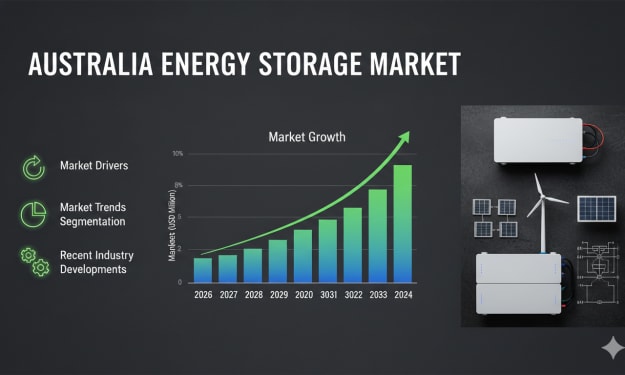
According to IMARC Group, the Australia energy storage market reached 4.72 GW in 2025 and is projected to expand significantly to 19.81 GW by 2034, exhibiting a compound annual growth rate (CAGR) of 17.28% during 2026–2034. The rapid growth of the sector reflects the country’s accelerating transition toward renewable energy and the increasing need for reliable electricity systems across Australia. As solar and wind power generation expands, energy storage technologies such as battery energy storage systems (BESS) are becoming essential for maintaining grid reliability and balancing electricity supply and demand. Government policies supporting clean energy adoption, declining battery costs, and investments in grid modernization are significantly strengthening Australia energy storage market share while enabling the integration of renewable power into the national electricity network.
By Shrestha Roy4 days ago in Futurism
Cooking Oil Market: AI-Driven Innovation Transforming Global Edible Oil Demand
AI Overview of the Cooking Oil Market The cooking oil market includes a wide range of edible oils derived from plant and seed sources such as soybean, palm, sunflower, olive, coconut, and canola. These oils are essential ingredients in households, restaurants, food processing industries, and the HoReCa (Hotel, Restaurant, and Catering) sector.
By James Smith6 days ago in Futurism
Guard Your Battery
Why are some people so attractive just by standing there? It’s not because they are "likable," but because they don’t need everyone to like them. I realized later that truly charismatic people allow themselves to be criticized, but they never criticize themselves. They never try to please the world; instead, the world stops to watch them.
By Emily Chan - Life and love sharing5 days ago in Poets



Comments
There are no comments for this story
Be the first to respond and start the conversation.