
Global Artificial Insemination Market Size and Forecast 2025–2033
How technology, changing family structures, and healthcare investment are reshaping the future of fertility worldwide


Global Artificial Insemination Market Overview
The global artificial insemination market is entering a phase of sustained growth, driven by rising infertility rates, rapid technological innovation, evolving family structures, and expanding healthcare infrastructure. According to Renub Research, the market is expected to grow from US$ 2.53 billion in 2024 to US$ 4.97 billion by 2033, registering a strong CAGR of 7.78% during 2025–2033.
Artificial insemination (AI) is a widely used assisted reproductive technology (ART) that involves the direct placement of sperm into a woman’s reproductive system to facilitate conception. The procedure is often recommended for couples facing male infertility issues, unexplained infertility, cervical problems, or ovulation timing challenges. It is also increasingly used by single women and same-sex couples, making it one of the most inclusive fertility treatments available today.
Compared to in-vitro fertilization (IVF), artificial insemination is less invasive, more affordable, and easier to access, which makes it a preferred first-line treatment across many fertility clinics worldwide. With growing awareness and acceptance of fertility treatments, artificial insemination is transitioning from a niche medical service to a mainstream reproductive solution.
Market Size and Forecast (2025–2033)
Renub Research estimates that the global artificial insemination market will nearly double in value by 2033, reflecting rising demand for fertility solutions across both developed and emerging economies.
Key drivers supporting this growth include:
Increasing infertility prevalence due to lifestyle changes and delayed parenthood
Advances in reproductive medicine and laboratory techniques
Expansion of fertility clinics and specialized healthcare centers
Supportive government policies and insurance coverage
Growing social acceptance of alternative family structures
As fertility challenges become more common, artificial insemination is expected to remain a cornerstone of assisted reproductive care globally.
Growth Drivers in the Artificial Insemination Market
1. Rising Infertility Rates Worldwide
One of the most powerful growth drivers is the increasing incidence of infertility. According to the World Health Organization (WHO), 17.5% of adults worldwide experience infertility at some point in their lifetime, highlighting the scale of the issue.
Infertility is rising due to multiple factors, including:
Delayed childbearing for career and financial stability
Sedentary lifestyles and poor dietary habits
Obesity and hormonal imbalances
Environmental pollution and chemical exposure
Stress-related disorders and chronic diseases
Artificial insemination is often the first treatment option recommended by fertility specialists because it is cost-effective and less physically demanding than IVF. As infertility becomes a global health concern rather than a private issue, demand for AI procedures is expected to rise steadily.
2. Technological Advancements in Reproductive Medicine
Technology is transforming artificial insemination from a basic clinical procedure into a data-driven, highly personalized medical service. Advances in sperm preparation, cryopreservation, donor matching, and lab automation have dramatically improved success rates.
In May 2022, Genea Limited launched a technology innovation program aimed at overcoming key challenges in fertility treatment. The initiative focuses on AI-driven embryo grading, advanced cryopreservation, and lab automation, demonstrating how technology is reshaping reproductive medicine.
Artificial intelligence is now being used to:
Identify the healthiest sperm and embryos
Optimize insemination timing
Predict treatment success rates
Reduce human error in laboratory settings
These innovations are increasing efficiency while lowering long-term treatment costs, making artificial insemination more accessible to patients globally.
3. Expansion of Healthcare Infrastructure
Improved healthcare infrastructure is another major growth factor, particularly in emerging markets. Governments and private healthcare providers are investing heavily in:
New fertility clinics and ART centers
Advanced diagnostic equipment
Training programs for reproductive specialists
Telemedicine and mobile fertility services
Urban centers now offer specialized fertility care, while mobile clinics and outreach programs are expanding access to rural populations. As healthcare infrastructure continues to improve, artificial insemination is becoming more affordable and widely available.
Challenges Facing the Artificial Insemination Market
High Cost of Treatment
Despite being cheaper than IVF, artificial insemination can still be expensive for many families, especially if multiple cycles are required. Costs often include hormone therapy, lab tests, ultrasounds, and specialist consultations. In many regions, these expenses are not fully covered by insurance.
This financial burden limits access for lower-income populations and remains a major obstacle to market expansion, particularly in developing countries.
Psychological and Emotional Stress
Infertility treatments are emotionally demanding. Patients often experience anxiety, depression, and social pressure, especially in cultures where parenthood is strongly emphasized. The uncertainty of success, repeated clinical visits, and hormonal changes can strain relationships and mental health.
Addressing these emotional challenges through counseling, support groups, and holistic care is becoming increasingly important for improving treatment outcomes and patient satisfaction.
Regional Market Insights
United States Artificial Insemination Market
The U.S. remains one of the most mature markets for artificial insemination, supported by advanced healthcare infrastructure, strong awareness, and growing insurance coverage. Intrauterine insemination (IUI) is the most commonly used method due to its high success rate and simplicity.
Rising acceptance of single-parent families and same-sex couples has expanded the patient base. Technological innovations such as AI-assisted genetic screening and improved sperm processing are further driving market growth across the country.
Germany Artificial Insemination Market
Germany’s market is growing steadily, supported by a robust healthcare system and favorable insurance policies. Artificial insemination is widely accepted and regulated, ensuring high treatment standards and success rates.
The increasing number of same-sex couples and single women seeking fertility services is also driving demand. Government support and public awareness campaigns continue to strengthen Germany’s position in the European fertility market.
India Artificial Insemination Market
India is emerging as a high-growth market for artificial insemination, driven by rising awareness, technological adoption, and strong government backing.
In September 2024, the Punjab Animal Husbandry Department set a target of 30 lakh (3 million) artificial inseminations annually, reflecting the rapid expansion of AI in livestock and human fertility programs. National initiatives such as the National Artificial Insemination Program (NAIP) and the Rashtriya Gokul Mission are further accelerating adoption.
Innovations such as sex-sorted semen, mobile AI units, and low-cost fertility clinics are making artificial insemination accessible to a wider population, positioning India as a major growth hub for reproductive technologies.
Saudi Arabia Artificial Insemination Market
Saudi Arabia’s artificial insemination market is expanding due to increased investment in livestock genetics and food security initiatives. The government is funding AI centers, veterinary training programs, and modern breeding technologies to improve herd quality.
Artificial insemination is widely used in cattle, sheep, and goat breeding, with rising interest in sexed semen and high-efficiency techniques. Continued modernization is expected to make Saudi Arabia a regional leader in sustainable breeding practices.
Recent Developments in the Artificial Insemination Market
September 2024: Lupane State University (LSU) launched an artificial insemination program to help farmers improve goat genetics and reduce breeding costs.
September 2024: Punjab Animal Husbandry Department announced a goal of 30 lakh artificial inseminations annually.
August 2024: Aetna®, a CVS Health® company, added intrauterine insemination (IUI) as a covered medical benefit for eligible plans, improving access to fertility care in the U.S.
These developments highlight growing institutional support and policy recognition of artificial insemination’s importance.
Artificial Insemination Market Segmentation
By Type
Intrauterine
Intracervical
Intravaginal
Intratubal
By Source Type
AIH (Husband)
AID (Donor)
By End Use
Hospitals and Clinics
Fertility Centers
Other End Users
By Country
North America: United States, Canada
Europe: France, Germany, Italy, Spain, UK, Belgium, Netherlands, Turkey
Asia Pacific: China, Japan, India, Australia, South Korea, Thailand, Malaysia, Indonesia, New Zealand
Latin America: Brazil, Mexico, Argentina
Middle East & Africa: South Africa, UAE, Saudi Arabia
Key Players in the Artificial Insemination Market
The market is moderately competitive, with companies focusing on innovation, strategic partnerships, and geographic expansion. Leading players include:
Vitrolife
Genea Pty Limited
Rinovum Women’s Health, LLC
Pride Angel
HI-TECH SOLUTIONS
FUJIFILM Irvine Scientific
Kitazato Corporation
Rocket Medical plc
Conceivex, Inc.
Each company has been analyzed across five key dimensions: company overview, leadership, recent strategies, SWOT analysis, and sales performance.
Final Thoughts
The global artificial insemination market is no longer just a medical niche—it is a fast-growing, technology-driven industry responding to one of humanity’s most fundamental needs: the desire to create families. With rising infertility rates, growing social acceptance, and major technological breakthroughs, artificial insemination is becoming a cornerstone of modern reproductive healthcare.
As governments, healthcare providers, and technology companies continue to invest in this space, artificial insemination will become more accessible, affordable, and effective, ensuring its strong growth trajectory through 2033 and beyond.
About the Creator
Keep reading
More stories from Aaina Oberoi and writers in Futurism and other communities.
ATM Managed Services Market Size and Forecast 2025–2033
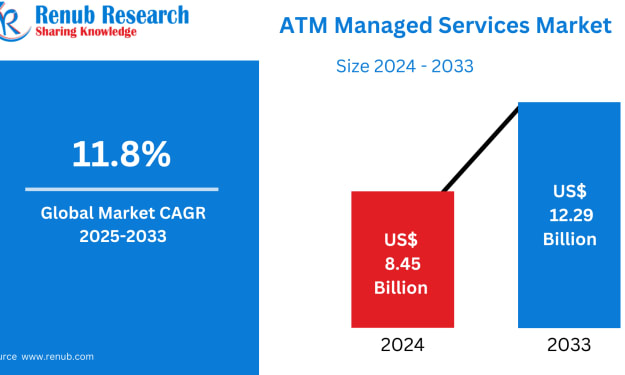
Global ATM Managed Services Market Outlook The global ATM Managed Services Market is entering a phase of steady and technology-driven expansion as banks and financial institutions worldwide shift toward outsourcing non-core operations. According to Renub Research, the market is projected to grow from US$ 8.45 billion in 2024 to US$ 12.29 billion by 2033, registering a compound annual growth rate (CAGR) of 4.25% from 2025 to 2033.
By Aaina Oberoia day ago in Futurism
About Binding Prometheus
I want to start actively advocating on behalf of my own work, and the most valuable part of my canon is, without a doubt, Binding Prometheus, the play I have been working on since 2019 and only finished in 2023 as part of my MA. The play itself is an amalgamation of a million different inspirations. On one end, it evokes the Ancient Greek myth-play, deriving its own title from the earliest extant work of Western drama we have, Aeschylus’s Prometheus Bound. On the other end, it borrows significantly from the sci-fi bulwarks from over the years, namely Mary Shelley’s Frankenstein and Karel Capek’s Rossum’s Universal Robots. The play could be an episode of Black Mirror, I fear. I don’t know. I’ve only ever seen one episode of Black Mirror.
By Steven Christopher McKnight22 days ago in Futurism
🅼🅸🅳🅽🅸🅶🅷🆃 🆂🅽🅰🅲🅺🆂
"It's 10 in Tuscon! We all know what that means... It's Time for Midnight Snacks with your man, Gerald Gee! Ready to spend the night together? Me too! I'm full of snacks and can't wait to regurgitate them all back into your hungry ears. Crack a brew! Pop some corn! Anything to get ready for one hell of a show where the talk maybe cheap but the words cut deep...
By Lamar Wigginsabout 12 hours ago in Fiction


Comments
There are no comments for this story
Be the first to respond and start the conversation.