
Futureproof by Kevin Roose Review
Can we truly Futureproof ourselves?
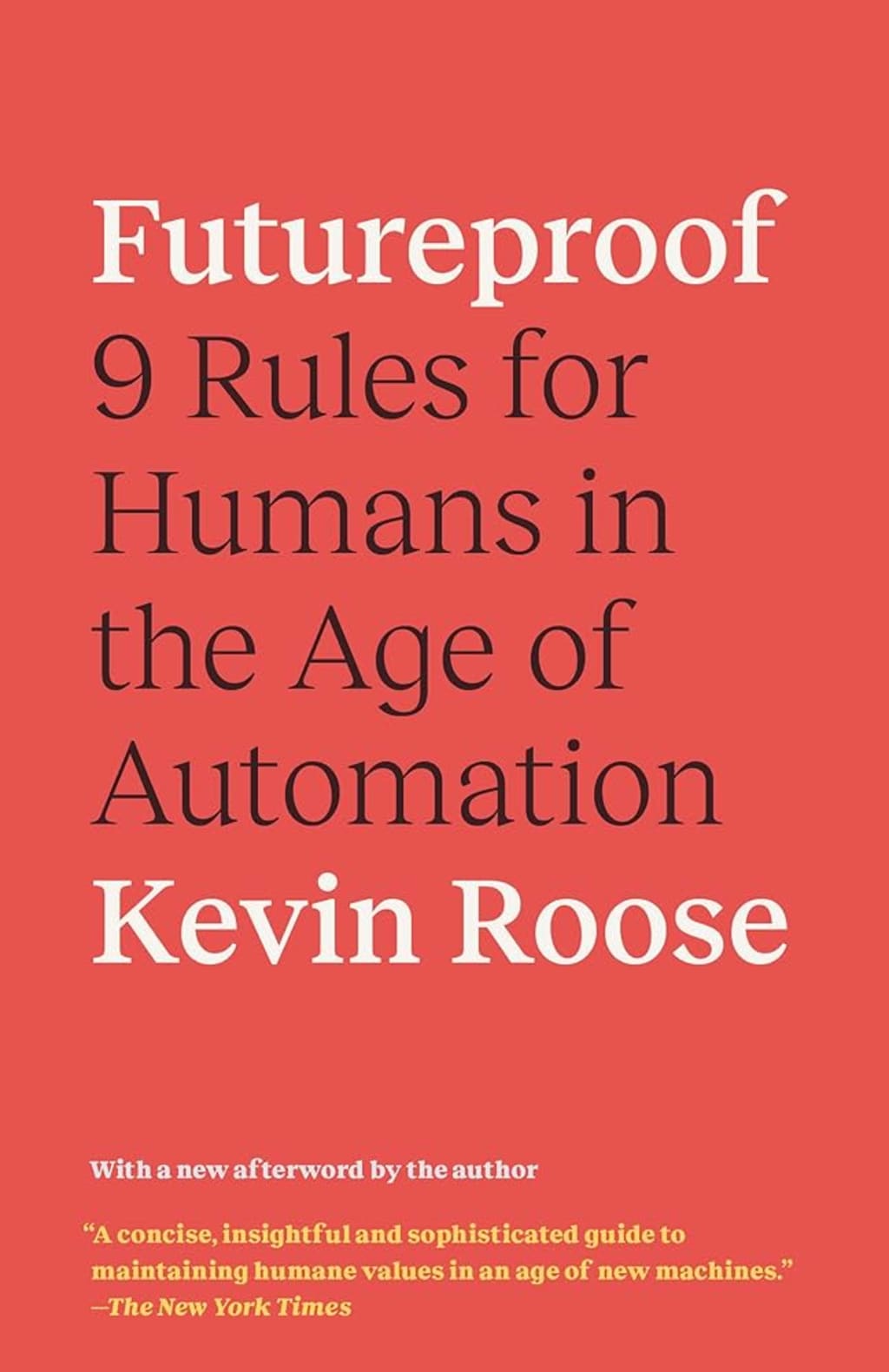
Futureproof: 9 Rules for Surviving in the Age of AI is an interesting book because of its goal. Kevin Roose, the author of Futureproof, attempts to do what few authors on the subject have done before- attempt to give us tips on how to survive in the coming age of AI instead of just informing us of its arrival and leaving us shaking in our boots. Roose’s book is interesting because of its two-part setup. Part One, titled ‘The Machines’ is meant to get readers up to speed on the topic of AI and Automation as well as provide a much-needed background into the development of technology. Part Two, aptly titled ‘The Rules’, is divided into nine parts which each follow a different rule that readers should follow if they don’t want to see themselves among the millions of people who will, and already have been displaced, by AI and Automation. Roose’s book functions similarly to a ‘For Dummies’ book, but does it actually have anything of value to say?
Part One: The Machines
In Part One, Roose briefly touches on each of the previous Industrial Revolutions. He does this in order to set the stage and get the reader more familiar with the way technology as a whole affects society, especially the workplace. Roose does this in order to prepare to address each of the four major arguments in favor of AI and Automation.
- “We’ve been here before, and it turned out fine.”
Roose shuts this argument down with the simple fact that while the world was not destroyed by the previous Industrial Revolutions, some people’s lives were forever changed by the Industrial Revolution of their era (and not in a good way). This is because “while periods of technological change often improve conditions for elites and capital owners, workers don’t always experience the benefits right away” (Roose, 2021, 14). Many people worked in hot, dangerous, and overcrowded conditions and never saw the fruits of their labor.
2. "AI will make our jobs better, by doing the boring parts for us.”
While it is true that since we are still going through the AI and Automation era, we cannot have a definite answer to this question, Roose shares his own counterargument. His first argument is that cutting the so-called ‘boring’ parts out of the job doesn't increase workplace morale. Roose also calls attention to the fact that while AI and Automation save time and labor in some areas, it also introduces another field of boring and repetitive work in the form of “Ghost Work” which is essentially low-paid workers helping the AI and Automated Systems to function as they should.
3. "Humans and AI will collaborate, not compete"
Roose quickly shuts down this argument with studies that show that pure AI teams outperform Human-AI teams nearly every time.
4. “AI won’t cause mass unemployment because human needs are limitless. In the future, we’ll come up with new jobs we can’t even imagine today.”
Roose can't exactly refute this claim as even he admits that quite a few job titles exist today that didn't exist ten years ago, but what he can prove is that from 1947 to 1987 AI was creating more than destroying, but from 1987 to 2017 AI was eliminating more jobs than it was creating (Roose, 2021, 14).
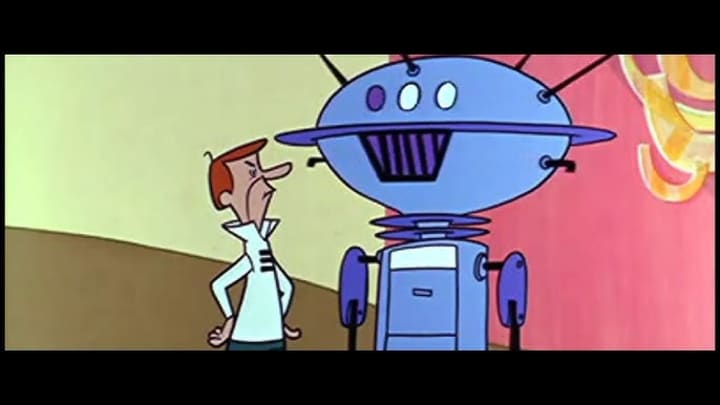
Roose closes out Part One by going into detail about the kind of jobs that are most at risk and how AI and Automation really replace us. (Hint: It doesn't look like that one episode of The Jetsons).
Part Two: The Rules
Rule 1: Be Surprising, Social, and Scarce
Roose tells us that our greatest asset is actually our humanity and that we need to find ways to cultivate it.
Rule 2: Resist Machine Drift
Because our greatest asset is our humanity, we need to take advantage of it. We have free will and we need to use it in order to resist the ease that comes with allowing machines to control our lives. We need to be unpredictable and unique and find ways of maintaining our individuality.
Rule 3: Demote Your Devices
Our relationship with our devices affects us much more than we may realize. Achieving a healthy balance is important as social media algorithms aim to destroy our attention spans which can divert our focus away from what is truly important such as our interpersonal relationships and our personal goals and interests. Our smartphones can be a powerful tool, but only if we control them and not the other way.

Rule 4: Leave Handprints
Roose says that while having electric appliances in your house may have once been a status symbol, that is no longer true because of how accessible these mass-produced appliances have become. Now, handcrafted and one-of-a-kind pieces are increasing in worth and acting as status symbols. This is why Roose highlights artists and artisans as those who are potentially safe from automation.
Rule 5: Don’t Be an Endpoint
Endpoints are people who act as a middle man between two machines or systems. The sole purpose of an endpoint is to do what some machines cannot yet do which is directly share information. Jobs like secretaries and turnstile operators could be considered Endpoint positions and may be eliminated in the future as technology improves with time.

Rule 6: Treat AI like a Chimp Army
You wouldn't allow a chimp army to have free rein over your business, would you? No, especially not if the chimp army hadn't proven themselves to be predictable, reliable, possessing common sense, and capable of understanding the nuance of human interaction. Even if they had these qualities, they wouldn't be the ones in charge, right? (Please say no) This is the example Roose uses to help warn against the overautomating of the workplace.
Rule 7: Build Big Nests and Small Webs
In case of job elimination and mass displacement of workers, Roose suggests that the government and businesses should have a system of support; this may come in the form of Universal Basic Income, retraining, systems of employee loans and hiring incentives, or even a "robot tax". Small webs are communities or personal relationships that you can depend on in times of need.
Rule 8: Learn Machine Age Humanities
Roose talks about the importance of Attention Guarding, Room Reading, and Resting.
Rule 9: Arm the Rebels
Since the AI and Automation Era is already here, and running to the hills isn't an option for most of us, Roose gives a few tips on communal and individual action that can help shape our future.

Final Takeaways:
While Roose does well to correct the dystopian image most of us have in mind when thinking of the future of AI and Automation, his 9 rules fall a little short of the mark. So, while we may not have a concrete answer of how to Futureproof ourselves, we do have a nice guideline to follow that can help us to make the appropriate decisions. Since the future of AI and Automation and technology in general are still contingent on the decisions we make in the near future, we can only work on applying Roose's rules to our lives; like cultivating our human-ness and honing the distinct skills that separate us from machines. We can also work on informing ourselves and our communities in order to organize so that we can have a say in what our workplaces look like in ten years.
About the Creator
Kryssa Daugereau
Student by day, author by night. Full time cat lady.
Keep reading
More stories from Kryssa Daugereau and writers in Futurism and other communities.
About Binding Prometheus
I want to start actively advocating on behalf of my own work, and the most valuable part of my canon is, without a doubt, Binding Prometheus, the play I have been working on since 2019 and only finished in 2023 as part of my MA. The play itself is an amalgamation of a million different inspirations. On one end, it evokes the Ancient Greek myth-play, deriving its own title from the earliest extant work of Western drama we have, Aeschylus’s Prometheus Bound. On the other end, it borrows significantly from the sci-fi bulwarks from over the years, namely Mary Shelley’s Frankenstein and Karel Capek’s Rossum’s Universal Robots. The play could be an episode of Black Mirror, I fear. I don’t know. I’ve only ever seen one episode of Black Mirror.
By Steven Christopher McKnight17 days ago in Futurism
The Era of Agentic AI
For the past three years, we’ve been smitten with "prompt engineering." We’ve interacted with AI as we would an oracle in an "answer cave": we came before its text box, articulated a question thoughtfully, and then waited for an answer. However, as we find ourselves in 2026, so is the passing of the era of "static prompts." We are now in the "Age of Agentic AI."
By Artical Media6 days ago in Futurism
Silver Screen Magic with Mae West
American actress and singer Mae West became a popular film actress during the Great Depression. She started entertaining in vaudeville, then performed on Broadway, and finally went to Hollywood. She signed up with Paramount Pictures and made her debut in the 1932 film “Night After Night.” She also starred in musicals, comedies, and crime dramas. The American Film Institute named her one of the best classic Hollywood actresses.
By Rasma Raisters4 days ago in Geeks



Comments
There are no comments for this story
Be the first to respond and start the conversation.