
From Waste to Resource
The Potential of Space Debris
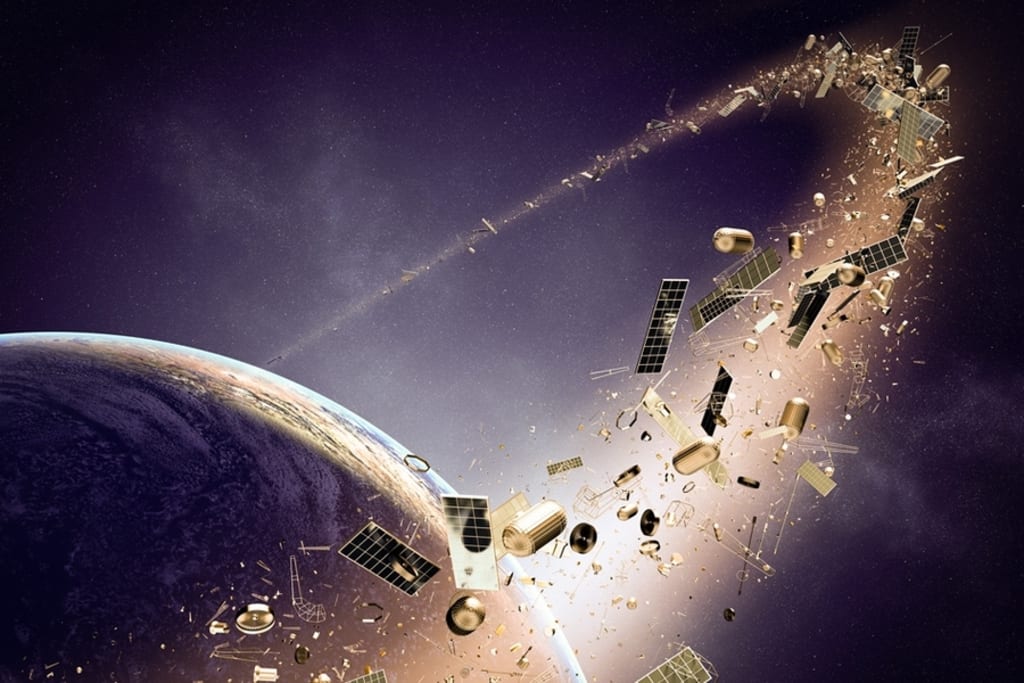
Space debris, also known as space waste or space junk, refers to the collection of defunct man-made objects in Earth's orbit, such as old satellites, rocket stages, and fragments from previous launches and collisions. These debris can travel at very high speeds and can cause damage to operational spacecrafts and threaten the safety of human spaceflight. The problem of space debris has been growing in recent years, due to the increasing number of launches and the accumulation of debris in low Earth orbit.
Efforts are being made to address this issue, such as active debris removal (ADR), which involves using a spacecraft to capture and remove debris from orbit, and passive debris removal, which involves designing spacecraft to naturally deorbit after their useful lifetime. Also, international guidelines and regulations have been proposed to limit the creation of new debris and encourage responsible space activity.
It's important that international cooperation and collaboration to address this issue, as it affects not only the space industry but also the security and safety of everyone on Earth.
OPPURTUNITIES ???
It is theoretically possible to earn money from space debris, but it would require significant investment and technical capabilities to collect and process the debris, as well as regulatory and legal frameworks to permit and govern such activities.
One potential approach could be to salvage valuable materials or components from the debris, such as metals, alloys, or electronics. However, the cost of collecting and processing the debris would likely be high and the potential revenue from salvaged materials may not be enough to offset the costs.
Another potential approach could be to sell debris as scrap metal or other materials. However, the market for space debris scrap is currently not well-established and there is a limited demand for it.
Another way could be to use space debris as a resource for space activities, like using them as building blocks for constructing space stations or other structures in space, or using them as a fuel source for propulsion systems.
Overall, while there may be potential for earning money from space debris, it would require significant investment, technical capabilities, and regulatory and legal frameworks to make it a viable option.
Current Demand
Currently, the demand for space debris is relatively limited. While there may be some interest in salvaging valuable materials or components from the debris, such as metals, alloys, or electronics, the cost of collecting and processing the debris would likely be high and the potential revenue from salvaged materials may not be enough to offset the costs. Additionally, the market for space debris scrap is currently not well-established and there is a limited demand for it.
Another potential approach could be to use space debris as a resource for space activities, like using them as building blocks for constructing space stations or other structures in space, or using them as a fuel source for propulsion systems. However, these are still in the early stages of development and the technology to make use of debris as a resource is not yet mature.
Overall, the demand for space debris is currently low, as the cost of collecting and processing it outweighs the potential revenue from its reuse or recycling. However, with the growing concern about space debris and the need to address this problem, there is a potential for future developments to make use of debris as a resource.
The Future
It is possible that the demand for space debris could increase in the future as the problem of space debris continues to grow and more efforts are made to address it. As the number of launches and the amount of debris in orbit continue to increase, the need for solutions to remove and dispose of debris will also increase.
As the technology for debris removal and recycling develops and becomes more advanced, it may become more cost-effective to collect and process debris, which could increase the demand for it. Additionally, as the commercial use of space continues to grow, the demand for resources like metals, alloys, and electronics found in debris could also increase.
Also, as the space industry continues to grow, the demand for space debris as a resource for space activities like constructing space stations or other structures in space, or using them as a fuel source for propulsion systems could also increase.
while the demand for space debris is currently low, it is possible that it could increase in the future as the technology and regulations for debris removal and recycling develop and the need for solutions to address the problem of space debris becomes more pressing.
About the Creator
Keep reading
More stories from Alvin raj Anbalagan and writers in Futurism and other communities.
From Stargazer to Hero
Max was a man who lived in a small town in the countryside and had a deep passion for the stars. He spent many nights gazing up at the sky, imagining the mysteries and wonders of the universe. Little did he know that his fascination with the stars would lead him on a journey of self-discovery and heroism. Join Max as he makes a groundbreaking discovery that will change the course of his life and the fate of the world.
By Alvin raj Anbalagan3 years ago in Humans
About Binding Prometheus
I want to start actively advocating on behalf of my own work, and the most valuable part of my canon is, without a doubt, Binding Prometheus, the play I have been working on since 2019 and only finished in 2023 as part of my MA. The play itself is an amalgamation of a million different inspirations. On one end, it evokes the Ancient Greek myth-play, deriving its own title from the earliest extant work of Western drama we have, Aeschylus’s Prometheus Bound. On the other end, it borrows significantly from the sci-fi bulwarks from over the years, namely Mary Shelley’s Frankenstein and Karel Capek’s Rossum’s Universal Robots. The play could be an episode of Black Mirror, I fear. I don’t know. I’ve only ever seen one episode of Black Mirror.
By Steven Christopher McKnight19 days ago in Futurism
Home Shopping Market: Convenience-Led Retail & Growth Outlook
According to IMARC Group's latest research publication, The global home shopping market size was valued at USD 4,598.70 Billion in 2024. Looking forward, IMARC Group estimates the market to reach USD 12,791.25 Billion by 2033, exhibiting a CAGR of 11.44% during 2025-2033.
By James Whitman6 days ago in Futurism




Comments
There are no comments for this story
Be the first to respond and start the conversation.