
From Classroom Consumer to Campus Creator
A University Student’s Wake-Up Call


There’s a silent epidemic on college campuses: Students are drowning in information but starving for impact. We attend lectures, highlight textbooks, and cram for exams, yet rarely apply what we learn beyond the classroom. I know this because I was the queen of “academic osmosis”—someone who treated education like a spectator sport.
But after two years of passive learning, I hit a wall. Despite straight A’s, I couldn’t answer one critical question: What am I building with this knowledge?
This is how I shifted from being a consumer of education to a creator of value—and how you can too, without sacrificing your GPA or social life.
The Student Consumer Trap: Why Good Grades Aren’t Enough
My wake-up call came during a internship interview. The hiring manager glanced at my 3.8 GPA and said, “Impressive. Now, show me a project where you solved a real problem.” I froze. My resume was a laundry list of coursework and part-time retail jobs—zero proof I could do anything.
Sound familiar?
The university system often trains us to:
Memorize, not apply: We regurgitate textbook theories but rarely test them in the real world.
Chase grades, not growth: We stress over A’s but skip opportunities to lead clubs, launch initiatives, or create.
Hoard knowledge, not share it: We treat ideas like secret treasures rather than tools to help others.
I realized I’d become a professional student—great at absorbing, terrible at executing.
The Myths Keeping Students Stuck
Myth 1: “I’ll Start Creating After Graduation”
The lie: “I’m too busy with classes to build anything now.”
The truth: I spent 4 hours daily scrolling TikTok, rewatching Friends, and stressing about deadlines I’d procrastinated.
Student Example:
Problem: Maya, a computer science major, dreamed of building apps but “waited for free time.”
Solution: She repurposed class projects. For a databases course, she created a roommate-matching app for her dorm. It went viral on campus, landed her a summer internship, and became her senior thesis.
Myth 2: “I Need Permission to Create”
The lie: “I’m not qualified—I’m just a student.”
The truth: Your fresh perspective is an asset. Companies crave students who innovate, not just recite textbooks.
Student Example:
Problem: Jake, a marketing student, felt unqualified to start a podcast.
Solution: He interviewed local businesses about their pandemic pivots for a class assignment. His professor shared it with the Chamber of Commerce, and Jake now hosts workshops for small biz owners.
Myth 3: “Creation Requires Money”
The lie: “I can’t afford software, equipment, or a team.”
Use free tools: Canva for design, Google Workspace for collaboration, Anchor for podcasts.
Tap campus resources: 3D printers, recording studios, and mentorship programs.
Student Example:
Problem: Aisha, an engineering student, wanted to prototype a sustainable water filter but had no budget.
Solution: She used her department’s lab, partnered with environmental science classmates, and won a $5k sustainability grant.
The Student Creator’s Playbook: 4 Steps to Start Now
1. Turn Classwork Into Portfolio Gold
Don’t just submit assignments—repurpose them.
Example: A sociology essay on gentrification? Expand it into a blog series or documentary short film.
My Story: For a statistics course, I analyzed campus dining hall waste. I turned it into an infographic shared by the university’s sustainability office, which led to a paid role in redesigning their recycling program.
2. Leverage Campus Resources
Universities are creating playgrounds—most students just don’t realize it.
Free software: Adobe Creative Cloud, MATLAB, LinkedIn Learning.
Clubs: Join (or start) a TEDx team, consulting group, or hackathon squad.
Grants: Pitch ideas to your department. I funded a mental health podcast through a $1k student wellness grant.
3. Build in Public
Share your process, not just polished results.
Example: Livestream your study sessions on Twitch while preparing for finals. Teach others your note-taking method.
My Story: I documented my journey writing a research paper on Instagram—from messy drafts to professor feedback. A startup founder saw it and hired me to write their whitepapers.
4. Partner with Peers
Collaboration > competition.
Example: Team up with an art student to illustrate your economics thesis. Partner with a coding club to automate a campus process (e.g., laundry room alerts).
My Story: I co-founded a newsletter with a biology major (she wrote health tips; I covered productivity). We monetized it through local cafe ads and split the profits.
The Results: Why Creating Beats Consuming
After 18 months of intentional creating:
My LinkedIn exploded from 200 to 5,000+ followers (employers DM me now).
I’ve earned $12k+ from freelance writing, campus workshops, and mini-courses.
My grades improved because applying knowledge cemented my understanding.
But the biggest win? I stopped defining myself by exams. I became someone who solves problems, not just studies them.
Your Assignment (Yes, Right Now)
Audit Your Time
Track your screen time for 48 hours. Replace just 30 minutes of scrolling with creating.
Pilot a Micro-Project
Turn a class presentation into a YouTube video.
Design a study guide and sell it for $2 on Etsy.
Organize a “Skill Swap” event (you teach essay writing; someone teaches Python basics).
Fail Forward
My first YouTube video got 27 views. My first blog post had 12 typos. My first workshop had 3 attendees. Keep going.
Universities don’t give grades for courage, but life does. The world needs students who do things—not just cram facts. That app you sketch in your notebook? What research topic you’re obsessed with? That club you’ve been too shy to join? Start now.
Your future employer—or customer, or community—isn’t waiting for your diploma. They’re waiting for proof you can solve problems. So, what will you create today?
P.S. Still stuck? Here’s your cheat code: Email your favorite professor this sentence—
“I’m passionate about [topic]. Can I help with any research or projects this semester?”
Watch doors fly open.
About the Creator
Pure Crown
I am a storyteller blending creativity with analytical thinking to craft compelling narratives. I write about personal development, motivation, science, and technology to inspire, educate, and entertain.
Keep reading
More stories from Pure Crown and writers in Futurism and other communities.
From Passive Learner to Active Creator
We live in a world saturated with information. Every day, we’re bombarded with podcasts, articles, online courses, and social media posts promising to teach us how to succeed. For years, I devoured this content, convinced that accumulating knowledge was the key to unlocking my potential. But despite filling my brain with strategies, hacks, and inspirational quotes, my life remained stagnant. The truth hit me hard: Consuming without creating is like stocking a library but never writing a book.
By Pure Crown12 months ago in Futurism
Australia Luxury Cosmetics Market: Premium Demand, Retail Expansion & Brand Innovation
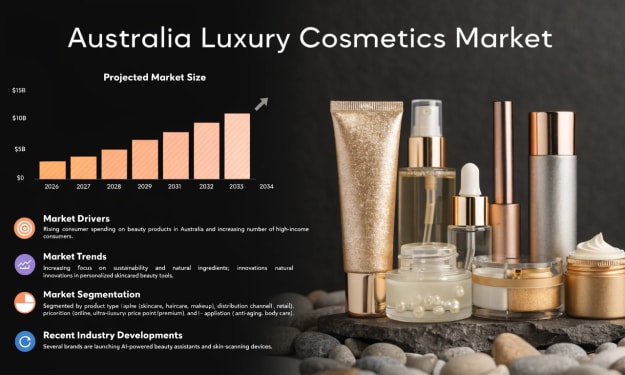
According to IMARC Group, the Australia luxury cosmetics market reached USD 1.6 Billion in 2025 and is projected to grow to USD 2.3 Billion by 2034, exhibiting a compound annual growth rate (CAGR) of 3.92% during 2026–2034. The steady expansion of the market reflects rising disposable incomes, evolving beauty standards, and a growing preference for premium personal care products across Australia. Consumers are increasingly investing in high-end skincare, makeup, and fragrance products that promise quality, performance, and exclusivity. With digital influence reshaping purchasing decisions and sustainability becoming central to brand identity, the Australia luxury cosmetics market share continues to expand within the broader beauty and personal care industry.
By Shrestha Roy6 days ago in Futurism
The BAFTA Awards
By now, in a stunning departure from recent years, most of the world is aware of what happened at the BAFTA film awards. Social Media Headlines will tell you the bare bones: that John Davidson, a Tourette's Syndrome advocate, shouted a racial slur at two Actors of Colour, Michael B Jordan and Delroy Lindo.
By Natasja Rose3 days ago in Psyche



Comments (1)
I love being a campus creator! Amazing work!