
France Overtakes U.S. in War Tech: Battle Robots to Hit the Front Lines by 2027 as America Lags Behind in Military AI Race
“As France Races Toward a Robotic Army by 2027, the U.S. Struggles to Keep Pace in the Rapidly Evolving World of Military AI.”

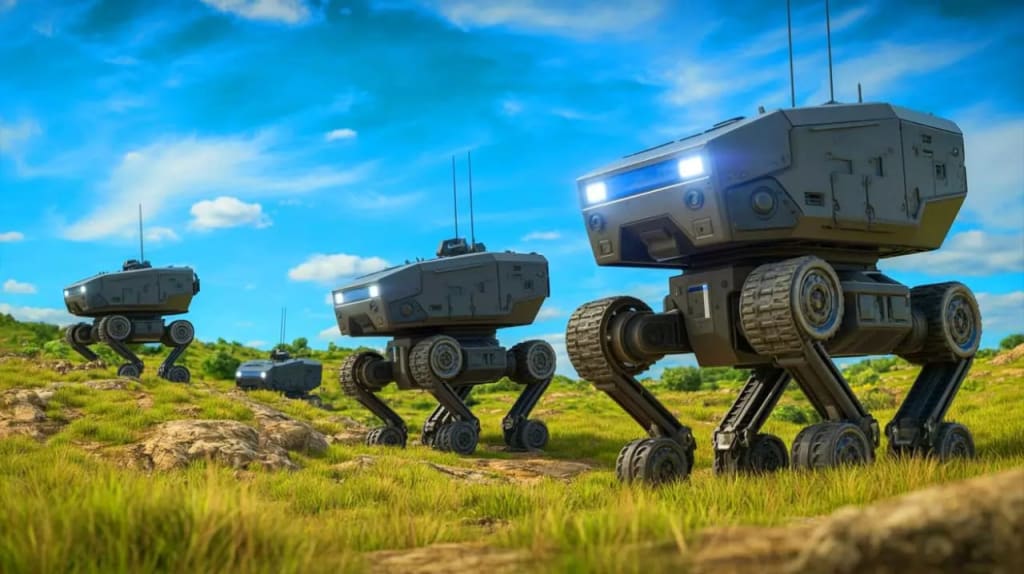
France Overtakes U.S. in War Tech: Battle Robots to Hit the Front Lines by 2027 as America Lags Behind in Military AI Race
In a bold leap into the future of warfare, France has announced its ambitious plan to deploy combat-ready battle robots to the front lines by 2027 — a move that puts the nation ahead of the United States in the race for military artificial intelligence (AI) supremacy. The announcement, backed by high-level military leadership, signals a transformative shift in defense strategy, where autonomous systems are no longer science fiction but an impending reality.
France’s Vision: Robotic Forces by 2040
The French Army has been intensively testing AI-powered combat systems under its program called CoHoMa (Collaboration Homme-Machine). This initiative focuses on integrating manned and unmanned systems to enhance battlefield performance. According to General Bruno Baratz, the head of the French Army’s future combat programs, France could see robotic systems fighting alongside human soldiers as early as 2027, with the long-term vision of fielding a fully robotic army by 2040.
In recent military exercises, robot units equipped with advanced mobility — including wheeled, legged, and tracked configurations — were seen maneuvering through complex terrain, engaging in reconnaissance missions, detecting enemy positions, and even simulating holding ground under fire. These drills, held in simulated battlefield environments, demonstrate how far the technology has progressed in just a few years.
General Tony Maffeis, the head of France’s Army Technical Section, emphasized that while fully autonomous combat systems are still under development, current technologies are already proving their worth in roles like explosive ordnance disposal, surveillance, and logistics. He noted that France is aggressively investing in solving remaining challenges in AI decision-making, coordination with human troops, and real-time battlefield data processing.
The U.S.: A More Cautious Approach
In contrast, the United States — long viewed as the global leader in defense technology — appears to be trailing behind in integrating AI-powered autonomous ground forces into its military doctrine. While the U.S. continues to lead in drone warfare and remote-controlled weapon systems, its transition to fully autonomous battlefield robots has been more measured.
Part of the delay is attributed to ethical and legal debates surrounding autonomous weapons systems, especially those capable of using lethal force without human intervention. U.S. policymakers and Pentagon officials remain divided on how quickly such systems should be deployed and under what circumstances AI can be trusted to make life-or-death decisions on the battlefield.
Furthermore, the U.S. Department of Defense’s Joint Artificial Intelligence Center (JAIC) has focused more on enhancing logistics, intelligence gathering, and decision-making tools rather than front-line combat roles. This has led critics to suggest that while the U.S. is technologically capable, it may be strategically hesitant.
Implications for Global Military Power
France’s robotic military initiative is not just about innovation — it’s a direct statement about shifting balances in global military power. By leading the charge into AI-driven warfare, France could redefine European and NATO defense strategies and inspire other countries to follow suit.
This also raises concerns about an AI arms race. If nations begin rapidly developing autonomous weapons without clear international regulations, the consequences could be devastating. Human rights groups and international watchdogs have repeatedly called for restrictions or outright bans on “killer robots,” but major powers remain divided on the issue.
Ethical Concerns and Future Warfare
The ethical implications of AI in warfare are profound. Who is responsible if a robot makes the wrong decision and kills civilians? Can AI distinguish friend from foe in a chaotic battlefield environment? These questions remain unanswered, even as the technology marches forward.
France has acknowledged these concerns but argues that its systems will maintain "human-in-the-loop" control — meaning that humans will always be responsible for approving lethal actions. However, critics warn that as AI becomes more capable and the battlefield more complex, this line may blur.
Conclusion
France’s pledge to deploy combat robots by 2027 marks a turning point in modern warfare. By prioritizing military AI, the nation has effectively taken the lead in a new global arms race — one where silicon, not steel, may determine supremacy.
Meanwhile, the United States must reassess its strategy if it hopes to maintain its technological and military dominance. The future of warfare is arriving faster than expected, and the question remains: will the world be ready — both technologically and morally — for what comes next?
About the Creator
Adnan Rasheed
Author & Creator | Writing News , Science Fiction, and Worldwide Update| Digital Product Designer | Sharing life-changing strategies for success.
Keep reading
More stories from Adnan Rasheed and writers in Futurism and other communities.
Elon Musk Shares 'Real-Time' Dance Video Of Tesla's Optimus Robot
Elon Musk Shares 'Real-Time' Dance Video Of Tesla's Optimus Robot In a move that once again captured global attention, tech visionary Elon Musk unveiled a remarkable video on May 13, 2025, showcasing Tesla’s humanoid robot, Optimus, performing a real-time dance routine. The short but captivating clip, posted on Musk's X (formerly Twitter) account, stunned viewers with the robot's impressive balance, fluid movements, and coordination—raising the bar for robotics worldwide.
By Adnan Rasheed8 months ago in Futurism
About Binding Prometheus
I want to start actively advocating on behalf of my own work, and the most valuable part of my canon is, without a doubt, Binding Prometheus, the play I have been working on since 2019 and only finished in 2023 as part of my MA. The play itself is an amalgamation of a million different inspirations. On one end, it evokes the Ancient Greek myth-play, deriving its own title from the earliest extant work of Western drama we have, Aeschylus’s Prometheus Bound. On the other end, it borrows significantly from the sci-fi bulwarks from over the years, namely Mary Shelley’s Frankenstein and Karel Capek’s Rossum’s Universal Robots. The play could be an episode of Black Mirror, I fear. I don’t know. I’ve only ever seen one episode of Black Mirror.
By Steven Christopher McKnight19 days ago in Futurism
Saudi Arabia Freeze-Drying Equipment Market: Pharmaceutical Demand, Food Processing & Growth
According to IMARC Group's latest research publication, Saudi Arabia freeze-drying equipment market size reached USD 22.0 Million in 2024. The market is projected to reach USD 40.1 Million by 2033, exhibiting a growth rate of 6.2% during 2025-2033.
By Suhaira Yusufabout 23 hours ago in Futurism
A Dart at Dusk
Seconds ago, the sullen sun set on the two of us… my exuberant furry companion and me. A fresh breeze embraces us, delivering welcome relief from the day’s oppressive heat. His typical stumbling and staggering along — apace with a sloth — has turned into trip-trapping, high-stepping, almost skipping along.
By Angie the Archivist 📚🪶6 days ago in Petlife



Comments
There are no comments for this story
Be the first to respond and start the conversation.