
Exploring the Vast Frontiers of Space
A Gateway to Infinite Possibilities
Introduction:
The realm of space has always captivated human imagination, serving as a gateway to endless possibilities and mysteries waiting to be unraveled. Over the years, humanity's exploration of space has expanded our understanding of the universe, pushed the boundaries of scientific knowledge, and paved the way for groundbreaking technological advancements. In this article, we delve into the exciting world of space exploration, its significance, and the incredible achievements we have made thus far.
The Significance of Space Exploration:
Space exploration holds immense significance on multiple fronts. First and foremost, it expands our knowledge of the universe and our place within it. Through telescopes, satellites, and space probes, scientists have unraveled cosmic phenomena, discovered exoplanets, and unveiled the origins of celestial bodies. Each discovery brings us closer to understanding the origins of life, the nature of the cosmos, and the possibility of extraterrestrial life.
Furthermore, space exploration fuels technological innovation. Countless inventions and advancements, such as GPS systems, satellite communications, and lightweight materials, have emerged as byproducts of space research. These breakthroughs have revolutionized various sectors, including telecommunications, weather forecasting, and environmental monitoring. Additionally, the quest for space exploration has driven advancements in robotics, artificial intelligence, and propulsion systems, pushing the boundaries of human capability and fostering scientific progress.
Space Exploration Milestones:
Humanity's journey into space has been marked by remarkable milestones that have forever changed our understanding of the universe. Here are some notable achievements:
1. The Apollo Moon Landings: The Apollo program, spearheaded by NASA, resulted in six successful manned missions to the Moon between 1969 and 1972. Astronauts Neil Armstrong and Buzz Aldrin became the first humans to set foot on the lunar surface during the historic Apollo 11 mission.
2. Hubble Space Telescope: Launched in 1990, the Hubble Space Telescope has provided breathtaking images of distant galaxies, stars, and nebulae. Its observations have expanded our understanding of the universe, including the age, size, and expansion rate of the cosmos.
3. Mars Exploration Rovers: NASA's Spirit and Opportunity rovers, followed by the Curiosity rover, have been instrumental in studying the geology and potential habitability of Mars. These robotic explorers have provided valuable data about the Red Planet's history and potential for sustaining life.
4. International Space Station (ISS): A joint venture involving multiple countries, the ISS serves as a remarkable testament to international cooperation and scientific research in space. It has been continuously occupied since November 2000, serving as a laboratory for various experiments and research.
The Future of Space Exploration:
Looking ahead, space exploration holds even more promise and excitement. NASA's Artemis program aims to return humans to the Moon and establish a sustainable lunar presence by 2024. Private space companies like SpaceX, Blue Origin, and Virgin Galactic are driving the development of reusable rockets and planning commercial space tourism, enabling more people to experience the wonders of space.
Advancements in space telescopes and deep space probes, such as the James Webb Space Telescope and the Europa Clipper mission, will enhance our understanding of distant galaxies and the potential for life beyond Earth. Moreover, ongoing research focuses on developing technologies for crewed missions to Mars, with the ultimate goal of establishing a human presence on the Red Planet.
Conclusion:
Space exploration is a testament to humanity's insatiable curiosity and unwavering desire to explore the unknown. Through our collective efforts, we have made significant strides in unraveling the mysteries of the universe, pushing the boundaries of scientific knowledge, and transforming technology for the better. As we continue to venture into the cosmos, space exploration will undoubtedly unlock new frontiers, shape our future
About the Creator
Keep reading
More stories from Matus Hrusovsky and writers in Futurism and other communities.
The Power of Growth and Learning
Introduction: In today's fast-paced and ever-evolving world, the ability to grow and learn has become more crucial than ever before. Whether in our personal or professional lives, embracing a mindset of continuous growth and learning can lead to tremendous personal development, expanded opportunities, and a sense of fulfillment. This article explores the transformative power of growth and learning, highlighting their importance and offering practical strategies to unlock your full potential.
By Matus Hrusovsky3 years ago in Journal
Alzheimer’s Drugs Market Outlook: Neurodegenerative Therapy Innovation and Growth Opportunities
According to IMARC Group's latest research publication, The global Alzheimer’s drugs market size reached USD 8.1 Billion in 2024. Looking forward, IMARC Group expects the market to reach USD 12.9 Billion by 2033, exhibiting a growth rate (CAGR) of 5.07% during 2025-2033.
By James Whitman5 days ago in Futurism
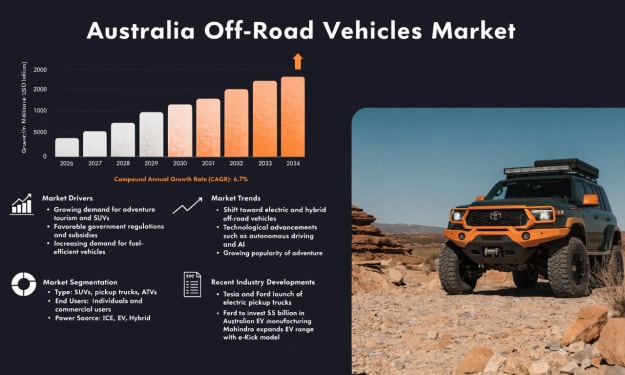
Australia Off-Road Vehicles Market: Adventure Tourism, Electric Models & Rural Utility Demand
According to IMARC Group, the Australia off-road vehicles market reached a value of USD 490.28 Million in 2024 and is projected to reach USD 861.59 Million by 2033, growing at a compound annual growth rate (CAGR) of 5.80% during 2025–2033. The market is experiencing steady growth as recreational, agricultural and commercial users increasingly adopt off-road vehicles for both adventure and practical applications. The expansion of adventure tourism across Australia’s remote landscapes is driving demand for rugged 4WD vehicles, all-terrain vehicles (ATVs) and utility task vehicles (UTVs) capable of navigating challenging terrain. At the same time, rising adoption of electric off-road vehicles supported by environmental regulations and battery technology advancements is transforming the industry. Additionally, growing demand from agriculture, mining and rural operations is strengthening the market as these sectors rely on off-road vehicles for transportation, equipment handling and operational efficiency.
By Shrestha Roy5 days ago in Futurism


Comments
There are no comments for this story
Be the first to respond and start the conversation.