
How Solar Winds Are Reshaping the Surface of Mercury
Space

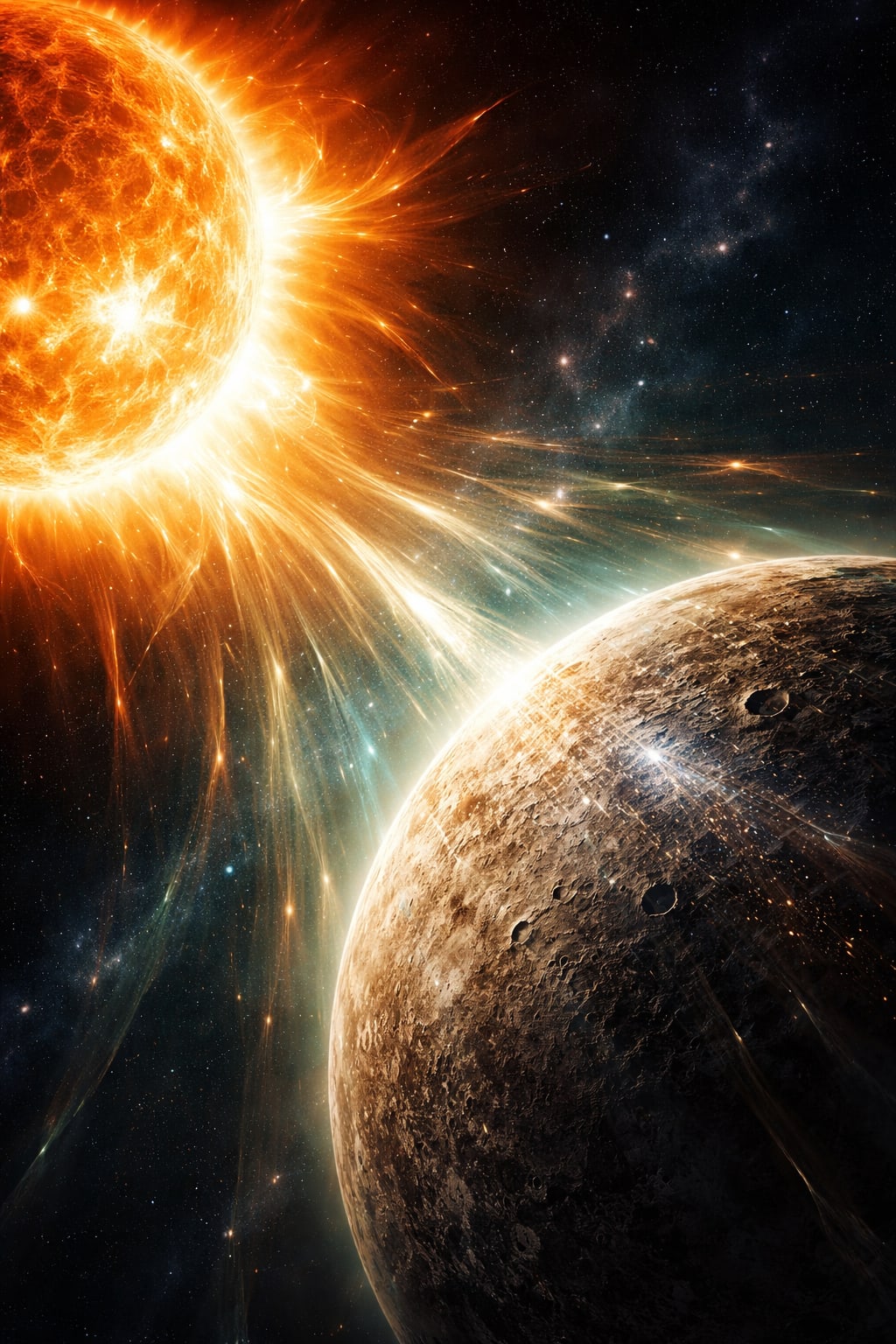
Mercury, the innermost planet of our Solar System, is often described as a silent, lifeless world — a scorched sphere of rock orbiting perilously close to the Sun. For a long time, scientists assumed that its surface was largely static, shaped mainly by ancient volcanic activity and impacts billions of years ago. Recent space missions, however, have revealed a far more dynamic reality. Mercury’s surface is constantly changing, sculpted by one of the most powerful and relentless forces in the Solar System: the solar wind.
What Is the Solar Wind?
The solar wind is a continuous stream of charged particles — primarily protons, electrons, and helium ions — ejected from the Sun’s outer atmosphere. These particles travel at speeds of hundreds of kilometers per second, carrying enormous energy across interplanetary space.
Earth is largely protected from this radiation by its strong magnetic field and dense atmosphere. Mercury, on the other hand, has neither. Its magnetic field is extremely weak — about one percent the strength of Earth’s — and it lacks a true atmosphere. Instead, Mercury is surrounded by an ultra-thin exosphere, composed of individual atoms that are easily lost to space. This makes the planet exceptionally vulnerable to direct solar bombardment.
A Planet Under Constant Assault
Because Mercury is so close to the Sun, it experiences solar wind pressure several times stronger than Earth does. Charged particles slam directly into the planet’s rocky surface, triggering a process known as space weathering. Over millions and billions of years, this steady assault has dramatically altered the planet’s appearance, chemistry, and structure.
One of the most important effects of solar wind exposure is ion sputtering. When high-energy particles strike Mercury’s surface, they knock atoms out of the minerals in the rocks. Elements such as sodium, potassium, and calcium are particularly vulnerable. Once freed, these atoms rise above the surface and temporarily populate Mercury’s exosphere before being swept away into space.
This phenomenon has been directly observed by spacecraft such as NASA’s MESSENGER mission. Spectrometers detected clouds of sodium and potassium around the planet, confirming that the solar wind is actively stripping material from Mercury’s crust even today.
Darkening the Planet’s Surface
Solar wind interactions do not just remove material — they also transform what remains. Over time, repeated particle impacts damage the crystal structure of surface minerals. This process leads to the formation of tiny particles of metallic iron, known as nanophase iron, embedded within the soil.
These microscopic iron particles absorb sunlight, causing Mercury’s surface to appear darker and less reflective than expected. This helps explain a long-standing mystery: despite Mercury’s unusually high metal content, it reflects less light than the Moon. The planet’s darkened appearance is essentially a visual record of billions of years of solar wind exposure.
Magnetic Weak Spots and Localized Erosion
Although Mercury does possess a magnetic field, it is highly irregular. In some regions, magnetic field lines are open, creating what scientists call “magnetic cusps” or windows. Through these openings, solar wind particles can stream directly onto the surface with little resistance.
These areas experience intensified erosion and enhanced chemical alteration. Measurements show that exospheric density is often higher above these magnetic weak spots, indicating increased sputtering activity. As a result, Mercury’s surface is not altered uniformly — it evolves in a patchwork pattern, with some regions weathering much faster than others.
Long-Term Loss of Planetary Material
Over geological timescales, the cumulative effect of solar wind erosion is substantial. While individual atoms may seem insignificant, the continuous loss over billions of years has removed vast quantities of material from Mercury’s surface. Scientists believe this process has contributed to the planet’s extreme dryness and its depletion of volatile elements.
Unlike Earth, Mercury cannot replenish its surface through atmospheric cycling or plate tectonics. Once material is lost, it is gone forever. This makes solar wind erosion a key driver of the planet’s long-term evolution.
A Natural Laboratory for Planetary Science
Mercury’s harsh environment makes it an invaluable natural laboratory. By studying how solar winds affect Mercury, scientists gain insights into the evolution of other airless bodies, such as the Moon, asteroids, and the moons of Jupiter and Saturn.
More importantly, these findings have implications far beyond our Solar System. Many exoplanets orbit extremely close to their parent stars, especially around red dwarfs. Like Mercury, these worlds may be exposed to intense stellar winds capable of stripping atmospheres and reshaping surfaces. Understanding Mercury helps scientists assess whether such planets could retain atmospheres — and potentially support life.
A Dynamic World in a Hostile Environment
Far from being a dead and unchanged rock, Mercury is a planet in constant interaction with its star. Solar winds continuously erode, darken, and chemically transform its surface, rewriting its geological story day by day. Each particle impact is a tiny event, but together they represent one of the most powerful forces shaping Mercury’s destiny.
In studying this battered world, scientists are not just uncovering the secrets of Mercury — they are learning how stars influence planets across the galaxy. The smallest planet, it turns out, has some of the biggest lessons to teach about the relationship between stars and the worlds that orbit them.
About the Creator
Keep reading
More stories from Holianyk Ihor and writers in Futurism and other communities.
Exploring New Frontiers: Innovative Methods to Find Exoplanets Around Red Dwarfs
In the quest to understand our place in the universe, one of the most exciting frontiers is the search for planets beyond our solar system. Among the most promising targets are red dwarf stars, also known as M-dwarfs.
By Holianyk Ihor2 months ago in Futurism
The Last Generation to Grow Up Without AI
For most of human history, technological revolutions arrived slowly. The printing press, electricity, the internet—each reshaped society over decades. But the rise of artificial intelligence is happening far faster. In fact, there’s a strong argument that Generation Z may be the last generation to grow up without AI fully integrated into childhood.
By Carmen Sinataabout 22 hours ago in Futurism
Seeing Is No Longer Believing
It started with a frantic FaceTime call at 2:00 AM. A mother in Arizona picked up her phone to see her teenage daughter crying, surrounded by dark shadows. The girl begged for help, saying she had been in an accident and the other driver was threatening her. The mother saw her daughter’s face—the specific way her lip quivers when she’s terrified—and heard the exact pitch of her scream. She was ready to pay any ransom, to do anything.
By Alex Sterling 3 days ago in Futurism


Comments
There are no comments for this story
Be the first to respond and start the conversation.