
Examining AI's Potential in Predictive Analytics, Personalized Therapy, and Diagnostics in Psychology
The Future of Mental Health Care in the Age of Artificial Intelligence
Artificial Intelligence (AI) is no longer just a buzzword; it is transforming industries, and one of the most promising areas where AI is making an impact is in the field of psychology. From predictive analytics to personalized therapy and diagnostics, AI is revolutionizing how we understand and treat mental health. In recent years, the rise of mental health awareness, coupled with technological advancements, has opened the door for AI to address long-standing challenges in psychological care. With mental health crises on the rise globally, the question of how AI can improve patient outcomes, increase accessibility, and enhance the accuracy of diagnoses is more pertinent than ever.
AI in Predictive Analytics: A Glimpse Into the Future of Mental Health Trends
One of the most exciting developments of AI in psychology is its ability to perform predictive analytics, which involves using data to forecast mental health trends and potential risks before they occur. Predictive analytics can be a game-changer in understanding psychological conditions like depression, anxiety, and even suicide risk. By analyzing vast amounts of data, including social media activity, speech patterns, genetic data, and even biometric signals, AI systems can identify early warning signs that are often difficult for humans to detect.
Take, for instance, the groundbreaking work done by AI-driven platforms like Woebot Health. Woebot, a mental health chatbot, uses AI to interact with users and monitor their emotional well-being. Through text conversations, Woebot can analyze patterns in the user’s language, tone, and engagement to predict whether someone is at risk of developing depression or experiencing a mental health crisis. This form of predictive analytics, although still in its early stages, has the potential to offer real-time interventions, allowing individuals to receive the care they need before their mental health deteriorates further.
As we continue to move forward in the digital age, AI’s capacity to predict trends based on behavior and environmental factors will only grow stronger. This could fundamentally change how society views mental health—transitioning from reactive care to proactive, preventive approaches. Given the stressors brought on by the COVID-19 pandemic and the rise in digital communication, it’s no surprise that AI-driven platforms are gaining traction as a means to identify and address mental health concerns early.
Personalized Therapy: Customizing Treatment with AI
Another area where AI is poised to have a massive impact is in personalized therapy. One-size-fits-all approaches have often been a limitation in mental health care, as each individual’s experiences, needs, and coping mechanisms are unique. AI is now providing therapists with tools to tailor interventions more effectively, allowing for treatment plans that are more suited to individual patients.
Consider the innovative work of AI-powered platforms like Quartet Health and Clara. These platforms leverage AI to match patients with therapists who are best suited to address their specific needs, preferences, and treatment goals. By analyzing a range of factors, from past therapeutic outcomes to personality traits, AI can help create a highly personalized approach to therapy. For example, AI can suggest cognitive behavioral therapy (CBT) techniques that have been most successful for a particular person’s symptoms, based on their psychological profile and therapy history.
Moreover, AI-powered apps like BetterHelp and Talkspace are revolutionizing how therapy is delivered by connecting people with licensed therapists remotely. This accessibility is crucial, especially as the global mental health crisis worsens, with the World Health Organization (WHO) reporting a 25% increase in anxiety and depression during the COVID-19 pandemic. In this context, AI is helping make therapy more accessible and tailored, enabling individuals to get the help they need from the comfort of their own homes. Personalized therapy isn’t just about comfort—it’s about efficiency and better outcomes for patients.
AI in Diagnostics: Enhancing the Accuracy of Mental Health Assessments
Another groundbreaking use of AI in psychology is its potential to enhance diagnostics. Traditional mental health diagnoses often rely on subjective assessments, patient history, and clinician judgment. While these methods are essential, they can also be prone to bias and inaccuracies. AI, with its ability to analyze large datasets, offers the potential to enhance diagnostic precision.
For example, AI-driven tools are now being developed to analyze brain scans and detect early markers of mental health disorders such as schizophrenia, bipolar disorder, and even Alzheimer’s disease. AI algorithms can process vast amounts of data from neuroimaging and predict the likelihood of mental health conditions, even before full-blown symptoms emerge. A recent study published in Nature Medicine demonstrated how AI could predict schizophrenia years before a diagnosis was made using MRI scans and other clinical data.
In addition to neuroimaging, AI is also making strides in analyzing speech patterns to identify signs of mental health conditions. Researchers at MIT have developed an AI system that analyzes subtle changes in speech, such as tone, pace, and volume, to detect depression and other mood disorders. This technology could potentially revolutionize diagnostics, making it faster, more accurate, and accessible to a wider range of people.
Ethical Considerations and Challenges
Despite the potential, there are significant ethical considerations surrounding AI’s role in mental health care. One major concern is data privacy. Mental health is an inherently sensitive issue, and AI systems often require access to highly personal information. As AI tools become more integrated into psychology, ensuring that data privacy is maintained and that patient confidentiality is safeguarded is paramount. Furthermore, there’s the risk of over-reliance on AI, where human clinicians might begin to defer too much to technology, which may not always fully understand the nuances of a patient’s unique experience.
Another challenge lies in algorithmic bias. If AI systems are trained on biased data, they could perpetuate existing inequalities in mental health care, especially for marginalized communities. Ensuring that AI systems are built with diversity in mind and are regularly updated to reflect evolving understandings of mental health is crucial to avoid exacerbating disparities.
Conclusion
AI’s potential in predictive analytics, personalized therapy, and diagnostics within psychology is nothing short of transformative. As the global mental health crisis continues to grow, AI offers a promising avenue for improving care delivery, enhancing diagnostic accuracy, and providing personalized, proactive treatment. However, it’s essential to remain mindful of the ethical challenges that accompany these advancements, particularly around privacy, bias, and the need for human oversight. The future of mental health care will undoubtedly be shaped by AI, but it is up to us to ensure that its integration serves to enhance, rather than replace, the deeply human connection at the heart of psychological healing.
About the Creator
Joysi
Writing with my feathers..
Digital Language Learning Market to Surpass USD 108.35 Billion by 2034: Accelerating AI-Powered Learning Platforms
The global digital language learning market is experiencing strong expansion as mobile applications, online education platforms, and artificial intelligence driven tutoring systems transform language education. The market is projected to grow from USD 22.16 billion in 2024 to approximately USD 108.35 billion by 2034, reflecting a strong 17.2% CAGR during the forecast period. Increasing globalization, international education mobility, and digital learning adoption have significantly accelerated demand for online language training solutions.
By Roberto Crum5 days ago in Futurism
Magnet Market Outlook: Industrial Machinery Demand, Automation Growth & Industry Forecast to 2025
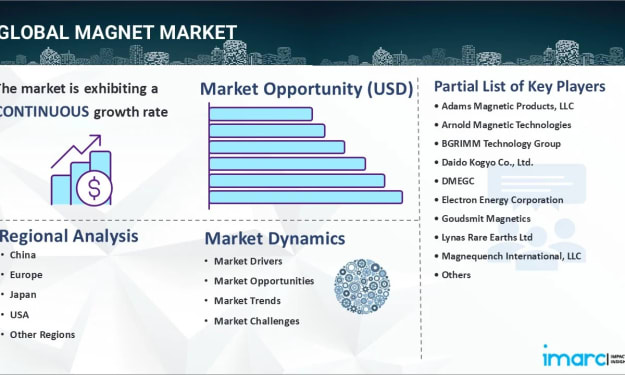
The global magnet industry is undergoing a significant transformation, evolving from a traditional component sector into a strategic pillar of the modern green economy. According to IMARC Group’s latest data, the global magnet market size reached USD 41.75 Billion in 2024. Looking forward, IMARC Group estimates the market to reach USD 58.7 Billion by 2033, exhibiting a CAGR of 3.82% during 2025-2033.
By Andrew Sullivan6 days ago in Futurism
Guard Your Battery
Why are some people so attractive just by standing there? It’s not because they are "likable," but because they don’t need everyone to like them. I realized later that truly charismatic people allow themselves to be criticized, but they never criticize themselves. They never try to please the world; instead, the world stops to watch them.
By Emily Chan - Life and love sharing5 days ago in Poets



Comments
There are no comments for this story
Be the first to respond and start the conversation.