
Evidence for a “Fifth Dimension”: Cosmology Hints at New Laws of Physics
Space

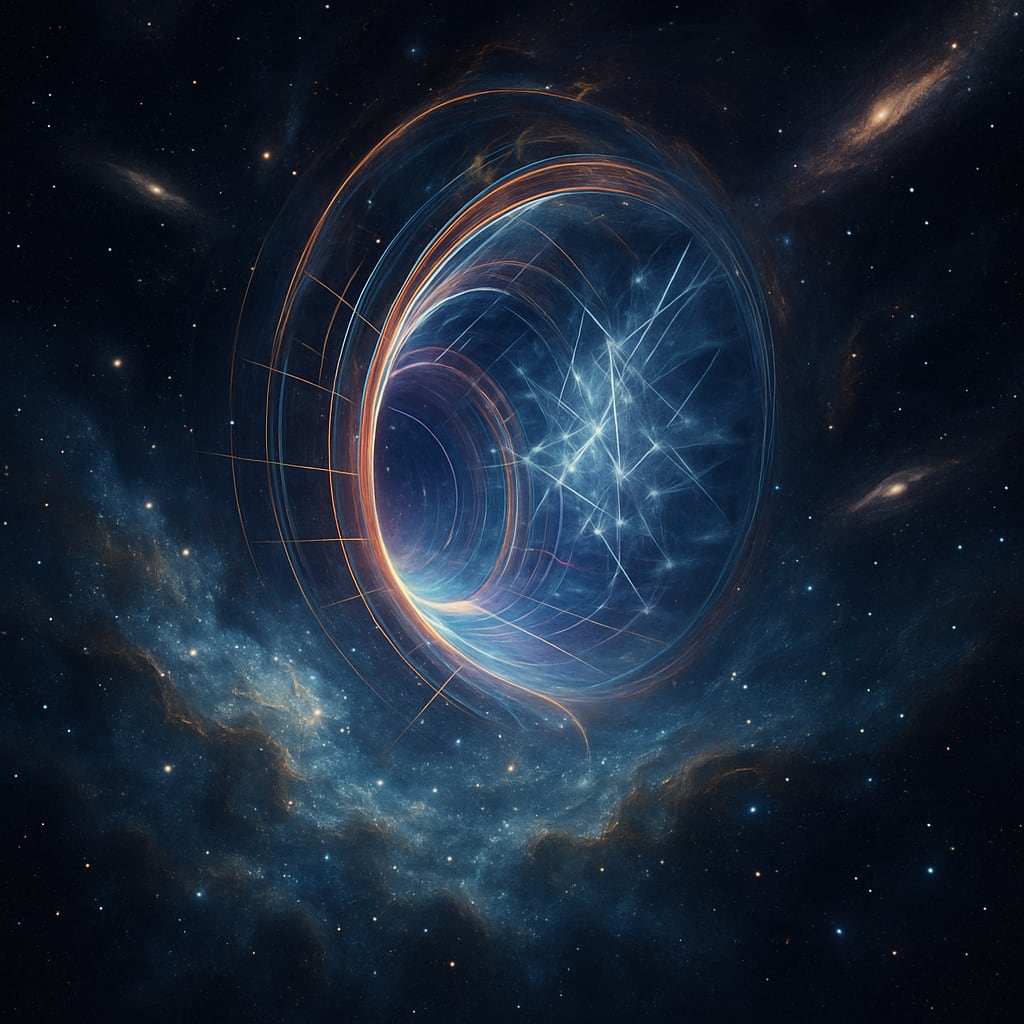
Modern science often feels like it is edging closer to science fiction. From black holes that swallow light to galaxies drifting apart at ever-increasing speeds, the universe never ceases to surprise us. Yet among the most intriguing ideas gaining attention today is the possibility that our cosmos may not be confined to the four familiar dimensions—length, width, height, and time. Instead, new cosmological evidence hints at the existence of a fifth dimension, an unseen layer of reality that could radically reshape our understanding of physics.
From Einstein to Hidden Dimensions
Albert Einstein revolutionized physics in the early 20th century with his theory of general relativity. He showed that gravity is not a force in the traditional sense but rather the curvature of four-dimensional spacetime. This elegant framework explained planetary orbits, the bending of starlight, and even the expansion of the universe. For a long time, it seemed sufficient.
But in the 1920s, German mathematician Theodor Kaluza and Swedish physicist Oskar Klein proposed a bold extension. What if the universe has a fifth dimension, curled up so tightly that we cannot perceive it directly? They suggested that this hidden dimension could unify gravity with electromagnetism—two seemingly separate forces—into a single elegant theory. At the time, the idea was too speculative to gain traction. Today, however, new astronomical data are breathing life into this century-old hypothesis.
Cosmic Clues That Something Is Missing
Modern cosmology is full of puzzles that standard four-dimensional physics struggles to explain.
1. Dark Matter and Dark Energy
We now know that ordinary matter—the atoms that make up stars, planets, and people—accounts for less than 5% of the universe. The rest is made of dark matter and dark energy, mysterious entities we cannot see directly but which dominate cosmic behavior. Dark matter acts like invisible glue holding galaxies together, while dark energy drives the accelerating expansion of space. But what are they? Some researchers argue that these “dark” components could actually be manifestations of interactions leaking from higher dimensions.
2. The Hubble Tension
Astronomers use different methods to measure how fast the universe is expanding. Yet puzzlingly, these methods yield conflicting results. This discrepancy, known as the “Hubble tension,” has sparked debates worldwide. One possible explanation? Our current models are incomplete, and a hidden dimension might subtly influence cosmic expansion.
3. Gravitational Anomalies
In small-scale experiments, gravity sometimes behaves oddly. The force seems weaker than expected at very tiny distances, raising the possibility that gravity is “spilling over” into other dimensions. This could explain why gravity is billions of times weaker than the electromagnetic or nuclear forces—it might be diluted across more than four dimensions of reality.
What Could the Fifth Dimension Contain?
If such a dimension exists, what would it mean for us? Scientists have floated several possibilities:
- New particles: Just as photons carry light and gluons carry the strong nuclear force, the fifth dimension might host unknown particles that interact with our universe only indirectly. These could be candidates for dark matter.
- Hidden pathways: The extra dimension could provide shortcuts or “portals” through spacetime, a concept often exploited in science fiction but now considered at least theoretically plausible.
- A unified theory of forces: The holy grail of physics is a “theory of everything,” a single framework that explains all forces of nature. A fifth dimension could provide the missing link to connect gravity, electromagnetism, and quantum mechanics.
Searching for Proof
The big question remains: how do we prove it? Right now, we don’t have a telescope that can simply “look” into the fifth dimension. But researchers are finding clever ways to search for hints.
The Euclid telescope launched by the European Space Agency is mapping billions of galaxies, looking for patterns in how matter clusters under the influence of dark energy. Anomalies in these patterns might signal hidden dimensions.
The James Webb Space Telescope is peering deeper into cosmic history than ever before. If galaxies behaved differently in the early universe, it could be a clue that extra dimensions were more influential then.
Gravitational wave detectors like LIGO and Virgo may also reveal evidence. If waves in spacetime lose energy in strange ways, it might mean they are bleeding into dimensions beyond our own.
A Glimpse Into the Future
Right now, the fifth dimension is still a hypothesis. But history reminds us that many ideas once dismissed as fantasy—atoms, relativity, black holes—eventually became accepted scientific reality. Should we discover solid evidence of hidden dimensions, it would trigger a revolution in physics as profound as Einstein’s relativity or quantum mechanics.
Beyond the thrill of discovery, the practical implications could be staggering. Understanding higher dimensions might open the door to new technologies: exotic energy sources, advanced propulsion systems, or even ways of manipulating spacetime itself. While this sounds like science fiction today, tomorrow it could be engineering.
Conclusion
The idea of a fifth dimension remains tantalizingly out of reach, yet cosmology keeps offering hints that our universe is more complex than we ever imagined. From unexplained cosmic acceleration to anomalies in gravity, the evidence is mounting that the four dimensions we know are just part of a larger picture.
If these theories are confirmed, humanity may be standing at the threshold of a new era of physics. The discovery of a fifth dimension would not just reshape textbooks—it would change our perception of reality itself.
About the Creator
Keep reading
More stories from Holianyk Ihor and writers in Futurism and other communities.
A Supermassive Black Hole Cast Out of Its Galaxy: The Tale of a Cosmic Wanderer
Imagine a giant of the universe — a supermassive black hole with millions of times the mass of our Sun — being expelled from its home galaxy and cast adrift into intergalactic space. It sounds like the plot of a science fiction novel, but astronomers have recently discovered exactly this phenomenon. A “wandering” supermassive black hole has been detected, racing through the cosmos and leaving behind a luminous trail of newborn stars.
By Holianyk Ihor4 months ago in Futurism
About Binding Prometheus
I want to start actively advocating on behalf of my own work, and the most valuable part of my canon is, without a doubt, Binding Prometheus, the play I have been working on since 2019 and only finished in 2023 as part of my MA. The play itself is an amalgamation of a million different inspirations. On one end, it evokes the Ancient Greek myth-play, deriving its own title from the earliest extant work of Western drama we have, Aeschylus’s Prometheus Bound. On the other end, it borrows significantly from the sci-fi bulwarks from over the years, namely Mary Shelley’s Frankenstein and Karel Capek’s Rossum’s Universal Robots. The play could be an episode of Black Mirror, I fear. I don’t know. I’ve only ever seen one episode of Black Mirror.
By Steven Christopher McKnight16 days ago in Futurism
Japan LED Modular Display Market Size & Forecast 2025–2033
Japan LED Modular Display Market at a Glance The Japan LED Modular Display market is anticipated to grow to US$ 1,009.54 million by 2033, rising from US$ 380.54 million in 2024, registering a robust CAGR of 11.45% during 2025–2033. This growth is driven by the increasing demand for high-resolution digital signage across retail, transportation, entertainment, and public infrastructure, combined with the adoption of energy-efficient, customizable display systems for Japan’s expanding smart city initiatives.
By Aaina Oberoia day ago in Futurism
Miss Persephone's Manual to a Seemingly Ordinary Life
Miss Persephone was found at the dining table, her blue eyes swollen, her tears arriving and retreating like the tides of the ocean. Earlier that day, her family had visited her in the retirement home where she had lived for eight years. It was her eightieth birthday.
By Imola Tóth2 days ago in Fiction


Comments
There are no comments for this story
Be the first to respond and start the conversation.