
A Supermassive Black Hole Cast Out of Its Galaxy: The Tale of a Cosmic Wanderer
Space

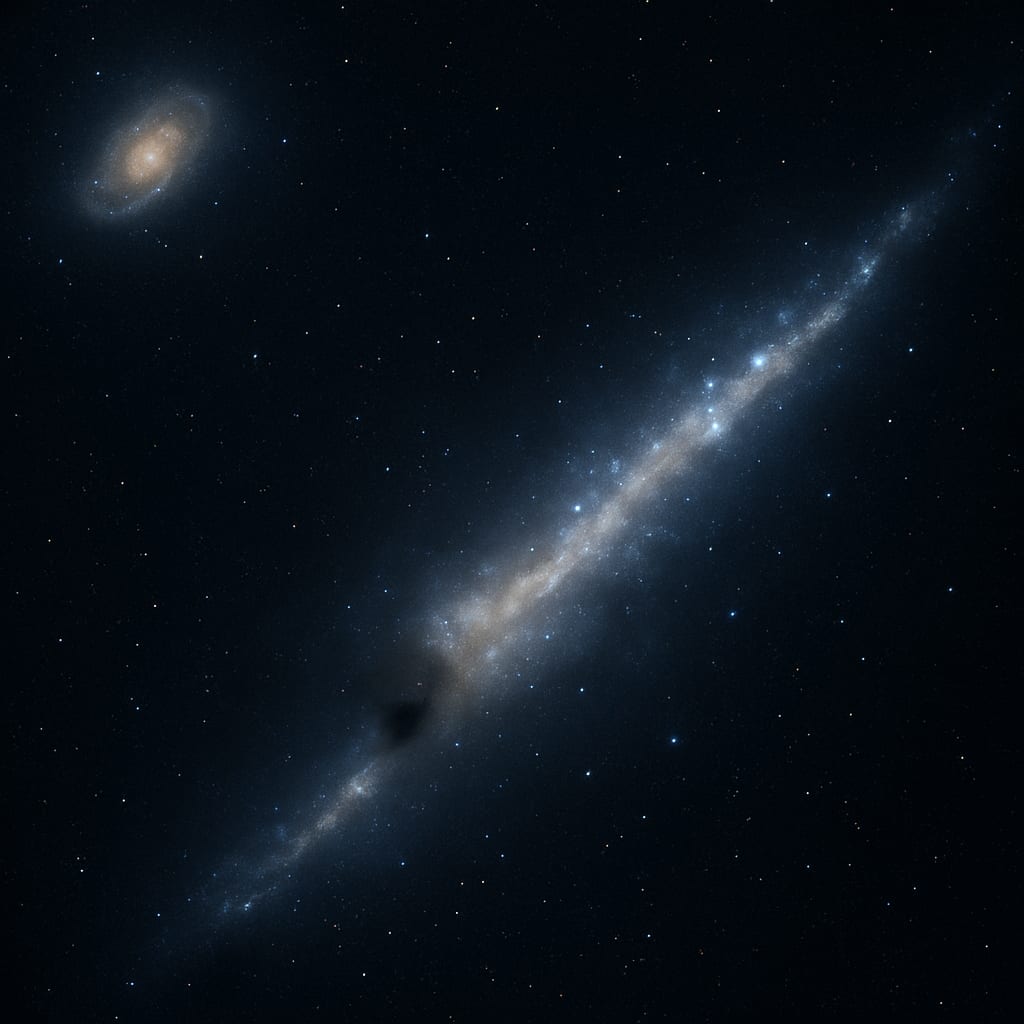
Imagine a giant of the universe — a supermassive black hole with millions of times the mass of our Sun — being expelled from its home galaxy and cast adrift into intergalactic space. It sounds like the plot of a science fiction novel, but astronomers have recently discovered exactly this phenomenon. A “wandering” supermassive black hole has been detected, racing through the cosmos and leaving behind a luminous trail of newborn stars.
This extraordinary discovery challenges our traditional view of galaxies as stable, self-contained systems. It suggests that the universe is far more dynamic, chaotic, and surprising than we ever imagined.
How Does a Black Hole Lose Its Home?
Supermassive black holes typically sit at the very heart of galaxies. They act almost like anchors, binding billions of stars together with their immense gravitational pull. For one to be ejected is both astonishing and puzzling.
Astronomers propose several possible scenarios that could explain such a dramatic exile:
- Galactic collisions. When two galaxies merge, their central black holes spiral toward each other in a gravitational dance. In some cases, the chaotic encounter can fling one of them outward at incredible speeds.
- Gravitational wave recoil. When two black holes merge, they release powerful ripples in space-time known as gravitational waves. If those waves are emitted unevenly, the merged black hole can be given a “kick” strong enough to eject it from the galaxy entirely.
- The three-body problem. If three supermassive black holes interact — for example, during multiple galactic mergers — the gravitational tug-of-war often ends with one being launched away, while the other two remain behind.
Any of these scenarios could explain the rogue giant that scientists have recently identified.
The Cosmic Trail: A Tail of Stars
At first glance, black holes are invisible. Their gravity traps light itself, making them notoriously difficult to detect. Yet in this case, astronomers spotted something remarkable: a glowing tail stretching across tens of thousands of light-years.
This trail isn’t made of gas or dust alone. It’s composed of young stars — a stellar nursery ignited in the wake of the black hole. As the runaway giant plows through intergalactic space, it compresses the clouds of gas it encounters, triggering bursts of star formation. The result is a brilliant ribbon of starlight, much like the shimmering tail of a comet, but on a galactic scale.
One could imagine the scene as a ship cutting through cosmic waters, leaving glowing wakes of light in its path. This trail becomes both the black hole’s fingerprint and the evidence of its dramatic journey.
Should We Worry?
Fortunately, this celestial vagabond lies billions of light-years away from Earth. Even moving at blistering speeds, it would take longer than the current age of the universe to ever reach our galaxy. In other words, humanity is safe.
But the discovery forces us to rethink what we know. If one such rogue black hole exists, how many more are silently wandering the universe? Could there be entire populations of these intergalactic giants — invisible, except for the faint star trails they leave behind?
Why This Discovery Matters
The implications of a runaway black hole are profound:
- It confirms that galactic mergers and black hole interactions can lead to violent expulsions.
- The star-forming trail offers astronomers a natural laboratory to study how new stars are born under extreme conditions.
- It raises the possibility that the universe is teeming with hidden black holes, roaming beyond the boundaries of galaxies, unnoticed until they collide with gas clouds.
This discovery also highlights the incredible power of modern telescopes and simulations, which allow us to see not only the structures of galaxies but also the faint, ephemeral marks left by cosmic events.
The Universe as a Cosmic Stage
The image of a supermassive black hole cast adrift serves as a powerful reminder: the universe is not static. Galaxies collide like dancers in a vast ballet, stars flare into life and fade into darkness, and even the titans of the cosmos — supermassive black holes — are not immune to being flung from their thrones.
We live in a universe full of drama, where the unimaginable becomes real. Perhaps, even as you read these words, another black hole is hurtling silently across the intergalactic void, leaving behind its luminous signature of starlight.
Astronomy often teaches us humility, and this discovery is no exception. The cosmos is more unpredictable and more astonishing than we can ever fully grasp. Every time we think we’ve mapped its rules, the universe surprises us with another twist in its grand narrative.
And somewhere, far beyond the reach of our telescopes, a supermassive wanderer continues its lonely voyage, carrying with it the story of galaxies torn apart, stars reborn, and the eternal motion of the universe itself.
About the Creator
Keep reading
More stories from Holianyk Ihor and writers in Futurism and other communities.
A Cosmic Traveler with the Traits of a Comet: [3I/ATLAS]
Every now and then, the universe sends us visitors from unimaginable distances — wanderers that do not belong to our Solar System. These interstellar objects streak across the skies, dazzling astronomers and sparking debates about their mysterious origins. One of the most fascinating among them is [3I/ATLAS], discovered in 2019. Officially recognized as the third interstellar object ever observed, it became a true cosmic traveler with all the dramatic qualities of a comet, yet with an alien twist.
By Holianyk Ihor4 months ago in Futurism
About Binding Prometheus
I want to start actively advocating on behalf of my own work, and the most valuable part of my canon is, without a doubt, Binding Prometheus, the play I have been working on since 2019 and only finished in 2023 as part of my MA. The play itself is an amalgamation of a million different inspirations. On one end, it evokes the Ancient Greek myth-play, deriving its own title from the earliest extant work of Western drama we have, Aeschylus’s Prometheus Bound. On the other end, it borrows significantly from the sci-fi bulwarks from over the years, namely Mary Shelley’s Frankenstein and Karel Capek’s Rossum’s Universal Robots. The play could be an episode of Black Mirror, I fear. I don’t know. I’ve only ever seen one episode of Black Mirror.
By Steven Christopher McKnight19 days ago in Futurism
Small Business CRM Comparison Chart for Easy Selection
I still remember the spreadsheet. It was messy, color-coded, and full of half-finished notes. I had opened it with good intentions. All I wanted was a simple way to choose a CRM for a small team that was already stretched thin. Instead, I found myself lost in tabs, feature lists, and pricing tiers that seemed to change every time I refreshed a website.
By Jane Smithabout 12 hours ago in Futurism



Comments
There are no comments for this story
Be the first to respond and start the conversation.