
Europe Commercial Drone Market Size & Forecast 2026–2034: Automation Takes Flight Across Industries
From smart farming to infrastructure inspection, Europe’s commercial drone industry is rapidly transforming how data, safety, and efficiency are managed across key sectors


Europe Commercial Drone Market Outlook 2026–2034
The Europe commercial drone market is set to witness strong and sustained growth, expanding from US$ 9.43 billion in 2025 to US$ 19.02 billion by 2034, according to Renub Research. This growth represents a compound annual growth rate (CAGR) of 8.11% during the forecast period 2026–2034. The expansion is fueled by rising adoption across construction, agriculture, logistics, public safety, environmental monitoring, and smart city development.
Commercial drones are rapidly becoming essential tools for European businesses, offering advanced aerial data, automation, and cost-efficient operations. Improved drone technology, harmonized regulations, and rising demand for real-time data are reshaping how organizations operate, inspect, and monitor assets across the region.
Overview of the Commercial Drone Market in Europe
A commercial drone is an unmanned aerial vehicle (UAV) specifically designed for professional and industrial use rather than recreational flying. Unlike consumer drones, commercial UAVs are equipped with high-resolution cameras, LiDAR sensors, thermal imagers, GPS navigation, AI-powered flight control systems, and automated data collection software. These capabilities allow drones to perform complex tasks such as surveying, mapping, crop analysis, security surveillance, asset inspection, delivery trials, and cinematography with exceptional precision.
Europe’s commercial drone ecosystem has matured significantly over the last decade. Accelerated digitalization, the rise of smart cities, and growing pressure on industries to improve efficiency have increased demand for UAV-based solutions. From monitoring wind farms and bridges to mapping farmland and managing urban infrastructure, drones are now embedded in day-to-day industrial workflows.
Additionally, Europe benefits from a strong technology ecosystem supported by aerospace leaders, research institutions, startups, and government-backed innovation programs. As industries search for faster, safer, and data-driven alternatives to traditional methods, commercial drones are becoming indispensable tools across the continent.
Growth Drivers in the Europe Commercial Drone Market
Industrial Digitalization and Demand for Data-Driven Operations
One of the strongest growth drivers in Europe’s commercial drone market is the region’s accelerating shift toward industrial digitalization. Companies across construction, mining, energy, transportation, and utilities increasingly require accurate, real-time data to improve productivity, reduce risk, and optimize costs.
Drones equipped with LiDAR, thermal imaging, and AI-based analytics replace labor-intensive and hazardous inspection processes. For example, inspecting wind turbines, power lines, pipelines, or bridges using drones significantly improves worker safety while reducing downtime.
The European Union’s focus on digital transformation through smart city initiatives and infrastructure modernization programs further supports UAV adoption. Drones are now critical for infrastructure monitoring, asset management, digital twin creation, and remote site analysis.
In March 2025, Airbus announced the development of LOAD (Low-Cost Air Defence), a European-made anti-drone system designed to intercept aerial threats affordably. Unveiled at an unmanned systems exhibition in Bonn, Germany, the platform highlights Europe’s growing investment in advanced UAV technologies.
Expanding Applications in Agriculture and Environmental Monitoring
Agriculture is one of the fastest-growing application areas for commercial drones in Europe. UAVs equipped with multispectral and thermal sensors help farmers monitor crop health, soil conditions, irrigation efficiency, and pest activity. This enables precision farming, reduces input costs, and supports sustainable agriculture.
Drones also play a vital role in environmental monitoring, forestry management, wildlife tracking, and climate research. European environmental agencies rely on UAVs for low-impact data collection over large or sensitive areas, supporting conservation and compliance efforts.
In August 2025, AgEagle Aerial Systems launched the RedEdge-P™ Green multispectral camera, designed to provide higher-resolution data for agriculture and environmental management, reflecting the rapid innovation occurring in the drone sensor ecosystem.
Supportive Regulations and Rising Investment in Drone Ecosystems
Europe has made notable progress in harmonizing drone regulations through the European Union Aviation Safety Agency (EASA). Standardized rules make cross-border operations easier and encourage wider commercial adoption. Clear operational categories, licensing structures, and safety frameworks have improved industry confidence.
At the same time, governments and private investors are funding drone corridors, pilot training programs, urban air mobility trials, and autonomous flight research. Venture capital investments in drone startups continue to rise, supporting innovations in battery technology, AI navigation, and payload efficiency.
In October 2025, Poland-based Orbotix Industries secured €6.5 million in funding to expand its AI-powered autonomous drone systems across the European Union, further demonstrating investor confidence in the sector.
Challenges in the Europe Commercial Drone Market
Regulatory Complexity and Airspace Integration
Despite progress, regulatory complexity remains a major challenge. Differences in interpretation of EU drone rules across countries create confusion for operators. Urban drone flights, especially beyond visual line of sight (BVLOS), require strict approvals and safety assessments.
Integrating drones into existing air traffic management systems also remains technically complex. These hurdles can increase costs and slow down large-scale commercial deployments, particularly in densely populated areas.
Technical Limitations and Privacy Concerns
Commercial drones still face limitations related to battery life, payload capacity, weather resistance, and flight duration, restricting certain industrial applications. Continued innovation is needed for long-range and heavy-duty operations.
Privacy concerns also influence public acceptance. Surveillance-related use cases must comply with GDPR regulations and address citizen concerns around data protection, noise, and safety. Building trust through transparency and responsible use will be essential for sustained growth.
Key Market Segments
Europe <2 Kg Commercial Drone Market
The <2 kg segment is among the fastest-growing categories, driven by lightweight, affordable drones used for mapping, photography, inspection, and training. These drones are popular among small businesses and consultants due to easier licensing and portability. Advances in camera quality, flight stability, and battery life continue to fuel this segment’s dominance.
Europe Commercial Drone Hardware Market
Hardware remains the backbone of the commercial drone industry, covering UAVs, sensors, cameras, batteries, and payload systems. Continuous innovation in LiDAR, thermal imaging, and AI processors improves mission accuracy and enables autonomous operations. European manufacturers and global brands are heavily investing in high-performance, application-specific hardware solutions.
Europe Fixed-Wing Commercial Drone Market
Fixed-wing drones are widely used for large-area mapping, environmental monitoring, and border surveillance. Their aerodynamic design enables longer flight endurance and wider coverage compared to multi-rotor drones. These UAVs are indispensable for rural, industrial, and environmental missions requiring extensive data collection.
Europe Semi-Autonomous Commercial Drone Market
Semi-autonomous drones combine human oversight with automated flight functions like waypoint navigation and obstacle avoidance. They reduce pilot workload while ensuring regulatory compliance, making them ideal for mapping, inspections, and logistics. This segment is expected to dominate mid-level commercial applications as AI capabilities advance.
Europe Mapping and Surveying Commercial Drone Market
Mapping and surveying remain the most established commercial drone applications in Europe. UAVs equipped with photogrammetry and LiDAR tools deliver precise 2D and 3D maps for construction, mining, infrastructure, and environmental projects. Adoption is further driven by Europe’s push toward digital twins and smart infrastructure planning.
Europe Commercial Drone Agriculture Market
Precision agriculture continues to be a long-term growth pillar. Farmers use drones for crop monitoring, disease detection, irrigation optimization, and targeted spraying. The EU’s focus on sustainable food production and climate resilience strongly supports continued UAV adoption in farming.
Europe Security and Law Enforcement Drone Market
Drones are increasingly used for crowd monitoring, border security, traffic management, and search-and-rescue operations. Equipped with thermal and night-vision cameras, UAVs provide real-time situational awareness while minimizing risk to personnel. Despite privacy challenges, adoption continues to rise due to clear operational benefits.
Country-Level Insights
France Commercial Drone Market
France leads Europe’s commercial drone market with strong aerospace expertise, government support, and advanced R&D. Drones are widely used in agriculture, construction, energy, and public safety. France also plays a key role in urban air mobility and drone delivery trials.
Italy Commercial Drone Market
Italy’s drone market is growing rapidly in agriculture, heritage preservation, and infrastructure inspection. UAVs are widely used for vineyard monitoring, archaeological mapping, and bridge inspections, supporting digital transformation across sectors.
United Kingdom Commercial Drone Market
The UK has one of Europe’s most advanced drone ecosystems, supported by strong regulation, research funding, and industrial adoption. Construction, energy, transportation, and security sectors lead demand, while London remains a hub for drone analytics and AI startups.
Market Segmentation Overview
By Weight:
<2 Kg | 2–25 Kg | 25–150 Kg
By System:
Hardware | Software
By Product:
Fixed Wing | Rotary Blade | Hybrid
By Mode of Operation:
Remotely Operated | Semi-Autonomous | Autonomous
By Application:
Filming & Photography | Inspection & Maintenance | Mapping & Surveying | Precision Agriculture | Surveillance & Monitoring | Others
By End Use:
Agriculture | Delivery & Logistics | Energy | Media & Entertainment | Construction | Security & Law Enforcement | Others
By Country:
France, Germany, Italy, Spain, United Kingdom, Belgium, Netherlands, Russia, Poland, Greece, Norway, Romania, Portugal, Rest of Europe
Competitive Landscape
The European commercial drone market features a diverse mix of global and regional players. Companies are analyzed across four key viewpoints: overview, key leadership, recent developments, and revenue performance.
Key Companies Include:
Aeronavics Ltd.
AeroVironment Inc.
Autel Robotics
Delair
Insitu Inc. (Boeing Company)
Leptron Unmanned Aircraft Systems Inc.
PrecisionHawk Inc.
SenseFly (AgEagle Aerial Systems)
Skydio Inc.
Yuneec International
Final Thoughts
The Europe commercial drone market is entering a high-growth phase, driven by digital transformation, supportive regulations, and expanding industrial applications. With the market expected to nearly double by 2034, drones are no longer experimental tools—they are becoming essential infrastructure for Europe’s smart, sustainable, and data-driven future.
As technology matures and regulatory clarity improves, commercial drones will play a central role in reshaping agriculture, construction, logistics, security, and environmental management across the continent. For businesses willing to innovate, the sky is no longer the limit—it is the starting point.
About the Creator
Marthan Sir
Educator with 30+ years of teaching experience | Passionate about sharing knowledge, life lessons & insights | Writing to inspire, inform, and empower readers.
Keep reading
More stories from Marthan Sir and writers in Futurism and other communities.
Probiotics Market Size, Trends & Forecast 2025–2033
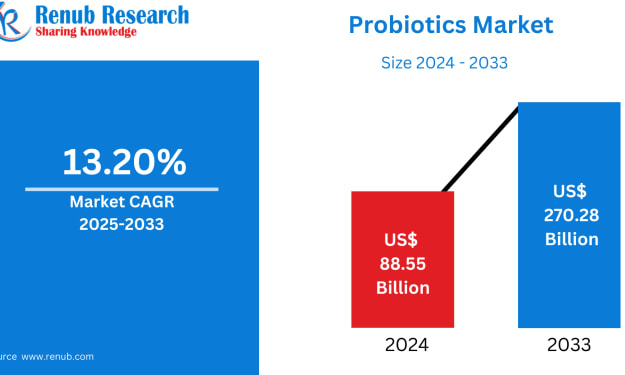
Global Probiotics Market Outlook: A Decade of Strong Growth The global probiotics market is entering a transformative growth phase as consumers across the world increasingly prioritize preventive healthcare, digestive wellness, and immune resilience. According to Renub Research, the probiotics market is expected to reach US$ 270.28 billion by 2033, up from US$ 88.55 billion in 2024, registering a robust CAGR of 13.20% during 2025–2033.
By Marthan Sira day ago in Futurism
About Binding Prometheus
I want to start actively advocating on behalf of my own work, and the most valuable part of my canon is, without a doubt, Binding Prometheus, the play I have been working on since 2019 and only finished in 2023 as part of my MA. The play itself is an amalgamation of a million different inspirations. On one end, it evokes the Ancient Greek myth-play, deriving its own title from the earliest extant work of Western drama we have, Aeschylus’s Prometheus Bound. On the other end, it borrows significantly from the sci-fi bulwarks from over the years, namely Mary Shelley’s Frankenstein and Karel Capek’s Rossum’s Universal Robots. The play could be an episode of Black Mirror, I fear. I don’t know. I’ve only ever seen one episode of Black Mirror.
By Steven Christopher McKnight24 days ago in Futurism
Digital Map Market Size and Forecast 2026–2034: Powering the World’s Location-Driven Future
Digital Map Market Outlook 2026–2034 The global Digital Map Market is entering a decisive decade of expansion as location intelligence becomes a foundational layer of the digital economy. According to Renub Research, the market is projected to grow from US$ 6.63 billion in 2025 to US$ 16.92 billion by 2034, registering a strong CAGR of 10.97% from 2026 to 2034.
By jaiklin Fanandishabout 9 hours ago in Futurism



Comments
There are no comments for this story
Be the first to respond and start the conversation.