
Probiotics Market Size, Trends & Forecast 2025–2033
How Gut Health, Functional Foods, and Personalized Nutrition Are Reshaping the Global Wellness Economy

Global Probiotics Market Outlook: A Decade of Strong Growth
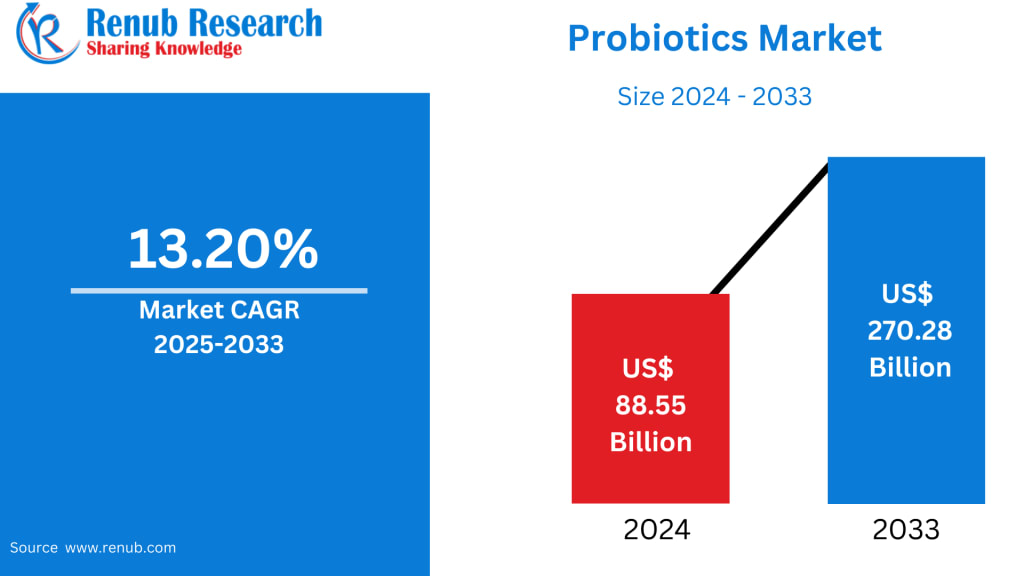
The global probiotics market is entering a transformative growth phase as consumers across the world increasingly prioritize preventive healthcare, digestive wellness, and immune resilience. According to Renub Research, the probiotics market is expected to reach US$ 270.28 billion by 2033, up from US$ 88.55 billion in 2024, registering a robust CAGR of 13.20% during 2025–2033.
This expansion is being fueled by rising awareness of gut health, growing demand for functional and natural foods, advances in microbiome research, and the rapid adoption of personalized nutrition. Once considered a niche category, probiotics have now become a mainstream component of food, dietary supplements, and animal nutrition industries worldwide.
Understanding Probiotics: The Foundation of Gut Wellness
Probiotics are live microorganisms—primarily beneficial bacteria and yeast—that provide health benefits when consumed in adequate amounts. Often referred to as “good bacteria,” probiotics help maintain a healthy balance of gut microflora, supporting digestion, nutrient absorption, immune function, and even mental well-being.
Naturally found in fermented foods such as yogurt, kefir, kimchi, sauerkraut, and kombucha, probiotics are also widely available in capsules, powders, gummies, and functional beverages. Scientific evidence increasingly links gut health to overall wellness, driving both medical professionals and consumers to adopt probiotics as a daily health habit.
Key Growth Drivers Powering the Probiotics Market
1. Rising Demand for Functional Foods
Consumers are no longer satisfied with food that simply fills them—they want products that deliver measurable health benefits. This shift is driving strong demand for functional foods enriched with probiotics.
Probiotic yogurts, drinks, snacks, and plant-based fermented products are seeing accelerated adoption, especially among health-conscious urban populations. Brands are innovating to improve taste, convenience, and strain diversity.
A notable example is Yakult Danone India, which introduced Yakult Light Mango Flavor in July 2024, responding to the demand for flavorful, low-calorie probiotic beverages. Such product innovation highlights how functional food trends are directly accelerating market expansion.
2. Growing Health Awareness and Preventive Nutrition
The global shift toward preventive healthcare is a major catalyst for probiotics adoption. Consumers increasingly understand the link between gut health, immunity, metabolism, mental health, and skin wellness.
Probiotics are now used not only for digestive issues but also for stress management, allergy relief, weight control, and immune support. This has expanded their relevance beyond traditional dietary supplements into lifestyle wellness.
In November 2023, Probiotic Partners LLC launched a plant-based probiotic supplement designed for vegetarians and people with dietary restrictions. Free from dairy, gluten, and artificial additives, the product reflects the growing demand for clean, inclusive nutrition solutions.
3. Clean Label and Natural Ingredient Trends
Today’s consumers carefully read ingredient labels and actively avoid artificial additives, preservatives, and synthetic chemicals. This clean-label movement aligns perfectly with probiotics, which are naturally positioned as health-enhancing and minimally processed products.
Manufacturers are reformulating products with simple, transparent ingredient lists, organic inputs, and non-GMO strains. As trust becomes a key purchasing factor, brands that emphasize transparency and quality are gaining strong competitive advantage in the global probiotics market.
Challenges Facing the Global Probiotics Industry
Regulatory Complexities
One of the biggest challenges is the lack of global regulatory harmonization. Health claims, strain approvals, and labeling requirements vary widely between regions, creating hurdles for multinational companies.
Strict approval processes in Europe and North America can delay product launches and increase compliance costs, limiting innovation speed and cross-border expansion.
Cost and Accessibility Barriers
High-quality probiotics require specialized production, storage, and transportation to maintain strain viability. These factors raise manufacturing costs and retail prices, limiting accessibility for lower-income populations.
In emerging markets, limited cold-chain infrastructure further restricts the availability of premium probiotic products, slowing market penetration in rural and semi-urban regions.
Regional Market Insights
United States Probiotics Market
The U.S. remains one of the largest and most mature probiotics markets globally. High consumer awareness, strong purchasing power, and widespread availability of functional foods drive market leadership.
In March 2022, Danone launched Activia+, a drinkable probiotic yogurt fortified with zinc, vitamin C, and vitamin D to support immune health. The product reflects the American consumer’s preference for convenient, multi-benefit wellness products, reinforcing the market’s long-term growth trajectory.
India Probiotics Market
India is emerging as one of the fastest-growing probiotics markets due to rising disposable incomes, increasing health awareness, and a cultural acceptance of fermented foods.
The market is witnessing innovation in personalized nutrition and metabolic health. In April 2025, Mumbai-based The Good Bug introduced a GLP-1-based weight management probiotic, combining metabolic fibers with clinically validated strains.
Meanwhile, Sova Health launched Sova X in November 2024—a personalized gut health solution that uses robotic compounding to create microbiome-specific probiotic formulations via a subscription model. These developments position India as a global innovation hub for precision nutrition.
United Kingdom Probiotics Market
In the UK, probiotics are gaining popularity due to increasing lifestyle-related health issues and a strong shift toward plant-based and vegan supplements.
In February 2022, Optibac Probiotics introduced vegan probiotic gummies for adults, targeting consumers seeking enjoyable and convenient supplement formats. Sustainability, ethical sourcing, and clean-label positioning continue to define growth in the UK probiotics sector.
United Arab Emirates Probiotics Market
The UAE probiotics market is growing rapidly, supported by rising health awareness, a diverse expatriate population, and increasing demand for natural wellness solutions.
Functional dairy products, probiotic beverages, and supplements are widely consumed through supermarkets, hypermarkets, and online channels. While price sensitivity and awareness gaps remain challenges, the market outlook remains positive as preventive healthcare adoption accelerates.
Probiotics Market Segmentation
By Product
Probiotic Food & Beverages
Probiotic Dietary Supplements
Animal Feed
By Ingredient
Bacteria
Yeast
By Distribution Channel
Supermarkets/Hypermarkets
Pharmacies & Health Stores
Convenience Stores
Online Retail
Others
By Country (25 Viewpoints)
North America: United States, Canada
Europe: France, Germany, Italy, Spain, United Kingdom, Belgium, Netherlands, Turkey
Asia Pacific: China, Japan, India, Australia, South Korea, Thailand, Malaysia, Indonesia, New Zealand
Latin America: Brazil, Mexico, Argentina
Middle East & Africa: South Africa, Saudi Arabia, United Arab Emirates
Competitive Landscape and Key Players
The global probiotics market is highly competitive, with companies focusing on innovation, strain research, product diversification, and strategic partnerships. Renub Research covers all companies from four viewpoints: Company Overview, Key Persons, Recent Developments & Strategies, and Sales Analysis.
Major Market Players Include:
PepsiCo Inc.
Nestlé SA
Danone SA
Yakult Honsha Co. Ltd
NOW Foods
BioGaia
Reckitt Benckiser LLC
Morinaga Milk Industry Co. Ltd
These companies are investing heavily in R&D, personalized nutrition platforms, plant-based formulations, and digital distribution channels to maintain competitive advantage.
Final Thoughts: The Future of Probiotics Is Personalized and Preventive
The probiotics market is transitioning from a supplement-driven category to a core pillar of the global wellness economy. As scientific research continues to validate the role of gut health in overall well-being, probiotics are becoming an essential daily health solution rather than an occasional remedy.
With strong growth projections, rising consumer trust, and expanding applications across food, healthcare, and animal nutrition, the market is poised for sustained momentum through 2033. Companies that focus on clean labels, personalization, innovation, and affordability will lead the next chapter of this rapidly evolving industry.
About the Creator
Marthan Sir
Educator with 30+ years of teaching experience | Passionate about sharing knowledge, life lessons & insights | Writing to inspire, inform, and empower readers.
Keep reading
More stories from Marthan Sir and writers in Futurism and other communities.
Photo Printing and Merchandise Market Size and Forecast 2025–2033: Personalization Drives the Next Phase of Growth
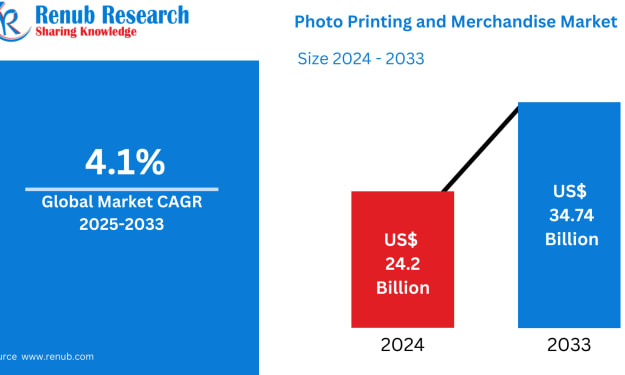
Market Overview: A Growing Industry Built on Memories The Global Photo Printing and Merchandise Market was valued at US$ 24.2 billion in 2024 and is projected to reach US$ 34.74 billion by 2033, expanding at a CAGR of 4.1% from 2025 to 2033, according to Renub Research. This steady growth reflects a fundamental shift in consumer behavior—people are increasingly seeking physical expressions of their digital lives.
By Marthan Sira day ago in Futurism
About Binding Prometheus
I want to start actively advocating on behalf of my own work, and the most valuable part of my canon is, without a doubt, Binding Prometheus, the play I have been working on since 2019 and only finished in 2023 as part of my MA. The play itself is an amalgamation of a million different inspirations. On one end, it evokes the Ancient Greek myth-play, deriving its own title from the earliest extant work of Western drama we have, Aeschylus’s Prometheus Bound. On the other end, it borrows significantly from the sci-fi bulwarks from over the years, namely Mary Shelley’s Frankenstein and Karel Capek’s Rossum’s Universal Robots. The play could be an episode of Black Mirror, I fear. I don’t know. I’ve only ever seen one episode of Black Mirror.
By Steven Christopher McKnight24 days ago in Futurism


Comments
There are no comments for this story
Be the first to respond and start the conversation.