
Ethics in AI Development: Can This Technology Understand Morality?
Can AI truly understand morality, or is it limited by human design and biases?

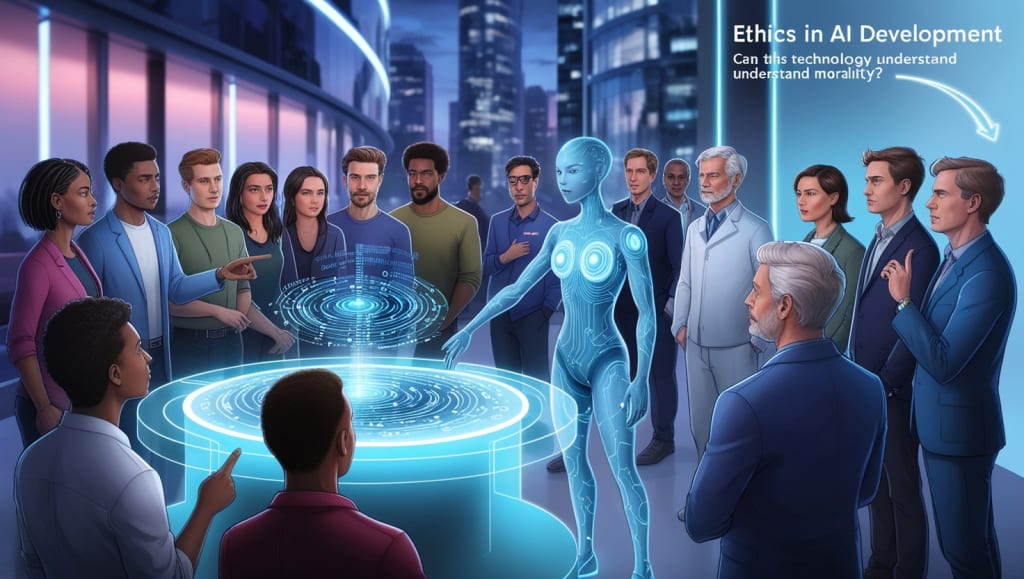
As artificial intelligence (AI) continues to evolve and integrate into various aspects of our lives, one question consistently arises: Can AI truly understand ethics and morality? We’re witnessing a world where AI systems are making decisions that affect everything from our healthcare choices to the way we interact with each other online. But, as these technologies grow more powerful, the ethical dilemmas they present seem to be growing as well.
The core of the question isn’t just whether AI can make decisions, but whether it can make the right decisions. Can a machine, devoid of human experience and emotional intelligence, understand the complexities of moral choices? Or, is it simply programmed to follow guidelines that may or may not align with our deeper moral beliefs?
The Challenge of Defining Morality for Machines
One of the primary issues with programming AI to understand morality is the very nature of morality itself. Morality is subjective—what one society considers ethical, another might see as a violation of rights. Take, for example, the use of autonomous vehicles. If an AI in a self-driving car has to make a decision in a critical situation, such as whether to swerve to avoid hitting a pedestrian and risk the lives of the passengers, how should it choose? Is it more ethical to prioritize the lives of the car’s occupants, or the innocent bystanders on the road?
This problem doesn’t have a clear answer, and that’s the crux of the issue. Programming morality into a machine is far from simple. It’s not just about teaching it rules—it’s about instilling it with a framework for making judgments based on an array of complex, often contradictory, human values. How do you teach a machine the nuance of empathy, justice, or fairness when these concepts themselves vary so widely across cultures and situations?
The Role of Data in Shaping AI’s Moral Compass
Another layer of complexity is the data that AI systems are trained on. Machines learn from vast datasets that reflect the biases, assumptions, and perspectives of the humans who create them. If the data is skewed or flawed, the AI can perpetuate those biases. For example, facial recognition software has been found to have higher error rates for women and people of color, simply because the data it was trained on lacked diversity.
If AI systems are learning from biased or incomplete datasets, how can we expect them to make moral decisions that are truly fair or ethical? This is a major concern when it comes to the development of AI in areas like law enforcement, hiring practices, or even healthcare, where the stakes are high, and the consequences of bias can be devastating.
The issue becomes even more pressing when we consider how AI could be used in more sensitive contexts, such as war. If AI is given control over drones or other autonomous weapons, how can we trust these machines to make decisions that align with human values? Can an algorithm truly understand the complexities of life and death, or would it follow its programming to the letter without consideration for the broader human consequences?
Ethical Frameworks: Can They Be Integrated Into AI?
Despite these challenges, some believe that it is possible to integrate ethical frameworks into AI development. There have been attempts to create guidelines and ethical codes for AI, such as ensuring that systems are transparent, accountable, and designed to minimize harm. But can these frameworks be comprehensive enough to account for the endless variations of human morality?
Philosophers and ethicists have long debated moral theories, from utilitarianism, which focuses on the greatest good for the greatest number, to deontological ethics, which emphasizes duties and rules. Could an AI ever fully grasp the intricacies of these frameworks and apply them appropriately in real-world situations? Perhaps it could, in a way, follow these rules, but whether it could truly understand their deeper meanings—like empathy or fairness—is another question entirely.
There’s also the issue of AI systems evolving beyond their initial programming. With the advent of machine learning, AI can now adapt, improve, and even make decisions that weren’t explicitly programmed into it. This leaves us in uncharted territory, where the very actions of AI might be unexpected or morally ambiguous, based on the way the system has learned to function.
The Human Element: A Necessary Component
Ultimately, it seems that AI cannot fully understand morality in the way humans do. Human decisions are guided by emotions, experiences, social context, and empathy—qualities that are difficult to program into a machine. Even with sophisticated algorithms, AI lacks the lived experience that shapes human moral judgment.
Perhaps the most important aspect of AI ethics, then, is not about trying to make machines understand morality, but about ensuring that humans remain at the center of decision-making. Rather than relying on AI to independently make moral judgments, we should focus on creating systems that support human oversight and accountability. AI should be a tool—an assistant that enhances human decision-making, not replaces it.
The Road Ahead: A Balanced Approach
The future of AI and its relationship with morality is still unfolding. As we continue to develop these technologies, it’s clear that there is a need for careful consideration of the ethical implications. Developers, ethicists, and lawmakers must work together to ensure that AI systems are designed in a way that minimizes harm and promotes fairness. At the same time, we need to acknowledge that AI cannot, and perhaps should not, be expected to completely understand morality the way humans do.
In the end, the key to ethical AI may not lie in the machines themselves, but in how we, as a society, choose to shape and use them. Our responsibility is to ensure that the technology serves humanity—upholding our values, not replacing them.
About the Creator
Indira Fania
As a writer, I’ve always been fascinated by the power of words to transform ideas into reality and inspire action.
Keep reading
More stories from Indira Fania and writers in Futurism and other communities.
Artificial Intelligence and Social Inequality: A Threat to Diversity and Equality
Artificial intelligence (AI) has been touted as a game-changer, revolutionizing industries, enhancing convenience, and even promising to solve global issues. From healthcare to entertainment, AI has proven its potential. However, while the technology offers remarkable advantages, it also brings with it a pressing concern that often flies under the radar: the exacerbation of social inequality and the threat it poses to diversity and equality.
By Indira Faniaabout a year ago in Futurism
Podcasting in EdTech Market to hit USD 48.4 Billion By 2034
The Podcasting in EdTech Market is expected to reach USD 48.4 Billion by 2034, growing from USD 2.5 Billion in 2024, at a remarkable CAGR of 34.5% during the forecast period from 2025 to 2034. The rapid growth in this market is driven by the increasing adoption of podcasting as an educational tool, offering flexible, on-demand learning experiences.
By Roberto Crum2 days ago in Futurism
Australia Pet Supplement Market: Pet Humanization, Preventive Care & Natural Nutrition
According to IMARC Group, the Australia pet supplement market reached a value of USD 26.0 Million in 2024 and is projected to reach USD 41.0 Million by 2033, growing at a compound annual growth rate (CAGR) of 5.2% during 2025–2033. The market is expanding as pet owners increasingly prioritize the health, nutrition and overall well-being of their companion animals. Rising awareness about preventive healthcare for pets is encouraging owners to incorporate dietary supplements into daily feeding routines. Products designed to support joint health, digestive wellness, immunity and skin care are becoming widely popular among pet owners. At the same time, the growing trend of pet humanization—where pets are treated as family members—is significantly influencing purchasing decisions. The convenience of e-commerce platforms and personalized digital guidance is also helping pet owners access a broader range of supplement products, contributing to the steady growth of Australia’s pet supplement industry.
By Shrestha Roy2 days ago in Futurism



Comments
There are no comments for this story
Be the first to respond and start the conversation.