
Driving Toward a Greener Future: United States Golf Cart Market Set to Reach US$ 0.92 Billion by 2033
Expanding golf participation, electric innovations, and lifestyle mobility adoption are steering the U.S. golf cart industry toward sustainable and profitable growth.


United States Golf Cart Market Overview
The United States Golf Cart Market is projected to reach US$ 0.92 billion by 2033, growing from US$ 0.59 billion in 2024, at a CAGR of 5.05% from 2025 to 2033, according to Renub Research. This steady rise reflects how golf carts have evolved far beyond the fairway—becoming integral to communities, campuses, resorts, and even industrial settings.
The sector’s expansion is fueled by rising golf participation, the shift toward electric mobility, and technological innovation that enhances both performance and sustainability. From Florida’s retirement communities to California’s green cities, golf carts are emerging as the symbol of eco-friendly mobility and lifestyle convenience.
A Changing Definition of Golf Carts
Once a simple tool for golfers, today’s golf carts are multi-purpose mobility vehicles. They now feature GPS-enabled dashboards, lithium-ion batteries, and luxury seating, catering not only to golfers but also to residents in gated communities, tourists in resorts, and workers in large industrial zones.
Modern golf carts are no longer restricted to sports; they are now part of the broader light electric vehicle (LEV) revolution, offering a bridge between recreational transport and sustainable urban commuting.
Key Growth Drivers of the U.S. Golf Cart Market
1. Rising Golf Participation
The game of golf is experiencing a resurgence across the United States, with participation expanding among younger generations, women, and corporate groups. The construction of new golf courses, resorts, and clubs has created a direct demand for more efficient, comfortable, and eco-friendly carts.
Moreover, golf carts are essential for course maintenance, transportation of staff, and hospitality services—creating a continuous replacement and upgrade cycle for golf facilities nationwide.
Municipal and community-backed golf projects, alongside major tournaments, have also contributed to market stability, ensuring golf carts remain indispensable to the sport’s infrastructure.
2. Shift Toward Electric Mobility
Sustainability and cost-efficiency are reshaping how Americans move—even on the golf course. The market has seen a clear transition from gas-powered to electric golf carts, driven by their low noise, minimal maintenance, and zero-emission benefits.
Technological leaps—especially lithium-ion battery integration, regenerative braking, and smart charging systems—are improving the range and lifespan of these vehicles.
A notable example: in July 2024, Kandi America and Lowe’s introduced officially licensed NFL team electric golf carts, each with 48V lithium batteries, touchscreen displays, and team branding—a creative blend of sports passion and green innovation.
This demonstrates how lifestyle, technology, and sustainability are converging to drive market expansion.
3. Technological Advancements
The U.S. golf cart market is undergoing a rapid technological transformation. Features once considered luxuries—digital displays, smart connectivity, automatic park brakes, and enhanced suspensions—are now standard.
Battery technology continues to be the backbone of innovation. Lithium-ion systems deliver longer range, faster charging, and greater durability compared to traditional lead-acid setups.
In December 2023, Vero Technologies, in partnership with TrojanEV, launched a floorplan financing program to accelerate distribution of eco-friendly electric carts. This integration of financial innovation and technology has made advanced models more accessible to dealers and end-users alike.
Challenges Hindering Market Expansion
High Initial Costs and Financing Barriers
Although electric golf carts are cheaper to operate long-term, their upfront costs—especially for lithium-ion and luxury models—remain a barrier. Smaller golf facilities and budget-conscious buyers often find the price tag steep.
Limited financing programs and state-by-state variation in low-speed vehicle (LSV) regulations also complicate adoption. Expanding leasing options, subsidies, and awareness of total cost-of-ownership benefits will be essential to overcome this challenge.
Regulatory and Infrastructure Constraints
Electric golf cart growth also depends heavily on local regulations and charging infrastructure. While some states allow carts on public roads under LSV rules, others impose strict restrictions, creating a patchwork of compliance challenges.
The absence of standardized charging networks, combined with licensing and zoning complexities, slows adoption outside traditional golf environments.
For the U.S. market to fully realize its potential, nationally consistent guidelines and broader EV infrastructure integration are necessary.
Regional Market Highlights
California: Sustainability in Motion
California leads in eco-conscious adoption. Its robust environmental policies and upscale coastal communities have embraced electric carts for short commutes. From Palm Springs resorts to Silicon Valley campuses, these vehicles are redefining luxury and sustainability.
Innovation in smart connectivity and battery tech keeps California’s market ahead of the curve.
Texas: Tradition Meets Innovation
With its sprawling landscapes and deep-rooted golf culture, Texas represents a powerhouse in golf cart sales. Communities and retirement villages rely heavily on carts for mobility, while local manufacturers focus on rugged, off-road, and utility-focused models.
Electric variants are gaining traction, especially in urban hubs like Austin, Dallas, and San Antonio, where sustainability is becoming a key theme.
New York: Urban Adaptation and Luxury
Despite its shorter golf season, New York’s market thrives in luxury clubs and resort regions. Beyond golf, college campuses and gated communities in upstate New York are using carts as green mobility options.
Growing tourism and state environmental programs are further spurring the shift toward energy-efficient, electric models.
Florida: The Nation’s Golf Cart Capital
Florida remains the largest and most mature golf cart market in the U.S. Its year-round warm weather, massive retirement population, and recreational communities have made golf carts ubiquitous.
From Naples to The Villages, electric carts are a lifestyle staple, supported by strong tourism and community mobility trends.
Florida embodies the future of golf carts as everyday neighborhood vehicles—not just for golfers but for anyone seeking convenience and sustainability.
Recent Developments in the U.S. Golf Cart Industry
May 2025: Kandi Technologies rolled out its first U.S.-assembled electric golf cart in Garland, Texas, marking a milestone in domestic manufacturing.
March 2025: Club Car revamped its Tempo lineup with StopSmart Technology, a sleeker dashboard, and dual USB ports for enhanced safety and comfort.
February 2025: Textron Specialized Vehicles launched the Cushman Hauler XL, offering a choice between gas or lithium-electric powertrains with a massive payload capacity.
July 2024: Kandi America and Lowe’s introduced NFL-branded electric golf carts, blending fandom with eco-friendly design.
May 2024: Columbia Vehicle Group invested $12.2 million in a new South Carolina facility to streamline production and regional supply chains.
June 2023: E-Z-GO launched the Liberty LSV and Freedom RXV, combining luxury, speed, and environmental performance for both golf and community use.
Market Segmentation Snapshot
By Propulsion Type:
Electric Golf Carts
Gasoline Golf Carts
Solar-Hybrid Golf Carts
By Seating Capacity:
2 Seater
4 Seater
6 Seater
8+ Seater
By Vehicle Format:
Open-Top
Enclosed / Weather-Proof
By Application:
Golf Courses
Personal / Residential Mobility
Commercial Services (Resorts, Campuses, Theme Parks)
Industrial & Airport Utility
By Sales Channel:
Offline (Dealers & Distributors)
Online / Direct-to-Consumer
Key Market Players
Yamaha Golf-Car Company
Columbia Vehicle Group (ParCar)
HDK Electric Vehicles
Suzhou Eagle EV Mfg. Co.
JH Global Services (Star EV)
ICON EV
Marshell Electric Vehicle
Bintelli Electric Vehicles
Xiamen Dalle Electric Car
Speedways Electric
These companies are investing heavily in battery innovation, AI-enabled fleet management, and customized consumer experiences, ensuring the market remains competitive and innovation-driven.
Final Thoughts
The United States Golf Cart Market is no longer confined to fairways—it’s driving into neighborhoods, campuses, and sustainable cities. With technological upgrades, the surge in electric adoption, and creative partnerships blending sports, mobility, and sustainability, the market is well-positioned for consistent growth through 2033.
As consumers embrace leisure-centric and green lifestyles, golf carts are shifting from niche vehicles to mainstream micro-mobility solutions.
In the next decade, expect golf carts to evolve into smart, connected, eco-friendly vehicles that bridge the gap between recreation and sustainable urban transport—making them a small but significant player in America’s clean mobility revolution.
About the Creator
Janine Root
Janine Root is a skilled content writer with a passion for creating engaging, informative, and SEO-optimized content. She excels in crafting compelling narratives that resonate with audiences and drive results.
Keep reading
More stories from Janine Root and writers in Futurism and other communities.
United States Brain-Computer Interface Market: Merging Minds and Machines – Growth Forecast to 2033
🧠 United States Brain-Computer Interface Market Overview The United States Brain-Computer Interface (BCI) Market is entering an era of transformative innovation, blending neuroscience, artificial intelligence, and medical technology. According to Renub Research, the U.S. BCI market is expected to rise from US$ 47.51 billion in 2024 to US$ 53.66 billion by 2033, at a CAGR of 1.36%.
By Janine Root 3 months ago in Futurism
About Binding Prometheus
I want to start actively advocating on behalf of my own work, and the most valuable part of my canon is, without a doubt, Binding Prometheus, the play I have been working on since 2019 and only finished in 2023 as part of my MA. The play itself is an amalgamation of a million different inspirations. On one end, it evokes the Ancient Greek myth-play, deriving its own title from the earliest extant work of Western drama we have, Aeschylus’s Prometheus Bound. On the other end, it borrows significantly from the sci-fi bulwarks from over the years, namely Mary Shelley’s Frankenstein and Karel Capek’s Rossum’s Universal Robots. The play could be an episode of Black Mirror, I fear. I don’t know. I’ve only ever seen one episode of Black Mirror.
By Steven Christopher McKnight19 days ago in Futurism
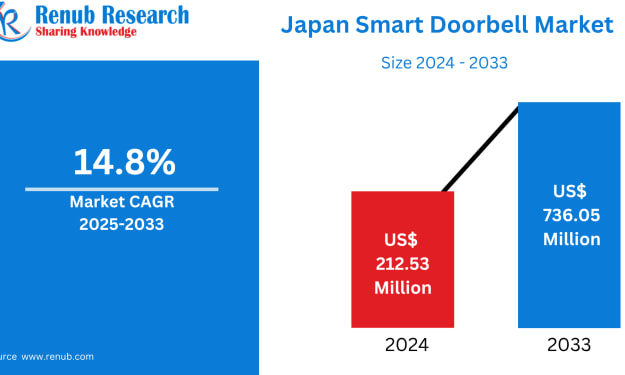
Japan Smart Doorbell Market Size and Forecast 2025–2033
Market Snapshot The Japan Smart Doorbell Market is expected to reach US$ 736.05 million by 2033, up from US$ 212.53 million in 2024, expanding at a robust CAGR of 14.8% from 2025 to 2033. Rapid urbanization, increasing adoption of smart home technologies, and rising demand for home security systems are driving market growth. Advancements in AI, video analytics, and wireless connectivity are further strengthening consumer demand for smart doorbell systems.
By Marthan Sir4 days ago in Futurism



Comments
There are no comments for this story
Be the first to respond and start the conversation.