
United States Brain-Computer Interface Market: Merging Minds and Machines – Growth Forecast to 2033
Driven by AI breakthroughs, neuroprosthetics, and growing clinical trials, the U.S. Brain-Computer Interface (BCI) market is poised to reach US$ 53.66 billion by 2033, up from US$ 47.51 billion in 2024, registering a CAGR of 1.36% (2025–2033).


🧠 United States Brain-Computer Interface Market Overview
The United States Brain-Computer Interface (BCI) Market is entering an era of transformative innovation, blending neuroscience, artificial intelligence, and medical technology. According to Renub Research, the U.S. BCI market is expected to rise from US$ 47.51 billion in 2024 to US$ 53.66 billion by 2033, at a CAGR of 1.36%.
A Brain–Computer Interface (BCI) enables direct communication between the human brain and external devices by converting neural activity into digital signals. These systems include components such as signal acquisition, preprocessing, feature extraction, and AI-based decoding algorithms. BCIs range from non-invasive EEG headsets to partially invasive ECoG systems and fully implanted microelectrode arrays.
Applications span across medical rehabilitation, neuromodulation, prosthetic control, communication aids, and cognitive enhancement. As neural decoding becomes more sophisticated and hardware more biocompatible, BCIs are transitioning from labs to real-world use — from clinical therapy to consumer wellness and human–machine synergy.
🚀 Key Market Growth Drivers
1. Rapid Advances in Neural Signal Processing and AI Integration
The synergy between AI and neural signal decoding has been a game-changer for the U.S. BCI market. Deep learning models now decode complex brain patterns with unprecedented accuracy, enabling real-time device control and naturalistic user experiences.
In September 2024, Neurable Inc. partnered with Master & Dynamic to launch the MW75 Neuro, AI-powered consumer headphones that use BCI technology to monitor cognitive load, manage stress, and enhance mental performance. This launch marks a paradigm shift — neurotechnology is no longer limited to hospitals but entering mainstream consumer wellness.
Such developments illustrate how AI integration is expanding BCI applications beyond clinical domains, fueling both public interest and commercial adoption across the U.S.
2. Rising Adoption of Neuroprosthetics and Neuromodulation Therapies
BCIs are redefining healthcare for individuals with neurological disorders such as Parkinson’s disease, epilepsy, and paralysis.
Neuroprosthetics—like brain-controlled limbs, speech synthesizers, and visual implants—offer independence to patients with spinal cord injuries or degenerative conditions. Similarly, neuromodulation therapies provide targeted stimulation to restore neural function, often paired with AI to create adaptive, closed-loop feedback systems.
U.S. hospitals and rehabilitation centers are conducting pioneering clinical trials, supported by FDA fast-tracking initiatives for implantable neurodevices. As clinical validation grows, insurance providers are slowly considering reimbursement pathways — a vital step toward widespread adoption.
3. Restoring Motor and Communication Abilities in Paralyzed Patients
Perhaps the most inspiring BCI use case lies in restoring movement and speech to individuals with paralysis.
Leading research institutions — including Stanford University, Brown University, and Mount Sinai — are developing implants that translate neural activity into digital commands to control robotic limbs, cursors, or voice synthesizers.
Recent trials have shown remarkable progress: paralyzed patients have successfully communicated or moved robotic limbs using only thought. These efforts align with national rehabilitation goals, emphasizing quality-of-life improvement and medical innovation leadership.
As these systems evolve toward wireless, minimally invasive designs with extended lifespans, patient outcomes are improving — drawing investors, tech firms, and healthcare innovators deeper into the U.S. neurotech ecosystem.
⚠️ Key Market Challenges
1. Ethical, Privacy, and Data Security Concerns
BCIs capture highly personal neural data — a person’s thoughts, emotions, and mental states. Without proper oversight, such data could be misused by corporations or insurers.
Ethical dilemmas revolve around user consent, cognitive autonomy, and potential manipulation via feedback systems. As consumer-oriented BCIs like Neurable’s MW75 Neuro gain popularity, brain data protection is becoming a critical issue.
Robust data encryption, transparent governance, and strict federal privacy standards are essential to build public trust and ensure ethical neurotechnology deployment.
2. High Costs, Scalability, and Regulatory Barriers
Developing and commercializing BCIs remains costly and complex. Invasive and semi-invasive systems require surgical precision, expensive materials, and extensive clinical validation. Even non-invasive BCIs must meet FDA performance and safety benchmarks, delaying time-to-market.
Small startups face hurdles in sustaining funding through long regulatory and testing phases. Furthermore, insurance reimbursement policies remain limited for neuroprosthetic treatments.
To unlock scalability, companies must streamline manufacturing, lower production costs, and clarify regulatory frameworks—ensuring affordability and availability across the U.S. healthcare landscape.
🏙️ Regional Insights
California: The Epicenter of Neurotech Innovation
California stands as the heart of the U.S. BCI ecosystem, powered by Stanford, UCSF, UCLA, and Cedars-Sinai. The Bay Area and Los Angeles host leading neurotech startups and AI research hubs, driving cross-disciplinary collaboration between robotics, biotech, and medical AI.
Strong venture capital presence, clinical infrastructure, and academic excellence make California the launchpad for first-in-human trials. However, competition for technical talent and regulatory complexities remain key challenges.
Texas: Emerging Hub for Clinical Translation
Texas is gaining recognition for clinical trial execution and implant testing, especially in Houston, Austin, and Dallas. Companies like Paradromics Inc. have achieved major milestones in human neural recordings, positioning Texas as a testing ground for implantable BCIs.
Its business-friendly climate, affordable facilities, and growing academic-medical partnerships make it a magnet for scaling up clinical-stage neurotech firms.
New York: Clinical and Academic Powerhouse
Home to Mount Sinai, Columbia, and NYU, New York’s BCI scene thrives on clinical research and translational medicine. The NYBCI Symposium fosters collaboration among researchers, surgeons, and investors.
With its dense hospital network and high patient diversity, New York excels in trial recruitment and clinical validation, making it a high-value region for hospital-driven BCI development.
Florida: Fast-Growing Clinical and Rehabilitation Hub
Florida’s neurotech momentum is fueled by the Miami Project to Cure Paralysis at the University of Miami — a major U.S. site for Neuralink’s PRIME study.
Florida’s lower costs, expanding rehab programs, and access to diverse patient pools make it ideal for clinical testing and rehabilitation-focused BCIs. Its steady progress underscores the growing national reach of U.S. brain-interface research.
🔬 Recent Developments in the U.S. BCI Market
Sept 2024 – Synchron: A U.S. patient with an endovascular BCI used Amazon Alexa via direct neural control, showcasing the first-ever mind-controlled smart home interface.
Aug 2024 – UC Davis Health: Researchers developed a BCI that translates brain signals into speech with 97% accuracy, marking a major milestone in communication restoration for ALS patients.
Apr 2023 – Seiko Epson & Neurable: Epson invested in Neurable Inc., advancing EEG-based consumer BCI systems for mental wellness and thought-driven control.
May 2023 – Paradromics Inc.: Raised $33 million Series A funding to advance its Connexus® Direct Data Interface, now holding FDA Breakthrough Device Designation for treating severe neurological disabilities.
🧩 Market Segmentation
By Component:
Hardware
Invasive
Non-invasive
Others
Software & Algorithms
Services
By Interface Type:
Motor/Output BCI
Communication BCI
Passive/Monitoring BCI
Hybrid BCI
By Application:
Neuroprosthetics & Motor Restoration
Communication & Control
Others
By End-User:
Hospitals & Clinics
Research & Academic Institutes
Others
By State (29 Viewpoints):
California, Texas, New York, Florida, Illinois, Pennsylvania, Ohio, Georgia, New Jersey, Washington, North Carolina, Massachusetts, Virginia, Michigan, Maryland, Colorado, Tennessee, Indiana, Arizona, Minnesota, Wisconsin, Missouri, Connecticut, South Carolina, Oregon, Louisiana, Alabama, Kentucky, and Rest of United States.
🏢 Key Players
Advanced Brain Monitoring Inc.
ANT Neuro
NIRx Medical Technologies LLC
EMOTIV
Medtronic plc
Natus Medical Incorporated
NeuroSky Inc.
Nihon Kohden Corporation
Compumedics Limited
Each of these companies is driving innovation through R&D, AI integration, and human clinical trials, shaping the next decade of neurotechnology in America.
💡 Final Thoughts
The United States Brain-Computer Interface Market represents a pivotal frontier in merging neuroscience and artificial intelligence. With innovations spanning from medical implants restoring communication to consumer neurotech enhancing cognition, BCIs are poised to transform both healthcare and human–machine interaction.
While ethical governance, affordability, and scalability remain challenges, rapid breakthroughs and supportive regulatory shifts are accelerating real-world adoption. The future U.S. landscape will likely see BCIs evolve from experimental devices into mainstream neuro-assistive technologies — empowering patients, augmenting human potential, and redefining the boundaries of what it means to think, feel, and connect.
About the Creator
Janine Root
Janine Root is a skilled content writer with a passion for creating engaging, informative, and SEO-optimized content. She excels in crafting compelling narratives that resonate with audiences and drive results.
Keep reading
More stories from Janine Root and writers in Futurism and other communities.
North America Textile Market to Hit US$ 1.32 Trillion by 2033 — Sustainability, Smart Fabrics, and Reshoring Redefine the Industry
North America Textile Market Overview The North America Textile Market is expected to grow significantly, increasing from US$ 739.66 billion in 2024 to US$ 1,322.55 billion by 2033, according to Renub Research. This expansion represents a Compound Annual Growth Rate (CAGR) of 6.67% between 2025 and 2033.
By Janine Root 2 months ago in Futurism
About Binding Prometheus
I want to start actively advocating on behalf of my own work, and the most valuable part of my canon is, without a doubt, Binding Prometheus, the play I have been working on since 2019 and only finished in 2023 as part of my MA. The play itself is an amalgamation of a million different inspirations. On one end, it evokes the Ancient Greek myth-play, deriving its own title from the earliest extant work of Western drama we have, Aeschylus’s Prometheus Bound. On the other end, it borrows significantly from the sci-fi bulwarks from over the years, namely Mary Shelley’s Frankenstein and Karel Capek’s Rossum’s Universal Robots. The play could be an episode of Black Mirror, I fear. I don’t know. I’ve only ever seen one episode of Black Mirror.
By Steven Christopher McKnight16 days ago in Futurism
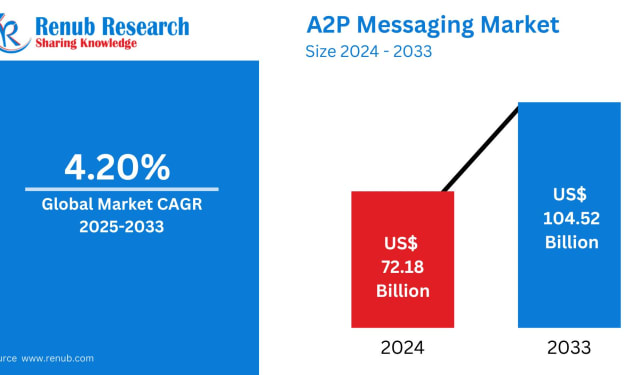
A2P Messaging Market Outlook 2025–2033
Introduction In an era where instant, reliable, and secure communication defines business success, Application-to-Person (A2P) messaging has become one of the most indispensable tools in the global digital economy. From one-time passwords (OTPs) and transaction alerts to delivery updates, customer notifications, and marketing campaigns, A2P messaging has reshaped how enterprises interact with consumers in real time.
By Marthan Sir6 days ago in Futurism
Miss Persephone's Manual to a Seemingly Ordinary Life
Miss Persephone was found at the dining table, her blue eyes swollen, her tears arriving and retreating like the tides of the ocean. Earlier that day, her family had visited her in the retirement home where she had lived for eight years. It was her eightieth birthday.
By Imola Tóth2 days ago in Fiction



Comments
There are no comments for this story
Be the first to respond and start the conversation.