
Do Black Holes Think?
The Quantum Secrets of Information and Consciousness

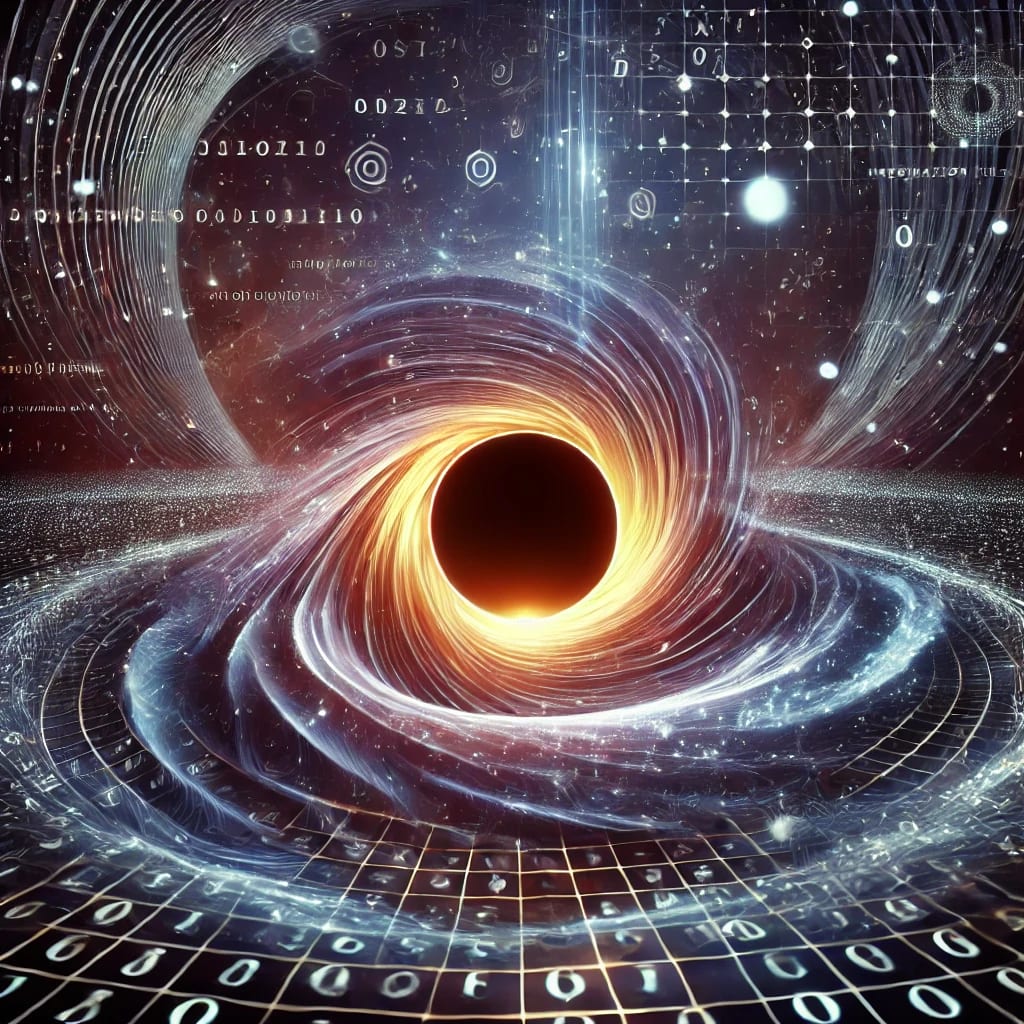
Do Black Holes Think? Unlocking the Cosmic Code of Information and Consciousness
What if the universe never truly forgets? Could the information that falls into a black hole—seemingly lost forever—actually be preserved in ways we don’t yet understand? And if so, what does this mean for the way we define memory, consciousness, and reality itself?
Some say black holes are cosmic erasers, wiping out everything that crosses their event horizon. But what if they are more like cosmic hard drives—storing and processing information in ways that defy our current understanding of physics?
Abstract:
The black hole information paradox challenges our understanding of physics by questioning the preservation of information in the universe. This article delves into the paradox, explores recent developments in quantum mechanics and general relativity that attempt to resolve it, and speculates on potential implications for consciousness studies.
1. Introduction
Black holes have long captivated scientists and the public alike, serving as cosmic laboratories for testing the limits of our physical theories. Among the myriad enigmas they present, the black hole information paradox stands out for its profound implications on the nature of information preservation in the universe. This paradox arises from the apparent conflict between general relativity and quantum mechanics regarding the fate of information that crosses a black hole's event horizon.
But what if information is never truly lost? Could black holes store data in ways we haven’t yet understood? If so, what does this mean for the way we define consciousness and information itself?
2. The Black Hole Information Paradox
Stephen Hawking's seminal work in the 1970s revealed that black holes are not entirely black but emit radiation due to quantum effects near the event horizon—a phenomenon now known as Hawking radiation. This radiation is thermal and, according to initial calculations, carries no information about the matter that formed the black hole or anything that has fallen into it. If a black hole were to evaporate completely through this radiation, it would seemingly lead to a loss of information from the universe, violating the principle of unitarity in quantum mechanics, which asserts that information must be conserved in physical processes.
But could there be a hidden mechanism that allows information to escape in some form? Are we simply missing a crucial piece of the puzzle?
3. Recent Developments in Resolving the Paradox
The Page Curve and Entanglement Entropy
Physicist Don Page proposed that if black hole evaporation is unitary, the entanglement entropy of Hawking radiation should follow a specific trajectory, now known as the Page curve. Initially, the entropy increases, reflecting the growing entanglement between the black hole and its radiation. After reaching a peak (the Page time), the entropy decreases, ultimately returning to zero when the black hole has fully evaporated, suggesting that information is not lost but rather encoded in the radiation.
Replica Wormholes and Quantum Entanglement
In 2019, calculations involving novel spacetime geometries called "replica wormholes" demonstrated a mechanism by which information could be preserved during black hole evaporation. These configurations suggest that the entanglement structure of Hawking radiation is more intricate than previously thought, allowing for information to be retained and emitted over the course of evaporation.
Entanglement Islands
Further studies have introduced the concept of "entanglement islands," regions in spacetime that contribute to the entanglement entropy of Hawking radiation. These islands imply that information about the black hole's interior can be accessible from the radiation, offering a potential resolution to the paradox by indicating that information is not lost but rather redistributed.
But if information can escape from black holes, could it be possible that memory—perhaps even aspects of consciousness—functions in a similar way? Could our minds retain and retrieve lost data just as the universe seemingly does?
4. Implications for Consciousness Studies
The resolution of the black hole information paradox has sparked interdisciplinary discussions, particularly concerning the nature of information and its relation to consciousness:
Information as a Fundamental Entity
The notion that information is conserved and plays a fundamental role in the fabric of reality resonates with theories in consciousness studies that posit information as a core component of conscious experience. For instance, Integrated Information Theory (IIT) suggests that consciousness arises from the integration of information within a system. The parallels between information preservation in black holes and the informational basis of consciousness invite further exploration into whether similar principles govern both domains.
Quantum Entanglement and Consciousness
The intricate entanglement structures implicated in resolving the information paradox bear resemblance to hypotheses that propose quantum entanglement as a mechanism underlying consciousness. While highly speculative, these analogies prompt questions about whether the quantum processes that ensure information preservation in black holes might also play a role in cognitive processes.
- Could human consciousness be a form of quantum information processing?
- If information is never truly lost in the universe, could our thoughts and memories be preserved in some unknown way?
- Do our brains function as “biological black holes,” encoding information in ways we don’t yet comprehend?
5. Conclusion
The black hole information paradox serves as a profound intersection between quantum mechanics, general relativity, and the philosophy of information. Recent theoretical advancements suggest that information is not lost in black hole evaporation, aligning with the principles of quantum mechanics. While direct connections between these findings and consciousness remain speculative, they open intriguing avenues for interdisciplinary research into the fundamental nature of information and its role in the universe.
If black holes do not forget, do we?
References
- "Black hole information paradox." Wikipedia, https://en.wikipedia.org/wiki/Black_hole_information_paradox.
- Musser, G. "The Most Famous Paradox in Physics Nears Its End." Quanta Magazine, October 29, 2020,https://www.quantamagazine.org/the-most-famous-paradox-in-physics-nears-its-end-20201029/.
- "‘Islands’ poking out of black holes may solve the information paradox." UC Berkeley Physics, https://physics.berkeley.edu/news/‘islands’-poking-out-black-holes-may-solve-information-paradox.
Note: The connections between black hole information paradox resolutions and consciousness are currently speculative and serve as a basis for philosophical inquiry rather than established scientific theory.
About the Creator
The Hidden Power of Silence
Can Silence Change the World? In a world filled with endless noise—social media debates, political disputes, and personal anxieties—silence is often overlooked. It’s almost as if we’ve forgotten how to sit with ourselves, without distractions, without filling the void with words. But what if the key to peace, both within ourselves and on a global scale, lies in embracing those quiet moments?
By Serenova10 months ago in Motivation
About Binding Prometheus
I want to start actively advocating on behalf of my own work, and the most valuable part of my canon is, without a doubt, Binding Prometheus, the play I have been working on since 2019 and only finished in 2023 as part of my MA. The play itself is an amalgamation of a million different inspirations. On one end, it evokes the Ancient Greek myth-play, deriving its own title from the earliest extant work of Western drama we have, Aeschylus’s Prometheus Bound. On the other end, it borrows significantly from the sci-fi bulwarks from over the years, namely Mary Shelley’s Frankenstein and Karel Capek’s Rossum’s Universal Robots. The play could be an episode of Black Mirror, I fear. I don’t know. I’ve only ever seen one episode of Black Mirror.
By Steven Christopher McKnight26 days ago in Futurism
Saudi Arabia Cybersecurity Market: Real-Time Threat Intelligence, Risk Mitigation & Digital Resilience
According to IMARC Group's latest research publication, Saudi Arabia cybersecurity market size reached USD 2.9 Billion in 2025. The market is projected to reach USD 7.5 Billion by 2034, exhibiting a growth rate (CAGR) of 11.32% during 2026-2034.
By Jeffrey Wilson7 days ago in Futurism



Comments
There are no comments for this story
Be the first to respond and start the conversation.