


YELLOWSTONE, USA — On Wyoming's dusky horizon, three animals tread carefully onto the planet — eyes keen, muscles rippled, and ancient history coursing through their veins. Romulus, Remus, and Khaleesi are not your average dogs. They are the first of their species in 10,000 years: genetically revived dire wolves — symbols of the Ice Age — now revived through the combination of ancient DNA, artificial intelligence, and human desire.
Colossal Biosciences, a biotech company from Texas, revealed a remarkable scientific achievement yesterday. The birth of three pups, each with a mix of modern gray wolf genes and dire wolf DNA, marks the start of a new chapter — where extinction doesn’t have to mean the end of a species.
The Ice Age Alpha Returns
Once roaming the plains and forests of prehistoric North America, the dire wolf (Canis dirus) was a dominant predator. Heavier and more robust than modern wolves. Dire wolves thrived in packs during the Ice Age, but when the Ice Age ended, so did theirs. Climate change and prey extinction caused their demise almost 10,000 years ago.
Until now.
"It is a dire wolf... It doesn’t look like a gray wolf." — Dr. Beth Shapiro, Chief Science Officer, Colossal Biosciences
Yesterday's Fiction is Tomorrow's Science: How the Wolves Returned?
Scientists extracted DNA from dire wolf fossils excavated from the La Brea Tar Pits. Once they had sequenced the ancient genome, computer programs using artificial intelligence compared it to that of modern wolves and dogs. They discovered 20 significant gene sequences that regulated the dire wolf's size, bone density, fur thickness, and jaw strength.
Scientists used CRISPR-Cas9 gene editing to introduce targeted genes into gray wolf embryos. The embryos were then mated in surrogate domestic dog females. The outcome was puppies that looked and acted very much like dire wolves.
In the words of Dr. Carroway: “We haven’t just resurrected a species — we’ve crossed a threshold. What we do next will define how history remembers us.”
AI: Architect of De-Extinction
AI was the behind-the-scenes hero. It helped to speed up genome sequencing, replicated evolutionary adaptation, forecasted protein folding, and simulated DNA compatibility. Without AI, this project would be decades in the making.
“We want to create functional versions of extinct species. We don’t have to have something that is 100 percent genetically identical,” says Dr. Shapiro.
Wild Comeback or Risky Move?
Resurrection may sound interesting, but it also raises a big question"The world has changed a lot in 10,000 years. Can these animals live safely in today’s ecosystems?"
Some scientists think they could help by keeping other animal populations balanced. But others worry they might cause problems — like spreading disease, harming other species, or even clashing with humans and livestock.
The Return of Dire wolves could help nature, but it might also bring risks if we're not careful enough.
Ethical Considerations
- Is it ethical to revive a species that evolution has phased out?
- Could these animals suffer in artificial environments or captivity?
- Reintroduced species might disrupt modern ecosystems.
- De-extinction projects may divert funds from protecting endangered species.
- Raises questions about ownership: Who controls revived species?
- Genetically edited animals could carry unknown health or environmental risks.
- No global rules currently exist to regulate de-extinction efforts.
- Commercial motives may outweigh ecological responsibility.
As more de-extinction projects begin, scientists and governments all over the world are calling for clear rules and global guidelines to make sure these projects move forward responsibly and ethically.
Future Plans of Colossal Biosciences
Colossal Biosciences extends its de-extinction project beyond the dire wolf. Among the most prominent projects are bringing back the woolly mammoth, the thylacine, and the dodo.
Scientists employ gene editing to boost genetic diversity in endangered species such as North Carolina's red wolves. Proposals to bring back Ice Age creatures, such as the Steller's sea cow and giant short-faced bear, have more than $200 million backing them.
Conclusion
The resurrection of Dire wolf is a turning point to science, it also brings serious questions about nature, responsibility, and the future of our planet. As we stand on the edge of a new era, it is up to us to decide how far should we go and not just how far we can.
In the words of Dr. Carroway: “We haven’t just resurrected a species — we’ve crossed a threshold. What we do next will define how history remembers us.”
About the Creator
Viswajith
Just a curious beginner diving into the world of tech—learning, sharing, and growing one blog at a time. Join me on this journey!
Keep reading
More stories from writers in Futurism and other communities.
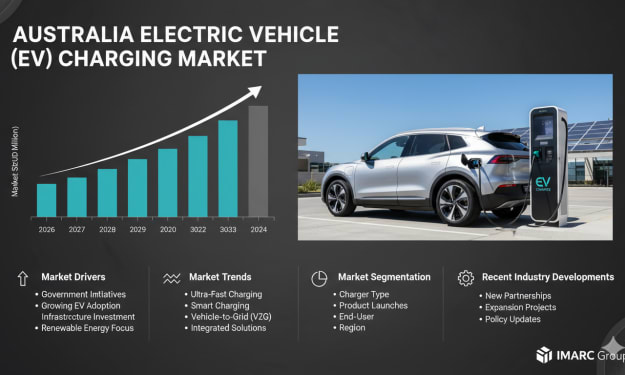
Australia Electric Vehicle (EV) Charging Market: Fast-Charging Infrastructure Expansion, Smart Charging Technologies & Public-Private Investments
According to IMARC Group, the Australia electric vehicle (EV) charging market reached a value of USD 304.4 Million in 2025 and is projected to reach USD 1,692.2 Million by 2034, growing at a compound annual growth rate (CAGR) of 21.00% during 2026–2034. The market is expanding rapidly as Australia accelerates the adoption of electric mobility and transitions toward a low-carbon transportation ecosystem. Electric vehicle charging infrastructure plays a critical role in supporting EV adoption by ensuring convenient and reliable access to charging services across cities, highways and regional areas. Governments and private sector stakeholders are investing heavily in public charging networks, fast-charging corridors and residential charging solutions. Technological advancements such as smart charging platforms, vehicle-to-grid (V2G) systems and integrated energy management solutions are also transforming the EV charging ecosystem. As electric vehicle ownership continues increasing and policy support strengthens nationwide charging infrastructure development, Australia’s EV charging market is becoming a cornerstone of the country’s sustainable mobility strategy.
By Kevin Cooper3 days ago in Futurism
Sometimes It's Like That and That'sThe Way It Is
It was the late 1960s, and ten-year-old Gloria Coleman was standing with her grandmother on the side of the highway waiting for the bus. As the Greyhound pulled up, it seemed monstrous and intimidating. Grandma Elizabeth grabbed Gloria's hand, holding it tightly as they boarded.
By Cheryl E Preston2 days ago in Fiction


Comments
There are no comments for this story
Be the first to respond and start the conversation.