
Digital Signage Market Size and Forecast 2025
From Static Displays to Smart Visual Communication: The Future of Digital Signage


Digital Signage Market Outlook at a Glance
The Digital Signage Market is projected to reach US$ 57.78 billion by 2033, growing from US$ 29.22 billion in 2024, at a robust CAGR of 7.87% during 2025–2033. This growth reflects the accelerating shift from traditional static signage toward dynamic, interactive, and data-driven visual communication platforms.
According to Renub Research, the market’s upward momentum is being fueled by rapid advances in display technologies, the rising adoption of smart city initiatives, increasing demand for digital advertising, and the need for real-time information delivery across industries such as retail, transportation, healthcare, education, and government.
Global Digital Signage Market Overview
The global digital signage market is undergoing a significant transformation as organizations increasingly prioritize engaging, visually immersive, and interactive communication tools. Digital signage encompasses LCD, LED, OLED, and projection-based displays that deliver multimedia content in real time for advertising, wayfinding, public information, and customer engagement.
Unlike static posters or billboards, digital signage offers flexibility, content personalization, and interactivity—allowing businesses and public institutions to tailor messages instantly based on audience, time, or location. From corporate offices and hospitals to shopping malls and transportation hubs, digital signage has become an essential component of modern communication infrastructure.
A key catalyst for this transformation is the rapid expansion of smart city programs worldwide. Governments are investing heavily in technology-driven urban development to enhance livability, sustainability, and operational efficiency. Digital signage plays a central role in these initiatives by enabling real-time public communication, interactive civic services, emergency alerts, and data visualization.
India’s Smart Cities Mission, launched in 2015, exemplifies this trend. By July 2024, over 7,200 projects had been completed, utilizing more than ₹144,000 crores. Digital signage solutions are widely deployed for traffic management, public announcements, interactive kiosks, and citizen engagement platforms. Globally, projections indicate that more than 500 cities may adopt digital twin technologies by 2025, potentially saving US$ 280 billion by 2030, with digital signage serving as a critical interface between digital systems and the public.
Key Factors Driving Digital Signage Market Growth
1. Advancements in Display Technologies
Technological innovation remains the backbone of digital signage growth. The increasing adoption of LED and OLED displays has significantly enhanced brightness, color accuracy, contrast ratios, and energy efficiency. Ultra-high-definition (4K and 8K) resolutions and seamless video walls are delivering cinema-quality visuals in commercial environments.
In addition, innovations such as transparent displays, curved screens, and micro-LED technology are expanding application possibilities across retail storefronts, museums, transportation hubs, and corporate spaces. The integration of artificial intelligence (AI) and analytics is further enhancing display responsiveness, content optimization, and audience measurement.
2. Expanding Opportunities in Digital Advertising
Digital signage has become a powerful advertising medium due to its ability to deliver targeted, context-aware, and visually compelling content. Retailers are increasingly deploying in-store digital displays to promote offers, guide customer journeys, and enhance brand experiences.
Healthcare providers are adopting digital signage to communicate health information, appointment schedules, and safety guidelines, while transportation authorities rely on it for schedules, wayfinding, and emergency messaging. Cloud-based content management systems (CMS) have made it easier to manage networks across multiple locations, enabling businesses of all sizes to participate in the digital signage ecosystem.
3. Growing Demand for Visually Appealing and Interactive Content
Modern consumers expect immersive and interactive experiences. Touch-enabled kiosks, gesture recognition, QR-code integration, and mobile connectivity are transforming digital signage from a passive display into an active engagement tool.
Large-format LED walls, virtual production environments, and immersive retail displays are gaining traction, particularly in entertainment, sports, and experiential marketing. Outdoor digital signage is also advancing rapidly, with improved brightness, durability, and weather resistance supporting deployment in smart cities, transportation corridors, and public spaces.
Challenges in the Digital Signage Market
High Initial Costs and Integration Complexity
Despite its advantages, digital signage adoption can be constrained by high upfront costs, including hardware procurement, software licensing, installation, and content creation. Small and medium-sized enterprises (SMEs) may struggle to justify the investment compared to traditional signage.
Integration with existing IT systems can also be complex, especially in large-scale deployments requiring network connectivity, cybersecurity safeguards, and ongoing maintenance. Managing diverse content formats, ensuring system uptime, and maintaining compatibility across hardware and software platforms can increase operational complexity.
Data Security and Content Management Risks
As digital signage systems become more connected and cloud-based, cybersecurity risks are increasing. Unauthorized access, data breaches, or content manipulation can undermine brand trust and public safety.
Effective digital signage strategies require robust encryption, access controls, real-time monitoring, and secure CMS platforms. Poor content governance can lead to outdated messaging, inconsistent branding, and reduced return on investment, emphasizing the need for skilled personnel and well-defined content workflows.
Digital Signage Market Overview by Region
United States Digital Signage Market
The United States represents one of the most mature digital signage markets globally. Adoption is widespread across retail, transportation, corporate, hospitality, and public sectors. Organizations leverage digital signage for branding, advertising, wayfinding, and emergency communication.
Growth is supported by advanced digital infrastructure, high cloud adoption, and strong demand for immersive customer experiences. AI-powered displays, real-time analytics, and interactive interfaces are gaining traction, while sustainability initiatives are encouraging energy-efficient signage solutions.
The hospitality and tourism sectors are also driving demand. According to the U.S. Bureau of Economic Analysis, travel and tourism output grew by 21% in 2022, boosting investments in interactive kiosks and digital advertising platforms.
United Kingdom Digital Signage Market
The UK digital signage market benefits from widespread digitization across retail, transportation, healthcare, and education. Smart displays are commonly used in airports, railway stations, shopping centers, and public institutions.
Interactive kiosks and touchscreens are increasingly deployed to enhance customer engagement and accessibility. Regulatory focus on sustainability and inclusive design is shaping deployment strategies, while ongoing investments in smart infrastructure continue to support market growth.
India Digital Signage Market
India is emerging as one of the fastest-growing digital signage markets globally. Rapid urbanization, infrastructure development, and digital transformation are driving adoption across government, retail, education, and transportation sectors.
Smart city initiatives, increasing internet penetration, and a young, tech-savvy population are accelerating demand. Digital signage is being used for public information systems, interactive learning environments, corporate communication, and advertising.
By 2024, nearly 90% of Smart Cities Mission projects had been completed, and rising affordability of hardware and software solutions is enabling SMEs to enter the market. Expanding broadband connectivity and improved display technologies are further strengthening India’s role in global market growth.
United Arab Emirates Digital Signage Market
The UAE is a leading digital signage market in the Middle East, driven by investments in smart cities, tourism, retail, and transportation. Cities such as Dubai and Abu Dhabi showcase advanced digital displays in malls, airports, hotels, and public spaces.
High digital literacy, strong connectivity, and a focus on premium customer experiences are fueling demand for interactive and large-format displays. Government-led smart infrastructure initiatives continue to position digital signage as a core component of the UAE’s urban communication ecosystem.
Recent Developments in the Digital Signage Industry
The digital signage industry is witnessing continuous innovation through partnerships, product launches, and large-scale deployments. Recent collaborations have focused on enhancing scalability, security, and performance of signage networks, while new LED video walls and cloud-integrated platforms are redefining user experiences across sports, education, and commercial environments.
Digital Signage Market Segmentation
By Type
Video Wall
Video Screen
Kiosk
Transparent LCD Screen
Digital Poster
Billboard
Other Types
By Component
Hardware
Software
Services
By Deployment
On-Premise
Cloud-Based
Hybrid
By Screen Size
Below 32"
32"–52"
Above 52"
Ultra-Large (Above 100")
By Location
In-store / Indoor
Outdoor
By End-Use Industry
Retail
Transportation
Hospitality
Corporate
Education
Healthcare
Government
Sports & Entertainment
Banking & Financial Services
Manufacturing Facilities
Competitive Landscape
The global digital signage market features a mix of multinational corporations and specialized solution providers. Companies compete on technology innovation, software capabilities, display quality, scalability, and service offerings. Strategic partnerships, acquisitions, and continuous product development remain key strategies for market leadership.
Final Thoughts
The digital signage market is entering a dynamic growth phase, driven by technological innovation, smart city expansion, and the rising importance of visual communication. As organizations seek more engaging and efficient ways to connect with audiences, digital signage is evolving into an intelligent, interactive, and data-driven platform.
While challenges related to cost, integration, and cybersecurity persist, ongoing advancements in cloud computing, AI, and display technologies are steadily lowering adoption barriers. With strong demand across retail, transportation, healthcare, and government sectors, and significant opportunities in emerging markets, digital signage is poised to remain a cornerstone of modern communication strategies through 2033 and beyond.
About the Creator
jaiklin Fanandish
Jaiklin Fanandish, a passionate storyteller with 10 years of experience, crafts engaging narratives that blend creativity, emotion, and imagination to inspire and connect with readers worldwide.
Keep reading
More stories from jaiklin Fanandish and writers in Futurism and other communities.
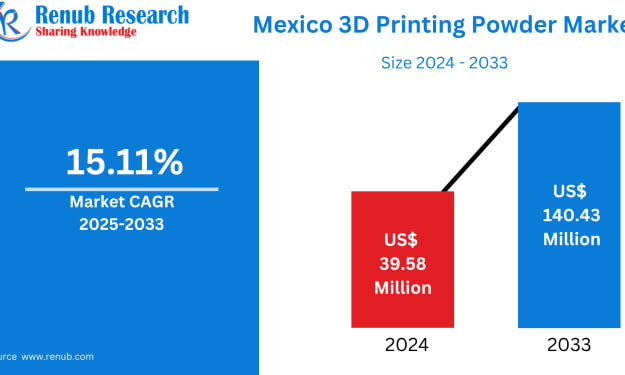
Mexico 3D Printing Powder Market Size and Forecast 2025–2033
Mexico 3D Printing Powder Market Outlook The Mexico 3D Printing Powder Market is witnessing a phase of rapid and sustained growth as additive manufacturing becomes an integral part of the country’s industrial ecosystem. According to Renub Research, the market is expected to grow from US$ 39.58 million in 2024 to US$ 140.43 million by 2033, expanding at a strong CAGR of 15.11% from 2025 to 2033.
By jaiklin Fanandish20 days ago in Futurism
About Binding Prometheus
I want to start actively advocating on behalf of my own work, and the most valuable part of my canon is, without a doubt, Binding Prometheus, the play I have been working on since 2019 and only finished in 2023 as part of my MA. The play itself is an amalgamation of a million different inspirations. On one end, it evokes the Ancient Greek myth-play, deriving its own title from the earliest extant work of Western drama we have, Aeschylus’s Prometheus Bound. On the other end, it borrows significantly from the sci-fi bulwarks from over the years, namely Mary Shelley’s Frankenstein and Karel Capek’s Rossum’s Universal Robots. The play could be an episode of Black Mirror, I fear. I don’t know. I’ve only ever seen one episode of Black Mirror.
By Steven Christopher McKnight14 days ago in Futurism
United States Cannabis Market Size & Forecast 2026–2034
Introduction The United States cannabis industry is entering a defining decade. What was once a tightly regulated and socially controversial product category has evolved into a structured, multi-billion-dollar commercial ecosystem spanning agriculture, pharmaceuticals, wellness, retail, and consumer packaged goods. According to Renub Research, the United States Cannabis Market is projected to grow from USD 11.73 billion in 2025 to USD 40.41 billion by 2034, registering a robust compound annual growth rate (CAGR) of 14.73% from 2026 to 2034.
By Marthan Sir6 days ago in Futurism


Comments
There are no comments for this story
Be the first to respond and start the conversation.