
Contrary to popular perception, far-side observations show that Earth's moon is not "dead."
Young ridges on the other side of the moon

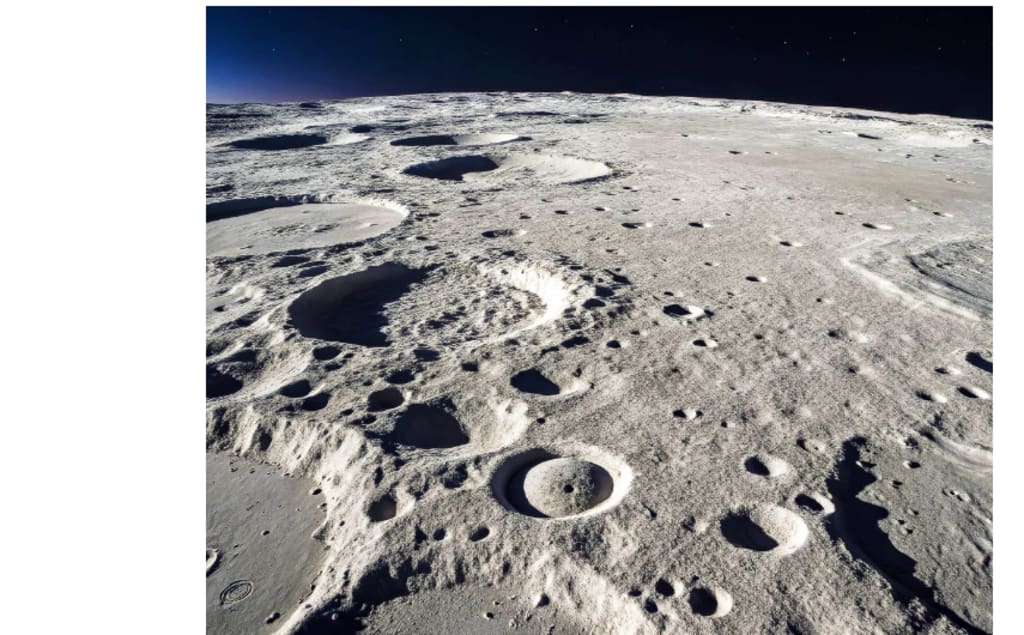
For a long time, the moon appeared to be a world that had completed its major transformations before becoming silent. Although there are still scars on its surface from heavy impacts and past lava floods, many experts have viewed such features as remnants of a far older era.
A twist is added by fresh data from the moon's far side. There are indications in some areas of that buried hemisphere that the crust continued to move much more recently than most people had anticipated.
Lunar maria are flat, black lava plains with long, arching ridges that scientists have tracked. When the ground is compressed and buckles, those ridges are created.
Since many of the most well-known ridges are located on the moon's near side, scientists have frequently linked them to a significant period of compression and shrinkage billions of years ago, assuming the maria remained largely still after then.
On the other side, a different pattern is reported by a study that was published in The Planetary Science Journal. Under the direction of Jaclyn Clark, an assistant research scientist in the University of Maryland's Department of Geology, researchers from the Smithsonian Institution and the University of Maryland produced the work.
Young ridges on the other side of the moon
The scientists discovered that the large, recognisable ridges on the near side appear far older than the tiny ridges on the far side.
According to Clark, "many scientists think that the majority of the moon's geological movements occurred two and a half, maybe three billion years ago."
However, it appears that these tectonic land forms have been active in the last billion years and might be active even now. Given the moon's chronology, these tiny mare ridges appear to have originated within the last 200 million years or so.
The researchers discovered 266 hitherto unidentified little ridges on the far side through meticulous mapping and modelling. Within volcanic regions that most likely developed between 3.2 and 3.6 billion years ago, they frequently appeared in clusters of 10 to 40.
This combination is important because weak zones can concentrate stress so that the crust deforms in certain areas rather than dispersing strain uniformly, and old lava plains can conceal weak zones beneath.
Surface crater counting
The scientists utilised crater counting, a common method for dating surfaces around the solar system when rocks cannot be brought back to a lab, to determine when these ridges developed.
"In general, the more craters a surface has, the older it is; the surface has more time to accumulate more craters," Clark clarified. In addition to counting craters close to the ridges, the researchers examined the interaction between the ridges and adjacent impacts.
Certain ridges cut across preexisting craters, indicating that the ground moved after the craters were created. For certain places, this association suggests that tectonic action occurred within the previous 160 million years—a blink of an eye on the moon's chronology.
The forces behind the ridges of the moon
The shape and structure of the near-side and far-side ridges are similar, indicating that the same fundamental forces produced both.
One reason is basic physics: the moon has cooled over time, and contraction results from cooling. The exterior crust experiences compressive stress when the inside decreases even little, and ridges may appear when the surface gives way.
Changes in orbit can also increase stress. The tug-of-war between Earth's gravity and the moon's solid crust can assist load some areas when the moon's route and orientation change over extended periods of time.
When those stresses are added to earlier volcanic terrain that already has weak places, it becomes simpler to explain small, youthful ridges without the requirement for large-scale resurfacing or new lava.
Shallow moon quakes, a long-standing conundrum from the Apollo era, are also consistent with this recent tectonic activity.
Moon quakes that didn't fit neatly into the concept of a completely lifeless interior were detected by Apollo sensors. The kind of ridges currently mapped on the far side are plausibly related to those earthquakes due to active faults and continuous compression.
Consequences for upcoming lunar expeditions
Future missions want to develop more durable infrastructure, transport heavier equipment, and spend more time on the moon. When planning landing locations, habitats, power systems, and storage places, any location that still shakes, slips, or cracks is important.
"In order to help researchers better understand the structures beneath the lunar surface, we hope that future missions to the moon will include tools like ground-penetrating radar," Clark stated.
"There are very real implications for where we plan to put our astronauts, equipment, and infrastructure on the moon given that the moon is still geologically dynamic."
Surface photographs are unable to display buried layers, broken zones, or the geometry of subsurface structures, but ground-penetrating radar can.
In order to map active faults and the thickness of rock strata that either protect or threaten a base, seismo meters are able to determine where earthquakes occur and how energy moves through the crust.
Lunar geology and far side ridges
Without the complicated impacts of oceans, weather, and plate tectonics, ridges on the moon provide a clear illustration of how a rocky body cools, contracts, and reacts to long-term gravitational forces.
Because of this, the moon can be used as a benchmark for other rocky worlds, such as Mercury, as well as for certain huge moons surrounding the outer planets that exhibit deformation and breaking.
The questions that mission planners can ask are also altered by the far side result. They can approach the moon as a location with a slow but genuine geologic pulse, one that leaves traces in tiny ridges, damaged craters, and sporadic earthquakes, rather than as a static construction site.
About the Creator
Keep reading
More stories from Francis Dami and writers in Futurism and other communities.
Before they disappear, scientists are racing to name ocean creatures.
Our oceans are home to millions of species, many of which are still unidentified. Tragically, too, a great number of species are disappearing before we even realise they exist. Some vanish forever without being studied, photographed, or comprehended for their part in the complex web of life on Earth.
By Francis Dami5 months ago in Futurism
Digital Smart Education Ecosystem Market to Reach USD 4,177.2 Billion by 2034
The global digital smart education ecosystem market is undergoing rapid transformation as advanced technologies reshape how educational services are delivered and managed. The market is projected to grow from USD 420.8 billion in 2024 to approximately USD 4,177.2 billion by 2034, reflecting a strong 25.80% CAGR during the forecast period. This expansion is being driven by the integration of digital learning platforms, artificial intelligence systems, cloud computing infrastructure, and connected classroom technologies.
By Roberto Crum7 days ago in Futurism




Comments
There are no comments for this story
Be the first to respond and start the conversation.