
Chinese Humanoid Robots Get Reality Check in Half-Marathon Debut
Chinese Humanoid Robots Face Hurdles in First Half Marathon Highlighting the Challenges of Human like Mobility and Endurance

Chinese Humanoid Robots Get Reality Check in Half-Marathon Debut
Chinese Humanoid Robots Face Hurdles in First Half Marathon Highlighting the Challenges of Human like Mobility and Endurance
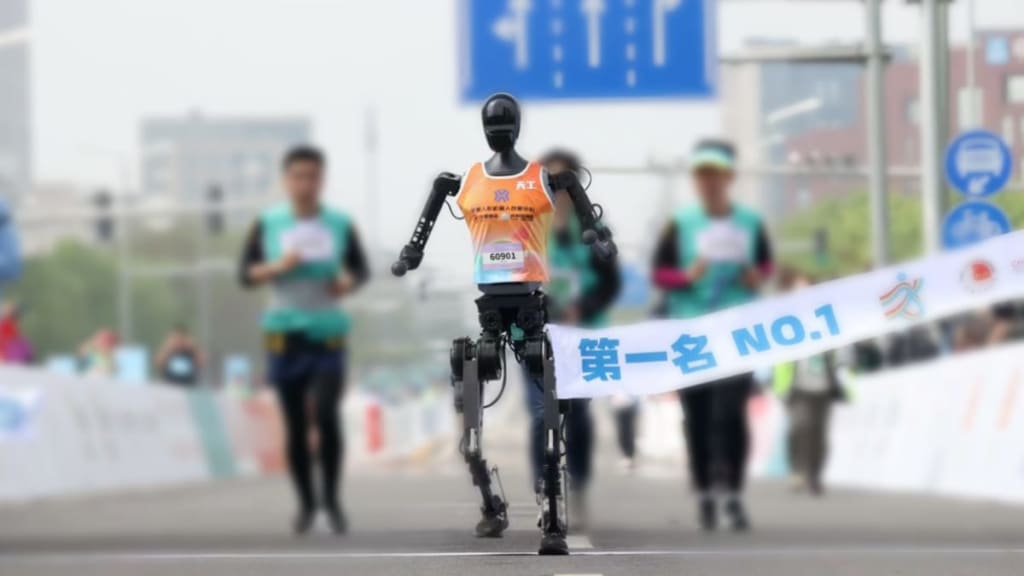
In a groundbreaking event that caught the attention of technology enthusiasts and skeptics alike Chinese humanoid robots made their debut in a half-marathon race, attempting to showcase the nation's advancements in robotics. The event, which took place at a sports stadium in Shanghai, marked a significant moment in the development of humanoid robots designed to mimic human movements, offering both impressive and humbling moments for the ambitious project. However, it was clear that these machines still face significant hurdles before they can compete with human athletes, even in a non-competitive context like a race.
The competition involved several robots, each designed and built by various Chinese tech firms and universities specializing in AI and robotics. The race was not about speed or records; it was an opportunity to test the robots' endurance, mobility, and efficiency over the challenging 21.1-kilometer course. The event served as a platform for testing the robots' ability to perform tasks like walking, running, and managing the physical strain of a long-distance race — tasks that, for humans, require years of conditioning, but are still incredibly difficult for machines to replicate.
The Robots: Highly Advanced Yet Far from Perfect
The robots were built with state-of-the-art hardware and software to replicate human walking and running motion. Featuring highly advanced sensors, cameras, and artificial intelligence, these robots were designed to navigate various obstacles and environmental conditions, much like an athlete might during a marathon. However, despite their advanced design, the robots faced challenges throughout the race.
One of the most significant hurdles was maintaining balance. As the robots traversed the course, many experienced difficulty maintaining stability, particularly when navigating turns or uneven surfaces. While the robots' walking capabilities were impressive, their running abilities fell short. The higher speeds led to more pronounced issues with balance, causing several robots to stumble or even fall, forcing them to rely on human assistance to get back on track.
Another challenge was the robots' energy consumption. Despite being equipped with high-performance batteries, many robots struggled to complete the half-marathon distance without needing to pause for a recharge. The strain of continuous movement caused some robots to overheat or run out of battery life before they could finish the race. This is a clear indication of the limitations of current battery technology in humanoid robots, which will need significant improvements before such machines can be considered practical for long-term applications.
The Unexpected Reality Check
While the robots' performance in the race was impressive in terms of their technological feats, they also served as a reminder of how much work remains before humanoid robots can fully match human performance in physically demanding tasks. The race, designed as a demonstration of the potential of robotics in real-world applications, highlighted several critical gaps in the technology.
One of the most glaring realities was the robots' reliance on human support. While their movements and ability to navigate obstacles showed promise, many robots needed to be manually adjusted, reset, or assisted during the race. This revealed that, despite their sophisticated design, the robots are still far from being autonomous, and their reliance on external help raises questions about their practicality in real-world scenarios where human assistance may not always be available.
Moreover, the robots’ physical endurance was far from comparable to human athletes, even in an event that did not require speed. They struggled with fatigue, their battery life was limited, and their ability to adjust to changing terrain was far below the level of a trained human. These limitations suggest that the development of humanoid robots capable of performing physical tasks with the same endurance and efficiency as humans will require years, if not decades, of further research and refinement.
The Road Ahead: Challenges and Opportunities
Despite the challenges faced by the robots in their half-marathon debut, the event was still a significant achievement. It served as a vital testing ground for China’s robotics industry and provided valuable insights into areas where improvements are needed. For instance, advancements in battery technology and energy efficiency will be crucial to enabling longer-lasting robots. Additionally, improvements in AI algorithms for balance, navigation, and decision-making will be key to enhancing the robots' overall performance.
The event also highlighted the immense potential of humanoid robots in various sectors, such as healthcare, service industries, and disaster response. Although they may not yet be capable of competing in long-distance races, humanoid robots could play an important role in tasks that require human-like interaction or movement, particularly in controlled environments.
In conclusion, the half-marathon race was both a triumph and a reality check for the Chinese humanoid robots. While their debut demonstrated the impressive capabilities of modern robotics, it also underscored the significant hurdles that remain in perfecting these machines for real-world applications. The race served as a reminder that, while the future of robotics is promising, there is still a long way to go before humanoid robots can fully replicate the physical prowess and endurance of humans. The race may have been just a small step in the journey of robotics, but it is one that will no doubt drive further innovation and breakthroughs in the years to come.
About the Creator
Adnan Rasheed
Author & Creator | Writing News , Science Fiction, and Worldwide Update| Digital Product Designer | Sharing life-changing strategies for success.
Keep reading
More stories from Adnan Rasheed and writers in Futurism and other communities.
Musk says Tesla's Optimus humanoid robots affected by China's export curbs on rare earths
Musk says Tesla's Optimus humanoid robots affected by China's export curbs on rare earths Tesla’s Ambitious Robot Project Faces Setbacks as China’s Rare Earth Export Curbs Disrupt Supply Chains
By Adnan Rasheed11 months ago in Futurism
Contract Catering Market: How AI Is Transforming Institutional Food Services
AI Overview of the Contract Catering Market Contract catering refers to outsourced food services provided under long-term agreements to institutions such as offices, hospitals, schools, airlines, and industrial sites. Unlike traditional restaurants, contract catering companies operate within client premises, offering tailored food solutions that align with organizational needs.
By James Smith7 days ago in Futurism
Vinyl Record Market Trends: Music Collectibles, Analog Revival & Forecast to 2034
Vinyl is no longer a relic of the past — it's one of the most exciting growth stories in the global music industry. Fueled by nostalgia, the enduring appeal of analog sound, and a passionate collector community, the global vinyl record market is on a firm upward trajectory. According to IMARC Group's latest research, the global vinyl record market size reached USD 2.1 Billion in 2025. Looking ahead, IMARC Group expects the market to reach USD 3.6 Billion by 2034, exhibiting a CAGR of 6.50% during 2026-2034. Asia Pacific currently dominates the global market, driven by growing middle-class spending, flourishing indie music scenes, and strong collector culture across the region.
By Suhaira Yusuf4 days ago in Futurism
Top tipple tricks
Been thinking a lot about drinking, lately. Not least because of a recent episode of over-indulgence and the inevitable after effects. Some readers may recall the earlier articles I wrote about beating the booze. Here I set out an experiment in techniques for cutting down on my alcohol intake. The experiment was successful, the techniques worked, and I have armed myself with an arsenal of weapons in the war against the demon drink. I have yet to fire the first round however. It's all a question of timing (perhaps procrastination).
By Raymond G. Taylora day ago in Psyche



Comments
There are no comments for this story
Be the first to respond and start the conversation.