
China vs USA in Humanoid Robot Race: How China is Taking the Lead in 2025
China is surging ahead in the humanoid robotics revolution, challenging U.S. dominance with massive investments, innovative tech, and a national strategy aimed at global leadership.

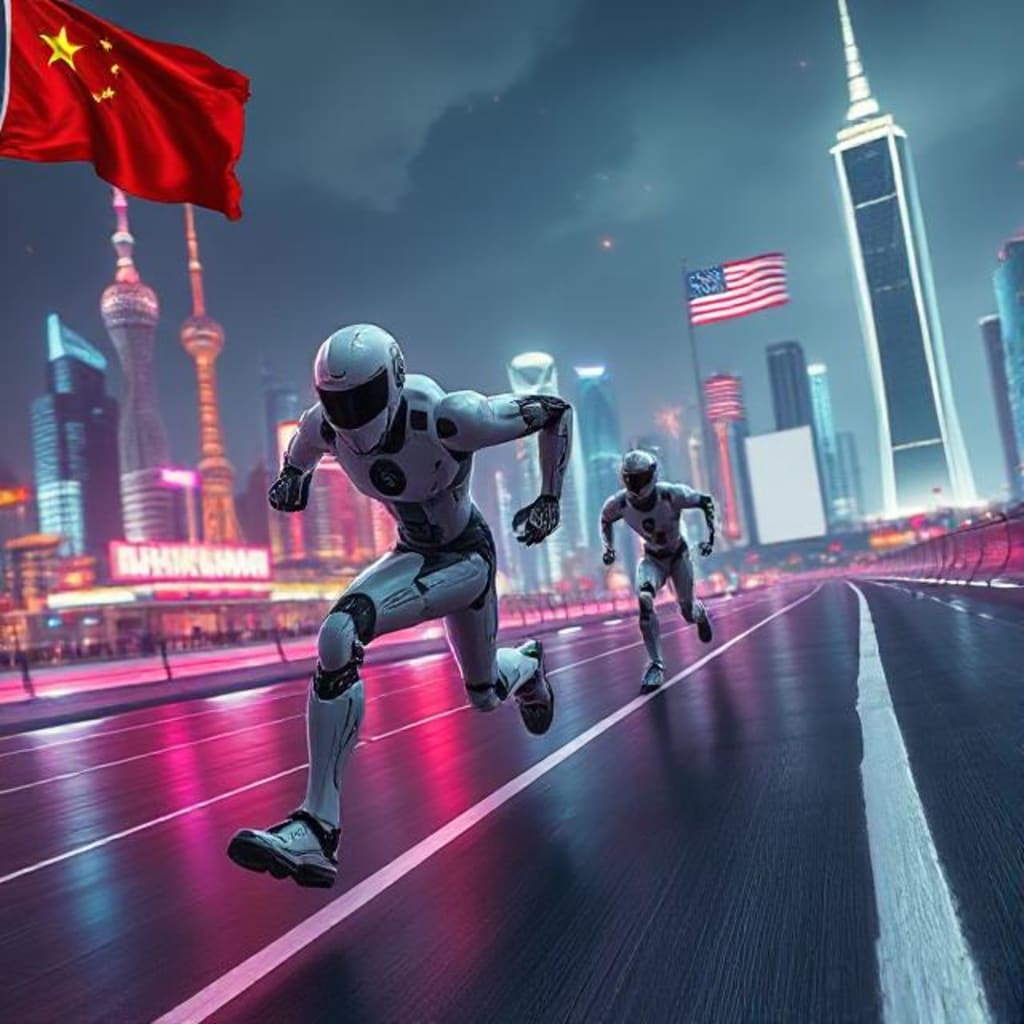
In the fast-moving arena of humanoid robotics, China is making significant strides, increasingly challenging the United States' long-standing technological supremacy.b0f97f Once viewed as a follower in high-end robotics, China is now rapidly positioning itself as a global leader through focused investment, innovative breakthroughs, and state-backed initiatives.ac47b3 This growing prowess is evident as Chinese humanoid robots begin to rival—and in some cases surpass—their Western counterparts in dexterity, functionality, and mass production potential.5cd6be
China's upper hand in humanoid robotics did not emerge by chance. It is the result of a coordinated national strategy. In late 2023, the Chinese government released a detailed policy document outlining its ambitions for the humanoid robot industry. The goal is clear: by 2025, China aims to achieve mass production capabilities and establish world-class industrial clusters focused on robotics.907688 This directive came with heavy state investment and incentives for both state-owned enterprises and private tech giants. As a result, companies like UBTECH Robotics, Fourier Intelligence, and Xiaomi have accelerated their efforts in developing lifelike humanoid robots with advanced motor skills, facial recognition, and emotional interaction capabilities.
China's Breakthroughs and Key Milestones
One of the most striking demonstrations of China's progress came in August 2025, when Beijing hosted the world's first World Humanoid Robot Games.38aef4 About 500 robot athletes from 16 countries competed in events like racing, fighting, and obstacle courses, showcasing awkward yet impressive feats of agility and AI.356800 This event not only highlighted China's organizational prowess but also underscored its technological edge, with local robots dominating in physical tasks due to superior cost-effective manufacturing and agility.97ca9a
Companies like Unitree are at the forefront, with plans for a $7 billion IPO valuation, positioning them as early leaders in humanoid robot commercialization.21bcfa Unitree's robots are known for their affordability and rapid deployment, making them ideal for industrial applications, healthcare, and even entertainment. Meanwhile, UBTECH has pushed boundaries with robots capable of complex interactions, leveraging China's vast supply chain to scale production faster than U.S. competitors.
The U.S. Response: Innovation vs. Scale
The United States, long a pioneer in robotics through companies like Boston Dynamics and Tesla, excels in advanced AI integration.c4d711 Tesla's Optimus robot, for instance, draws on neural networks from its autonomous vehicles to perform sophisticated tasks. However, the U.S. faces challenges in mass production, where China's manufacturing ecosystem gives it a clear advantage.5f7e53 American firms are investing heavily—Boston Dynamics continues to innovate in dynamic movement—but geopolitical tensions, including export controls on AI tech, have slowed collaborative efforts.
This rivalry is often compared to a new "space race," with humanoid robots poised to transform economies by automating labor in factories, elder care, and hazardous environments.31fded While the U.S. leads in cutting-edge research, China's ability to produce at scale could flood global markets with affordable humanoids, shifting the balance of power.
Challenges Ahead for Both Nations
Despite the progress, hurdles remain. For China, integrating top-tier AI to match U.S. models is a key challenge, as American firms dominate in generative AI.f74910 Ethical concerns, such as job displacement and data privacy, also loom large. In the U.S., regulatory scrutiny and funding gaps could hinder acceleration.
Yet, the race is heating up. China's state-driven approach contrasts with the U.S.'s private-sector innovation, creating a dynamic competition that could accelerate global advancements in robotics.
Future Vision: A World Transformed by Humanoids
By 2025 and beyond, China's lead could redefine industries worldwide. Imagine humanoid robots assisting in disaster relief, performing surgeries, or even exploring space—all at a fraction of current costs. This isn't just about technology; it's about economic dominance in the AI era.
As the U.S. and China vie for supremacy, the winner may not be a single nation but humanity itself, benefiting from rapid innovations. However, collaboration—or at least healthy competition—will be crucial to avoid a fragmented future.
SEO KEYWORD:
China humanoid robots 2025, USA vs China robot race, Chinese robotics leadership, Unitree IPO, World Humanoid Robot Games, UBTECH robots, Tesla Optimus vs Chinese robots, AI robotics competition, Mass production humanoid robots, State-backed robotics China, Future of humanoid robots, China robotics policy 2023, Fourier Intelligence robots, Xiaomi humanoid tech, Global robotics supremacy.
artificial intelligence tech futurism science robotics china usa competition innovation ai.
About the Creator
Muhammad Riaz
- Writer. Thinker. Storyteller. I’m Muhammad Riaz, sharing honest stories that inspire, reflect, and connect. Writing about life, society, and ideas that matter. Let’s grow through words.
Keep reading
More stories from Muhammad Riaz and writers in Futurism and other communities.
AI-Powered Cities: How Artificial Intelligence Could Run Entire Nations by 2035
The Future of Civilization Is Changing It’s no longer a question of if artificial intelligence will reshape society—it’s how fast. According to leading researchers, by 2035, AI won’t just assist us with work, shopping, or entertainment. It could become the invisible backbone of entire cities, nations, and even global systems.
By Muhammad Riaz4 months ago in Futurism
About Binding Prometheus
I want to start actively advocating on behalf of my own work, and the most valuable part of my canon is, without a doubt, Binding Prometheus, the play I have been working on since 2019 and only finished in 2023 as part of my MA. The play itself is an amalgamation of a million different inspirations. On one end, it evokes the Ancient Greek myth-play, deriving its own title from the earliest extant work of Western drama we have, Aeschylus’s Prometheus Bound. On the other end, it borrows significantly from the sci-fi bulwarks from over the years, namely Mary Shelley’s Frankenstein and Karel Capek’s Rossum’s Universal Robots. The play could be an episode of Black Mirror, I fear. I don’t know. I’ve only ever seen one episode of Black Mirror.
By Steven Christopher McKnight19 days ago in Futurism




Comments
There are no comments for this story
Be the first to respond and start the conversation.