
China Hits the Moon With a Laser: First Daylight Lunar Reflection in History Stuns Scientists and Ignites Global Space Race
In a historic scientific breakthrough China becomes the first nation to successfully reflect a laser off the Moon during daylight redefining space communication and intensifying the global race for lunar dominance.

China Hits the Moon With a Laser: First Daylight Lunar Reflection in History Stuns Scientists and Ignites Global Space Race
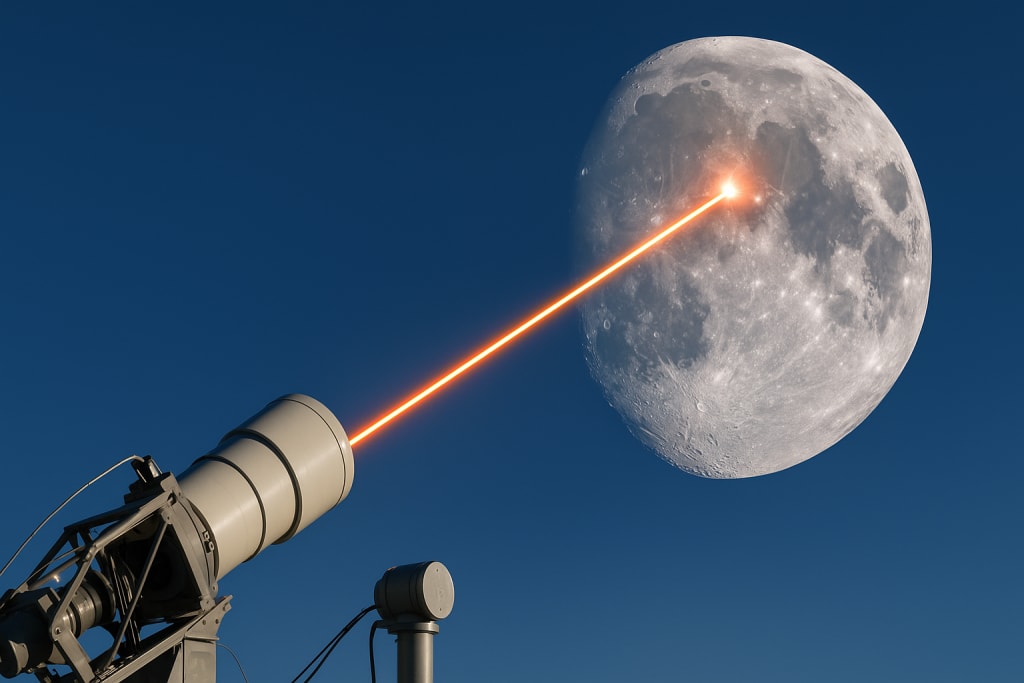
In a groundbreaking achievement that has stunned the global scientific community and triggered a new wave of international competition in space exploration China has successfully targeted the Moon with a powerful laser beam during daylight an unprecedented feat. The historic reflection of the laser beam back to Earth marks the first ever successful daylight lunar laser ranging opening new doors for precision space communication deep space navigation and global space dominance. This monumental experiment was carried out by the Chinese Academy of Sciences (CAS) using a high power laser system developed at the Aerospace Information Research Institute. Unlike previous laser ranging missions conducted during night hours when atmospheric interference is minimal this attempt took place in broad daylight a much more difficult and scientifically significant endeavor. The laser beam was fired from a terrestrial station and managed to strike a retroreflector left on the Moon’s surface which then bounced the light back to Earth. What astonished scientists was the clarity and precision of the reflection despite the Sun’s overwhelming brightness during the day. According to the lead scientist of the mission Dr. Liu Qiang This is not just a national achievement but a milestone in human space capability. Daylight lunar ranging was once considered nearly impossible due to atmospheric scattering and background light interference. We've now overcome that barrier.
Why Daylight Lunar Laser Reflection Matters
Laser ranging is a crucial component in modern space science. It allows scientists to measure the distance between Earth and the Moon with millimeter level accuracy. These measurements are essential for lunar mapping satellite navigation and verifying aspects of general relativity. Conducting such measurements in daylight provides greater flexibility and more frequent opportunities to gather data. Until now scientists were limited to nighttime sessions but China’s breakthrough eliminates that constraint significantly increasing the efficiency of lunar research and spacecraft positioning. Additionally this achievement demonstrates the capability of China’s advanced adaptive optics and atmospheric filtering systems which enabled the laser to penetrate the atmosphere and reach the Moon with pinpoint accuracy a critical capability for future space communication networks and lunar bases. This success is not only a scientific triumph but also a strategic signal. As the U.S China India and private companies like SpaceX and Blue Origin ramp up their lunar ambitions China's achievement in laser based Moon targeting during daylight shows its rapid progression in space technology. Space experts believe this event could shift global priorities. Dr. Emily Carter a space policy analyst at MIT commented This sends a clear message China is not just catching up it is setting the pace. We may be looking at a new era of laser communication with Moon bases and China is now leading that frontier. Indeed this could be a precursor to a more ambitious vision where laser communication replaces or enhances current radio frequency systems offering higher bandwidth and lower latency crucial for real time command lunar internet and interplanetary networks.
Scientific and Military Ramifications
While the scientific benefits are immense experts also warn about potential military applications. High powered lasers capable of interplanetary accuracy could also be adapted for defense systems or satellite targeting. The dual use nature of such technology has drawn attention from global defense circles. The U.S Department of Defense has not officially responded but anonymous sources suggest American agencies are reviewing the implications of China’s new laser capability. Meanwhile India and the European Space Agency have expressed admiration and emphasized the need for more international collaboration and transparency in such developments.
Public Reaction and What’s Next
News of the laser reflection has gone viral across social media and news outlets worldwide. Chinese citizens are celebrating the success as a national pride moment while international scientists are calling for more open data sharing to foster collaborative progress. China has already announced plans to further enhance its lunar laser ranging systems and possibly deploy an even more advanced reflector array on the Moon with the upcoming Chang’e-7 mission scheduled for launch in 2026. In response the U.S is reportedly accelerating its own lunar communication and laser research projects under NASA’s Artemis program. The space race that once symbolized the Cold War has now taken on a high tech 21st century form one that’s fought not with rockets alone but with lasers and light. China’s successful daylight laser reflection from the Moon is more than a technological first it’s a bold leap forward in humanity’s pursuit of the stars. With potential implications for science communication defense and geopolitics the world now watches closely as the next chapter in the global space race begins brighter faster and more focused than ever before.
About the Creator
Adnan Rasheed
Author & Creator | Writing News , Science Fiction, and Worldwide Update| Digital Product Designer | Sharing life-changing strategies for success.
Keep reading
More stories from Adnan Rasheed and writers in Futurism and other communities.
China Stunned by US Jet: SR-72 Hypersonic Aircraft to Fly at Over Mach 5 in 2025, Triggering Shock and Panic in Beijing
China Stunned by US Jet: SR-72 Hypersonic Aircraft to Fly at Over Mach 5 in 2025, Triggering Shock and Panic in Beijing The United States is preparing to usher in a new era of aerial dominance with the anticipated flight of the SR-72 hypersonic aircraft in 2025. Known as the “Son of Blackbird,” the SR-72 is the successor to the legendary SR-71 Blackbird and is capable of flying at speeds exceeding Mach 5—over 3,800 miles per hour. The announcement has reportedly stunned Chinese defense analysts, triggering alarm in Beijing over the strategic imbalance this aircraft may create.
By Adnan Rasheed11 months ago in Futurism
Mobile Gaming Market Trends: Esports Growth, Competitive Gaming & Forecast to 2033
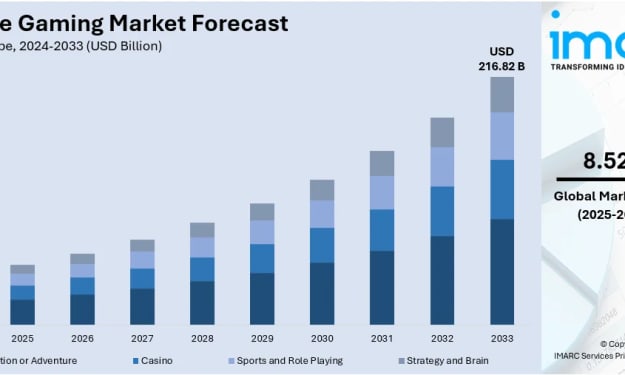
Smartphones have quietly become the world's most popular gaming console — no expensive hardware, no downloads, just a tap and play. That shift is fueling one of the fastest-growing segments in the entire technology sector. According to IMARC Group's latest research, the global mobile gaming market was valued at USD 100.08 Billion in 2024. Looking ahead, IMARC Group estimates the market to reach USD 216.82 Billion by 2033, exhibiting a CAGR of 8.52% from 2025 to 2033. Asia Pacific currently dominates the market, holding a market share of 58.9% in 2024. The region's lead is built on a massive tech-savvy population, rapid smartphone adoption, robust digital infrastructure, and consistent government investment in connectivity.
By Suhaira Yusuf6 days ago in Futurism
Stanislav Kondrashov: How Circumvention Drives Technological Breakthroughs
Innovation rarely follows a straight path. Many of the most meaningful technological advances emerged not from perfectly planned strategies but from creative detours around obstacles. In this context, the concept of circumvention becomes an unexpected catalyst for discovery. Rather than representing avoidance, it reflects the ability to rethink limitations and approach challenges from new angles.
By Stanislav Kondrashovabout 6 hours ago in Futurism


Comments (1)
Nice article!!!