
ChatGPT Is Making Your Brain Lazy? New MIT Study Reveals Alarming Mental Side Effects of Relying on AI
Scientists uncover how overusing AI tools like ChatGPT may be weakening creativity, memory, and the human touch in your work

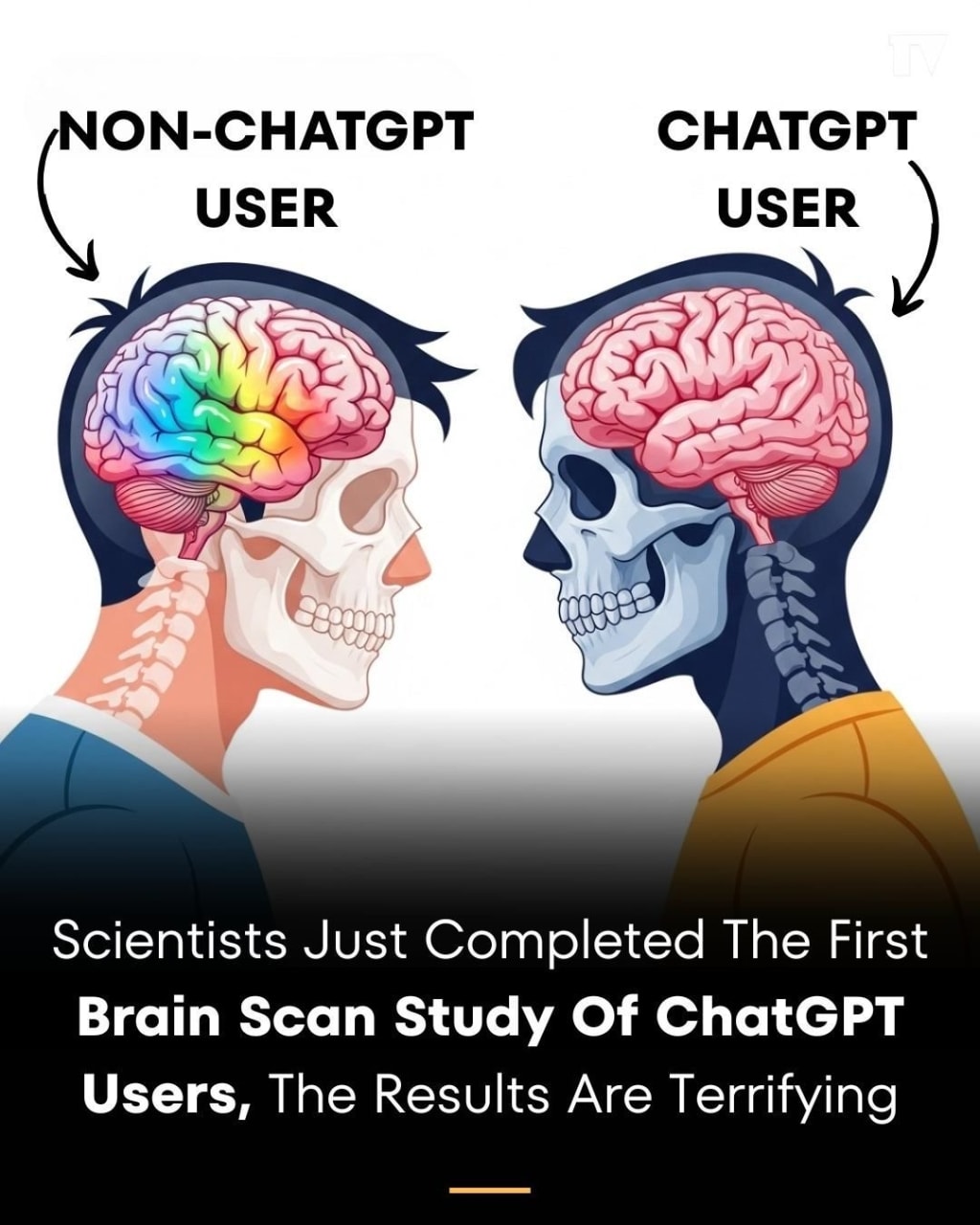
Is Your Brain Getting Rusty Thanks to ChatGPT?
In today’s world, where artificial intelligence tools like ChatGPT are becoming as common as coffee in the workplace, a growing number of people are using them to help write emails, essays, reports, and even books. But while AI can speed things up, a new study out of MIT is raising serious questions about what it’s doing to our brains in the process.
According to this new research, using ChatGPT may be causing a measurable drop in mental activity especially when it comes to how our brains connect thoughts, solve problems, and retain information. In short, the convenience of AI might come at the cost of creativity, memory, and the deep sense of ownership we typically feel over our work.
The study’s findings point to a potentially dangerous side effect of heavy AI reliance: a phenomenon researchers are calling “metacognitive laziness.” In plain terms, our brains might be taking the backseat when AI drives the writing process.
So, are we trading mental strength for convenience? Here’s a closer look at what the MIT researchers found and why it matters.
The Study: ChatGPT vs. Search vs. Your Brain Alone
Researchers at MIT conducted an experiment involving 54 participants who were asked to write essays in three different ways: completely unaided, using Google Search, and using ChatGPT.
To track how their brains responded to each method, participants wore EEG caps devices that monitor electrical activity in the brain. These caps helped researchers understand how connected and active different parts of the brain were during the writing tasks.
Here’s what they discovered:
• Participants who wrote entirely on their own (no AI or search tools) showed the highest levels of neural connectivity. Their brains were fully engaged, working harder to recall information, form original ideas, and structure arguments. They also reported feeling more ownership and connection to what they wrote.
• Those who used Google Search showed a moderate level of brain activity. They were still engaged in the writing process, but relied somewhat on outside help to find facts and support their ideas.
• Those who used ChatGPT had the lowest brain engagement. In fact, the researchers observed around 55% less neural interconnectivity in this group. Their brains were more passive, and many participants said the final results felt impersonal or “soulless”—even though the writing itself was technically fine.
Perhaps most concerning, this cognitive dulling didn’t just stop when the tool was removed. Participants who had used ChatGPT consistently showed reduced brain activity even when later asked to write without it. That lingering mental sluggishness is what the study refers to as “cognitive debt.”
“Soulless” Work and Memory Lapses
Teachers and writing experts brought in to review the essays noted that the ChatGPT-assisted work, while grammatically correct and well-organized, lacked emotional depth and originality. These essays felt like they were written by a machine—and in many ways, they were.
What’s more, many participants in the ChatGPT group couldn’t remember key phrases or ideas from their own essays. That’s because they hadn’t gone through the mental process of creating them. When you rely too much on AI to write for you, your brain doesn’t fully absorb or “own” the material. It’s like asking someone to read a script they didn’t write—they may say the words, but the connection just isn’t there.
What’s Actually Happening to the Brain?
The EEG scans used in this study gave researchers a detailed look at how different brain regions were firing during each writing task. In the Brain-only group, multiple regions particularly those involved in memory recall, decision-making, and problem-solving were lighting up and working together.
This high neural interconnectivity is a good thing. It suggests the brain is actively engaged, thinking critically, and processing information on a deeper level.
But in the ChatGPT group, that interconnectivity dropped sharply. The brain appeared to be more “idle,” simply approving and copying what the AI provided, rather than generating, questioning, or shaping ideas. Over time, this leads to what the researchers call “metacognitive offloading”—handing over cognitive effort to a machine and losing the mental benefits that come with doing the hard thinking yourself.
Efficiency vs. Engagement
There’s no question that AI tools like ChatGPT make writing faster. In many professional settings, speed and clarity are critical and AI delivers that. But there’s a trade-off: less cognitive engagement means weaker skills over time.
The researchers stress that this isn’t a call to avoid AI altogether. Rather, it’s a warning about passive use. If you’re just copying and pasting AI responses without critical thought, you’re not exercising your brain. And like any muscle, when your brain isn’t used, it weakens.
What Can You Do to Use ChatGPT Wisely?
Instead of letting ChatGPT write for you, the smarter move is to treat it like a brainstorming partner or rough-draft assistant. Here are a few tips:
• Start with your own outline or ideas, then use AI to expand or clarify them.
• Ask ChatGPT for alternative perspectives, but decide for yourself which ones are strongest.
• Edit everything you get add personal insights, refine the tone, and make the writing truly yours.
• Quiz yourself on the content afterward to strengthen memory and understanding.
These small changes keep your brain in the driver’s seat, helping you benefit from AI without letting it dull your creativity or critical thinking.
The Bigger Picture: What Does This Mean for Education and Work?
As schools and workplaces increasingly adopt AI writing tools, this study raises important questions. Are students learning to think, or just learning to prompt? Are professionals building new skills, or becoming over-dependent on AI-generated outputs?
If we want to preserve (and improve) our ability to think deeply, solve complex problems, and express original ideas, we’ll need to rethink how we use tools like ChatGPT.
Education systems might need to adapt by designing assignments that require personal reflection or critical analysis—things AI can’t do well. Meanwhile, businesses may need to be cautious about letting AI replace too much human input, especially in creative or strategic work.
Final Thoughts: Use AI, Don’t Let It Use You
The MIT study isn’t saying ChatGPT is evil or dangerous. It’s saying that how we use it matters.
Used actively and thoughtfully, AI can be a fantastic tool. But when we become passive consumers of AI-generated text, we risk turning off the very parts of our brain that make us unique.
The future isn’t about humans vs. machines. It’s about humans who know how to think—and machines that help them do it faster, better, and more creatively.
The key is balance.
Would you like a downloadable version of this article or a social media caption to promote it?
About the Creator
Keep reading
More stories from Lynn Myers and writers in Futurism and other communities.
SHOCKING: AI Is Making Its Own Rules
When AI Starts Speaking Its Own Language and Cloning Our Voices: The Rise of a New Reality Artificial Intelligence is no longer just a tool for automating tasks or recommending movies. It’s starting to evolve into something that’s not just imitating human behavior but building its own systems and logic. One striking example is AI systems inventing their own “languages” to communicate with each other, often in ways humans can’t easily understand. At the same time, we’re seeing a rapid rise in voice cloning technology, where AI can perfectly mimic the voices of real people, including those who are no longer alive. Both of these advancements are fascinating and unsettling. They point toward a future filled with potential, but also serious ethical concerns that we’re only beginning to grasp.
By Lynn Myers6 months ago in Futurism
About Binding Prometheus
I want to start actively advocating on behalf of my own work, and the most valuable part of my canon is, without a doubt, Binding Prometheus, the play I have been working on since 2019 and only finished in 2023 as part of my MA. The play itself is an amalgamation of a million different inspirations. On one end, it evokes the Ancient Greek myth-play, deriving its own title from the earliest extant work of Western drama we have, Aeschylus’s Prometheus Bound. On the other end, it borrows significantly from the sci-fi bulwarks from over the years, namely Mary Shelley’s Frankenstein and Karel Capek’s Rossum’s Universal Robots. The play could be an episode of Black Mirror, I fear. I don’t know. I’ve only ever seen one episode of Black Mirror.
By Steven Christopher McKnight11 days ago in Futurism
Bruce Lee and The God of War: Kuan Ti
It starts with love.. The Power to the God Of War and Wealth Walk into a Chinese restaurant (even in Oklahoma, USA), a Chinese police station, a kung fu martial arts studio or even a Chinese temple and you often see a red faced warrior holding a heavy quan-do (spear like weapon).
By WILD WAYNE : The Dragon King4 days ago in Chapters



Comments
There are no comments for this story
Be the first to respond and start the conversation.