
Catholic Saints Feast Days - June
An Overview of June Saints Days in the Catholic Calendar
4th June
Saint Saturnina
Not much is known of Saturnina's early life. She was said to have been a maiden from Germany who journeyed to France.
Saturnina was deeply devoted, and she sacrificed for her faith. She grew up in a devout Christian family. She is associated with Arras in France where she travelled to spread Christianity and convert people to the faith.
Saturnina's timeline is unknown. There are some sources that claim she existed around the end of the 9th century and died in the early 10th century. Christianity was already the major religion in France at that time.
Saturnina supposedly died in France while defending an attack on her chastity. She was recognised and venerated as a saint pre-congregation.
Some sources state that Saturnina has no specific patronage while others claim her as patron saint of farmers and wine merchants. She was thought to be a virgin martyr but is now believed to be purely legendary.
Saint Mary Elizabeth Hesselblad
Maria Elisabetta (Mary Elizabeth) Hesselblad was born in Faglavik, Älvsborg (now part of Götaland County in Sweden) on 4th June 1870. She was the fifth of thirteen children born to Augusto Roberto Hesselblad and Cajsa Rettesdotter Dag.
At one month old, Mary was baptised into the Reformed Church of Sweden in Hudene parish. By this time, the Swedish Church had transitioned from Reform to Lutheranism.
At the age of 18, Mary emigrated to New York to earn money for her family. She studied nursing at Roosevelt Hospital (now Mount Sinai West). She then worked at a care home for the sick and aged where she cared for Catholics of New York City.
Mary's interest in the Catholic Church grew and she began to view it as a place to be near to Christ. In 1902, Mary converted from Lutheranism to Catholicism. She received conditional baptism from Giovani Hagen, a Jesuit priest.
Mary was an advocate of peace and of the reunification of Christians. During World War II, she protected Jews from persecution and saved many lives. Her health suffered and Mary died, surrounded by her Brigittine sisters, on 24th April 1957 at the age of 87.
Mary was beatified by Pope John Paul II on 9th April 2000, and was canonised by Pope Francis on 5th June 2016, making her the first Swedish saint in more than 600 years. Mary is patron of Bridgettines, nuns, and nursing.
12th June
Saint Odulf
Odulf (also known as Odwulf or Odulphus) was born in North Brabant, Netherlands, and received education in Utrecht. He was the son of Ludgis of Oorschoot. The local church stood on his land.
Odulf became a monk at the Monastery of Saint Martin of Utrecht. Endowed with the gift of prophecy, Odulf made many predictions. One such prediction was the invasion of Vikings, destruction of Frisia, and the return to Pagan beliefs. In 991, Vikings did attack the town of Stavoren, Netherlands.
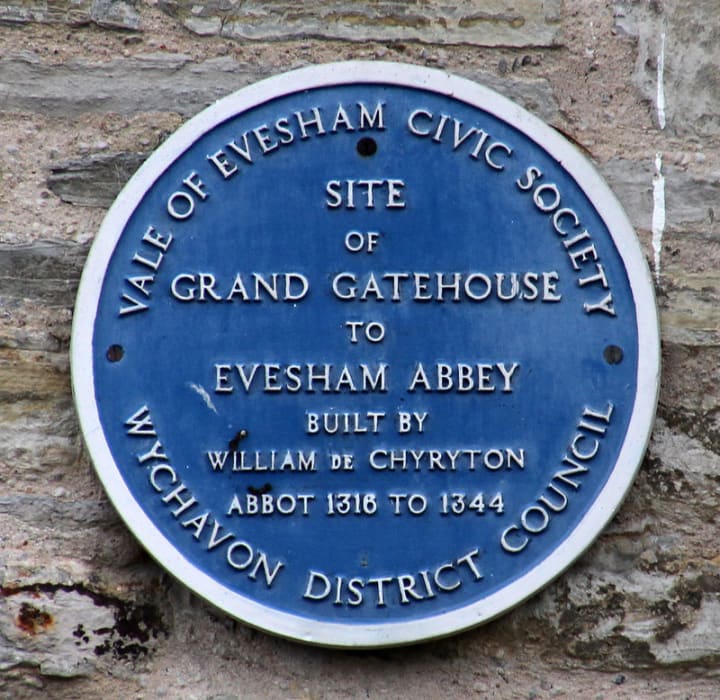
The date of Odulf's death is uncertain but it is thought to be circa 855 or 865. His relics were transferred from Utrecht to Pensoren but they disappeared, possibly stolen, and reappeared in England. The relics were taken to London and Evesham Abbey, and Odulf became patron saint of Evesham.
108 Polish Martyrs
The 108 Polish Martyrs of World War II (also known as the 108 Blessed Polish Martyrs) were Roman Catholics from Poland, killed by German Nazis.
The group included three bishops, 52 priests, 7 friars, 26 men and eight women from religious communities, three seminarians, and nine lay people.
Many of these martyrs were killed in concentration camps. They were killed for refusing to renounce their faith or because they were considered a threat to Nazi occupation. Two villages in Poland (Powiercie and Malbork) were named after two of the martyrs.

On 13th June 1999, the martyrs were beatified in Warsaw by Pope John Paul II. The Pope, a Polish native, worked in a quarry during the war in order to avoid his own deportation to Germany.
Ternan
Ternan, known in Ireland as Torannan, was a Scottish missionary and bishop. While some sources claim that Ternan was a 6th-Century saint, most agree that he lived during the early 5th century.
Ternan is thought to have been a disciple of Saint Palladius, who possibly consecrated Ternan as bishop in 432. Ternan worked as a missionary bishop among the Picts in Scotland.
According to an article by Hugh Cochran, Ternan was probably the first Christian evangelist on Deeside, and the founder of the Christian settlement which was to become the focus of the medieval Parish of Banchory Ternan.
Ternan is associated with the Gospel of Saint Matthew, which was enshrined in a metal case, and a bell (Ronnecht), which now hangs at Banchory Ternan East Church.
Saint Ternan in Arbuthnott, Grampian, is dedicated to Ternan. Some sources claim that Ternan is honoured as founder of the abbey at Culross, Fifeshire, where he died. However, Culross Abbey was founded by Máel Coluim I, Earl of Fife, in the 13th century.
Onuphrius
Onuphrius was born in Ethiopia in 320. The main account of his life comes from his disciple, Paphnutius.
There is a legend that Onuphrius had been a woman. She asked for God to give her the features of a man in order to avoid the attention of men. The legend suggests that God gave Onuphria a beard and she was transformed into Onuphrius.
Onuphrius wore only his hair and a loincloth, which is why he became patron saint of weavers. He is also patron saint of jurists and of Centrache in Italy.
18th June
Fortunatus
Saint Fortunatus the Philosopher was known for his education and piety. The year of his birth is unknown. It is possible that this Saint Fortunatus has been conflated with Venantius Fortunatus, a poet and hymnographer, who existed around the same time.
Fortunatus was an Italian bishop. Driven out of his see in northern Italy by the Lombards, Fortunatus settled in Chelles, France.
Fortunatus died of natural causes in 569.
Mark and Marcellian
Mark and Marcellian were twin brothers from a distinguished Roman family. They were deacons, who lived during the reign of Emperor Diocletian.
The twin brothers were raised in a pagan family but converted to Christianity. They lived in Rome with their wives and children.

When Mark and Marcellian were arrested, they refused to renounce their faith or to sacrifice to Roman gods. Despite torture, they held steadfast to their beliefs. The two men managed to escape after converting their guards but were recaptured.
Even when their parents pleaded with them, the twins still refused to renounce Christ. Saint Sebastian visited Mark and Marcellian every day. He is said to have converted several people while visiting, including the twins' parents.
The brothers were separated, with the idea that they would be weakened. This was unsuccessful as neither brother gave in, both choosing martyrdom rather than abandoning their commitment to Christ. They were sentenced to death in 286.
Mark and Marcellian were buried at Saint Balbina. Their bodies may have been translated to the church of Saints Cosmas and Damian during the 9th century. Their basilica in the catacombs of Saint Balbina was discovered in 1902.
The twins have no specific patronage associated with them. They are venerated in Roman Catholic and Eastern Orthodox Churches.
Aquilina
Aquilina was born in Byblos, Lebanon, circa 281. She was raised in a Christian family.
Reported to have been only 12 years old, Aquilina converted a friend to Christianity. She was accused of teaching others to reject paganism. She confessed her faith to governor Volusian, who ordered for her to be tortured.
Aquilina was tortured in various ways, including having metal rods drilled through her ears. When Aquilina fell down, her torturers presumed she was dead. They ordered for her to be thrown outside the city to be eaten by wild dogs.
During the night, an angel visited Aquilina. The angel told her to rise and to denounce Volusian. Aquilina regained consciousness and returned to Byblos to do as the angel had instructed. Volusian ordered for her to be watched until the morning. He then accused Aquilina of being a sorceress and sentenced her to death by beheading.
Aquilina prayed and thanked God for allowing her to suffer in his name. A voice was heard summoning her to heaven, and her spirit left her body. She died a martyr in her native city in 293. Although already dead, the executioner cut off her head.
Christians buried Aquilina's body outside the city. Her tomb became a popular site for pilgrimage. Aquilina's relics were transported to Constantinople. A basilica was built there for her but that was later destroyed by fire.
22nd June
Saint Alban of Britain
Born in Verulamium, Britain, on an unknown date, little of Saint Alban's life before his conversion is known. The earliest accounts of him were written in the 5th century.
According to the Venerable Bede, Alban served in the Roman army. He certainly lived in Britannia but Verulamium may have been an enclave that refused Roman rule.
Although he was a pagan at the time, Alban sheltered a priest (named by chronicler Geoffrey of Monmouth as Saint Amphibalus). Inspired by the priest's devotion and piety, Alban converted to Christianity. When the authorities came for the fugitive priest, Alban swapped clothes with him. The priest fled and Alban was arrested in his place.
Alban was threatened with torture and death but refused to renounce his newfound faith. Sentenced to death by beheading, Alban became Britain's first Christian martyr. He was whipped and beheaded on the site that is now Saint Alban's Cathedral, although the exact site and date are disputed.
Bede proposed that Alban's death occurred in 305, during the reign of Diocletian. More modern scholars, however, have suggested 254 (under Decius) or 209 (under Septimus Severus).

Alban's relics were transported to Ely, Cambridgeshire, during a Danish invasion. St Canute's in Odense claims to have relics stolen by Canute in his raid on York in 1075. The remaining relics were scattered during the dissolution of churches in the 16th century.
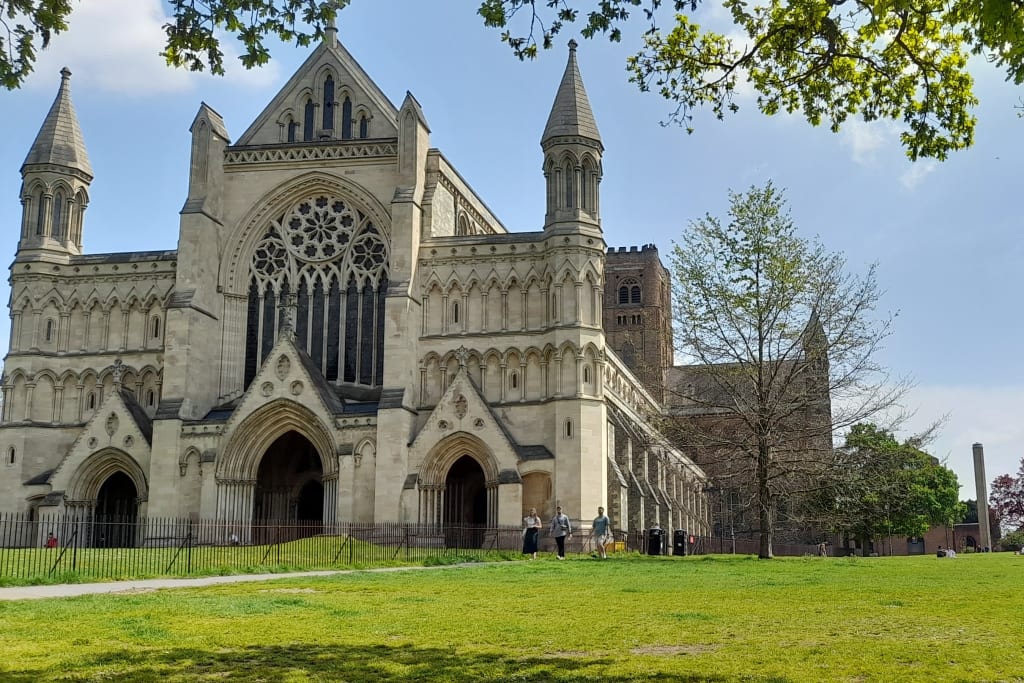
Saint Alban is patron saint of converts, refugees, and torture victims. His tomb at Holmhurst Hill (now Holywell hill, St Alban's) was venerated. There had been an established church on the site before Saint Germanus visited as its first known pilgrim in 429. An abbey was founded there by King Offa in the 8th century with Norman's rebuilding during the 11th and 12th centuries. The town, which would become St Alban's (given city status in 1877), grew up around the abbey.
Saint Thomas More
Born on 7th February 1478, Saint Thomas More was the son of Sir John More. John was a lawyer and a judge. Thomas's mother was Agnes Graunger, the first of John's four wives (all of whom left John widowed). Thomas had two brothers and three sisters. Three of the siblings died before they reached a year old.
Thomas attended Saint Anthony's School, one of the best schools in London at the time. He became household page to the Archbishop of Canterbury, who encouraged Thomas in the pursuit of his continued education.
From 1492, Thomas studied Greek and Latin at Oxford. He left after two years in order to train as a lawyer in London. Thomas practised law from 1502.
Thomas was married twice. He had four children with his first wife, Jane Colt, before her death in 1511. The marriage was thought to be a happy one. Thomas married his second wife, Alice Harpur Middleton, less than one month after Jane's death. He accepted her child from a previous marriage as his own. Thomas was considered a doting father and insisted that his daughters received the same education as his son.
As well as practising law, Thomas held a number of other roles that included theologian, philosopher and writer. In 1516, he published 'Utopia', exploring a fantasy world of people living harmoniously on the titular island.
Thomas became Privy Counsellor in 1514. He was well liked by Henry VIII, who grew to trust him greatly and offer him positions of much responsibility. Thomas was knighted in 1521.
In 1529, Thomas was the first layman to be elected Lord High Chancellor of England (a role that still exists today as Lord High Chancellor of Britain and is currently held by Shabana Mahmood).Thomas held this position until 1532 under Henry VIII.
When Henry VIII requested an annulment of his marriage to Catherine of Aragon, Thomas stood against him. Thomas could not compromise his Catholic beliefs so he refused to take the Oath of Supremacy. Thomas resigned from his position with the King, citing ill health.
Thome refused to attend the coronation of Anne Boleyn, Henry VIII's second wife, in 1533. Although Thomas wrote a letter of congratulations, Henry was offended by Thomas's absence.
In 1534, Thomas accepted Anne as queen. He did not, however, accept Henry's annulment of his first marriage nor did he accept Henry as head of the church. This led to Thomas's arrest for treason. He was imprisoned and executed. His body was buried in an unmarked grave at the Tower of London while his decapitated head was displayed on London Bridge as a deterrent for would-be traitors to the crown.
Thomas is remembered as a man of integrity and indefatigable faith. He was beatified by Pope Leo XIII on 29th November 1886 and canonised by Pope Pius XI on 19th May 1935. In October 2000, Pope John Paul II declared Thomas the patron saint of statesmen and politicians.
Thomas is patron saint of: adopted children; civil servants; lawyers; politicians; and difficult marriages.
Several churches in the south of England and one in Sheldon, historically in Warwickshire but now a suburb of Birmingham, are dedicated to Saint Thomas More. There are also a number of schools in the English Midlands bearing his name.
30th June
First Martyrs of the See of Rome
In 64 AD, 27-year-old Roman Emperor Nero accused Christians of burning Rome. Nero was known to be tyrannical, violent and impulsive. Many believed that he had burned Rome himself. When people started to question him, Nero blamed Christians for the fire.
Some of the martyrs were burned as living torches at banquets, others were crucified, and some were fed to wild animals. Their individual names are not recorded but, as a group, they are known as the protomartyrs of Rome. Thought to be disciples of the Apostles, the martyrs died before Saints Peter and Paul.
This article is part of a series. If you have enjoyed reading this, please take a look at the others in the series (linked below) and look out for the next one.
August September October November December January February March April May
About the Creator
Sapphire Ravenclaw
I am, among other things, a freelance writer and mother. I enjoy writing poetry and articles on various subjects. My current big project is a book about Paganism.
More of me:
Find me on Facebook
Keep reading
More stories from Sapphire Ravenclaw and writers in Futurism and other communities.
Metering Pump Market: Precise Fluid Dosing, Industrial Automation & Industry Growth Outlook
According to IMARC Group's latest research publication, global metering pump market size reached USD 8.3 Billion in 2024. Looking forward, IMARC Group expects the market to reach USD 11.2 Billion by 2033, exhibiting a growth rate (CAGR) of 3.41% during 2025-2033.
By sujeet. imarcgroup4 days ago in Futurism
Fermenters Market Trends: Sustainable Manufacturing, Energy Optimization & Industry Outlook to 2033
The rapid evolution of the biopharmaceutical and food technology sectors is reshaping the industrial landscape, with advanced fermentation systems at the forefront of this transformation. According to IMARC Group’s latest data, the global fermenters market size reached USD 1.8 Billion in 2024. Looking forward, IMARC Group expects the market to reach USD 2.9 Billion by 2033, exhibiting a growth rate (CAGR) of 5.47% during 2025-2033.
By Andrew Sullivan5 days ago in Futurism


Comments