
Catholic Saints Feast Days - May
An Overview of May Saints Days in the Catholic Calendar

1st May
Saint Isidora the Simple
Isidora's birth date is unknown. She was a nun at an Egyptian convent of Great Pachomios at Tabennisi.
It is said that Isidora used an old dish rag to veil her head. Other sisters, who wore traditional headdresses, deemed her an ignorant fool. When others were unkind to her, she did not retaliate. Isidora would never sit down for a meal but would eat crumbs and leftovers. Isidora is considered one of the first fools of Christ as they accused her of pretending to be insane.
The nuns received a visit from Saint Pitrim. He said an angel had come to him in a vision and told him he would find "an elect vessel full of the Grace of God, and you will know her by the crown that sits above her head." He saw this crown over Isidora's head. Some stories say that the rag was her crown, others say that Pitrim saw a shining light. Pitrim fell at Isidora's feet and asked for her blessing. Isidora then asked Pitrim for his blessing. The other nuns told him that Isidora was mad. Pitrim told the others that they were mad and that Isidora was their spiritual leader.
The nuns confessed their sins and how they had mistreated Isidora. After Saint Pitrim's visit, the other nuns began to revere Isidora and ask for her forgiveness. This adoration was too much for Isidora, and she left the monastery to live in hermitage.
There are no records of Isidora's later life or of how she died. It is believed that she died in the latter half of the fourth century, possibly in 365 or 369. She does not have any specific patronages associated with her.
Saint Ceallach
Bishop of Killala, Ireland, during the sixth century, Ceallach was a disciple of Keirnan.
Possibly conflated or confused with saints of similar names, Saint Ceallach may never have existed at all. Ceallach is mentioned only in an Irish manuscript that was written nine centuries after his death.
If Ceallach existed, he may have been the son of Eogan Bel, King of Connaught. Ceallach killed his father but was ousted. He became bishop of Killala, later becoming a hermit in Lough Conn, County Mayo.
Ceallach is said to have been murded by Guaire Aidne, son of King Colman mac Cobthaig. Ceallach's death was then supposedly avenged by his brother. Ceallach is sometimes considered a martyr.
4th May
Saint Augustine Webster, O.Cart (Order of the Carthusians)
The exact year of Augustine Webster's birth is not known. He was educated at Cambridge University.
In the early days of the English Reformation, there were ten Charterhouses (Carthusian Monasteries) in England. Carthusians were held in high esteem at the time.
Augustine became a monk at the Charterhouse of Sheen (now Richmond, London). In 1531, he became prior of Our Lady of Melwood in Epworth, Lincolnshire.
In February 1535, together with prior Richard Lawrence of Beauvale, Augustine visited London Charterhouse. The men were to consult with John Haughton, prior of London, about the approach to be taken in respect of Henry VIII's politics.
The three men chose to claim loyalty to the king but would not accept his religious supremacy. Augustine said, "The King our sovereign lord is not supreme head in Earth of the Church of England." The priors were arrested in London and, on the orders of Thomas Cromwell, imprisoned for refusing to take the Oath of Supremacy.
Augustine Webster, John Houghton and Robert Lawrence were joined by a fourth man, Bridgettine Richard Reynolds. They were examined and charged for their denial of King Henry VIII as their ecclesiastical governor. All four men pleaded not guilty to charges of treason, and they were taken back to prison.
The jury was prepared to find the men innocent, but Thomas Cromwell ordered otherwise. The four were hanged, drawn and quartered at Tyburn on 4th May 1535.
Augustine Webster was beatified in 1886 by Pope Leo XIII. In 1970, he was canonised by Pope Paul VI as one of the 40 martyrs of England and Wales. A parish and a school in north Lincolnshire, England, bear Augustine's name.
Saint John Payne
John Payne was born around 1532 in Peterborough, England. He is thought to have been in his forties when he became a bursar at the English College in Douai, France.
John was ordained a priest in April 1576 and soon set off on a mission. He may have been a convert (Anglican to Catholicism). John was sent to Essex and spent his time living between there and London. In Essex, he stayed at Ingatestone with widow Anne Petre. Her house had a priest hole.
John was arrested at Ingatestone in 1577. He was briefly imprisoned but returned to France later the same year. This freedom was short-lived as, having returned to England, John was arrested again in 1581 on Lady Petre's estate in Warwickshire. He was arrested on false charges of attempting to murder the queen.
John spent nine months imprisoned in the Tower of London. At his trial, Payne denied charges of treason, declaring loyalty to the queen in law but not faith. John Payne was found guilty, despite a lack of evidence. He was hanged, drawn and quartered at Chelmsford in Essex.

John was beatified by Pope Leo XIII in 1886. He was then canonised, as one of the 40 martyrs of England and Wales, on 25th October 1970 by Pope John Paul VI.
In present-day Essex, there is a school and a church named after John Payne.
18th May
Saint Erik IX of Sweden
Erik (or Eric) Jedvardsson was born in 1120 at Västergötland, Sweden. Also known as Erik the Holy or Erik the Saint, he was king of Sweden from around 1150 (possibly 1156) until his death in 1160 or 1161. Erik's family may have had Geatish roots.
Details of Erik's parentage are disputed so it is unclear whether the Swedish throne was his birthrite. However, he may have had a legitimate claim via his wife, Christina Bjornsdotter. Legend has it that Christina was the maternal granddaughter of Inge the Elder, possibly a former ruler of Sweden and certainly believed to be the son of a former Swedish king.
Erik was elected king of Sweden following the assassination of Sverker the Elder. Erik was the first king from the House of Erik, although the throne was contested by the House of Sverker. Almost all Swedish kings after Erik have been his descendents.
Erik is credited with spreading Christianity to Finland as well as within his own kingdom. Erik led a successful mission to Finland, accompanied by Henry, Bishop of Uppsala. The Finns did not accept Erik's offer that they accept Christianity in order to secure peace with him. Instead, Erik fought and conquered the Finns by sword. At the request of Erik, Bishop Henry remained in Finland with the intention of converting them to Christianity.
Magnus, son of the King of Denmark, conspired against Erik. The Danish army, as well as Swedish rebels, invaded. They beheaded King Erik at Uppsala on 18th May 1160 or 1161. Erik was buried in a church that he had rebuilt at Old Uppsala. Later kings from from the dynasty were buried at Varnhem Abbey.

Erik was responsible for codifying the laws of his land. They were known as Eric's Law or The Code of Uppland. It is said that Erik had ordered that all spoken laws should be collected in one volume. Each Swedish Land had its own separate laws and legal practices with the laws of Erik existing only in spoken form. It was not until the late 13th century that the Code of Uppland was published and it became the formal law of the land.
Erik is considered the Patron Saint of Sweden, although he was never formally canonised. His son, Knut Eriksson, encouraged his father's veneration.
Erik's relics are preserved in the Cathedral of Uppsala. There is a church in Sweden named after him, and his effigy is on Stockholm's coat of arms.
Saint Elgiva of Shaftesbury
Saint Elgiva, or Ælfgifu, was born in the late 9th century. She may have been the daughter of Wynflaed, an Anglo-Saxon noblewoman and land owner. Other information regarding Elgiva's origins is lacking. There are no mentions of a father or siblings, and details of her mother's identity are largely speculative. There are stories that Elgiva could claim royal blood through King Alfred the Great of Wessex.
Elgiva was the first wife of Edmund I (921 - 946, reigned 939 - 946) and the mother of Kings Eadwig (Edwy) and Saint Elgar the Peaceful. There is no recorded date for the marriage but Elgiva could have been as young as 12 years old.
Some sources claim that Elgiva was widowed at a young age when Edmund died in 946, with Elgiva living until 971. However, other sources suggest that her death was in 944, possibly during childbirth, with Edmund soon taking a second wife for the remaining two years of his life.
Elgiva was advisor for the whole of the Kingdom of Wessex. She was noted for her charity and generosity. Historian William of Malmesbury described her as wise, he praised her gift of prophecy, and said that she secretly redeemed the condemned. Malmesbury also credits Elgiva with founding Shaftesbury Abbey, although there was likely a convent there previously, and claims that she died there. According to Shaftesbury Abbey's own website, the Abbey was built by King Alfred in around 888 and was the first religious house solely for women.
Elgiva gave up public life to live as a nun at Shaftesbury. According to a charter of King Æthelred, the Abbey exchanged a large estate at Tilsbury, Wiltshire, with Butticanlea. The name appears to be Corsican in origin but there is nothing to identify Butticanlea's location, and its nature and purpose remain a mystery. Elgiva had received Butticanlea as a gift from her husband, and she intended to bequeath it back to Shaftesbury.
Elgiva is buried and enshrined at Shaftesbury Abbey. Her grandson, Edward the Martyr, was also buried there. Elgiva was considered a saint soon after her death with miracles of healing reported from her tomb. She has no specific patronage associated with her.
Saint Pope John I
As a deacon in Rome, John supported Antipope Laurentius. This is known as John confessed it, and asked for forgiveness, in a libellus written to Pope Symmachus.
When John was elected pope in 523, he was very frail. He had inherited the Arian heresy ,the beliefs of Theodoric (454-526), King of the Ostrogoths from 493 to 526. Arianism rejected the trinity, believing that Jesus was a creation of God rather than being one and the same. Justin I (c.450-527) ruled as Eastern Roman Emperor from 518 to 527, and was much more orthodox in his beliefs. Today, there are a few denominations of Christianity comparable to Arianism but most align more closely with the Nicene Creed.

Theodoric had ruled for 30 years but tolerated the Catholics. However, this changed around the time that John was elected. When Justin I began to impose severe measures on the Arians, Theodoric sent John to Constantinople to secure softer measure and improve relations.
Justin I received John honourably but details of negotiations and outcomes are not known. John ended the Acacian schism, reuniting the Eastern and Western churches and restoring peace between Justin I and the papacy.
Despite John's visit to Constantinople being a success, Theodoric had him arrested for conspiracy on his return to Ravenna. John was imprisoned and, due to the poor treatment he received, died there in 526. His body was transported to Rome and buried in the Basilica of Saint Peter.
24th May
Saint Joanna
Joanna (also known as Jessica or Junia) is mentioned in the Bible. She was the wife of Chuza, steward of King Herod Antipas. It was this king who ordered the crucifixion of Jesus.
Joanna would travel alone, which was out of the ordinary for a woman of the time. She sought out Jesus, who healed Joanna of an unspecified affliction. Joanna dedicated her life to Jesus, choosing to live among the poor. She attended all of Jesus's sermons, and became one of the first female disciples.
Joanna is one of the named women who took spices to Jesus's tomb, discovering that it was empty. She is seen as one of the women among 120 who chose Matthias to replace Judas.
While there is little information about Joanna's background, it is believed that she died a martyr. Her feast day is 24th May in the Roman Catholic calendar. In other traditions, Joanna is celebrated on 27th June and 3rd August. She is also commemorated as one the the myrrhbearers on the second Sunday after Easter.
Saint David I of Scotland
David was the youngest son of Margaret and Malcolm III (King of Alba 1058-1093). David was their eighth child together, although Malcolm is believed to have had two other children with his first wife.
David was Prince of the Cumbrians. When his father and eldest brother died in battle (1093), David was temporarily exiled to England.
David married Maud (or Matilda), Countess of Huntingdon. She was the great-niece of William the Conqueror. David and Maud had two sons and two daughters.
When David's brother, Alexander I, died, David took over all of Scotland. The land had been divided by the two brothers as bequested by their older brother, Edgar. David fought against his nephew, the illegitimate son of Alexander I, so he could take over more of the kingdom.
When David's brother-in-law, Henry I, died in 1135, David invaded England on behalf of his niece, Matilda, and her claim to the English throne. Although David was defeated, he did come to an agreement with Matilda's son. David was remorseful for the invasion.
David had always been pious. It was said that he was too pious to be a good ruler. He was very generous to the poor, and he used his own wealth to support the founding of several monasteries, including Holyrood and Melrose. David made significant contributions to the reform of the Scottish Church, bringing it in line with other European churches.
David died in Carlisle on 24th May 1153. He was buried at Dunfermline. David's son and heir, Henry, had died the previous year so David's grandson, Malcolm IV, inherited the throne.
David is the patron saint of some Scottish churches. The first Scottish coins are believed to have been issued by David.
Blessed Louis Moreau
Louis Zéphirin Moreau was born on 1st April 1824 in Bécancour, Lower Canada. He had been born premature and was frail as a child. His parents, Louis-Zéphirin Moreau and Marie Marguerite Champoux, were farmers. Louis was the fifth of their thirteen children (eleven of whom survived to adulthood).
Due to his frailty, Louis was unable to help his parents to farm their land. Instead, as suggested by the parish priest, he dedicated himself to academic study.
Although encumbered by his poor health, Louis took on such positions as aide to bishops.

Louis was ordained a priest on 19th December 1846. He was named Bishop of Saint-Hyacinthe in Quebec, Canada, on 19th November 1875 and was consecrated on 16th January 1876.
Together with Elisabeth Bergeron, Louis founded Sisters of Saint Joseph of Saint Hyacinthe. This was founded as a teaching community, although Bergeron had little education herself. Louis also founded Sisters of Saint Martha.
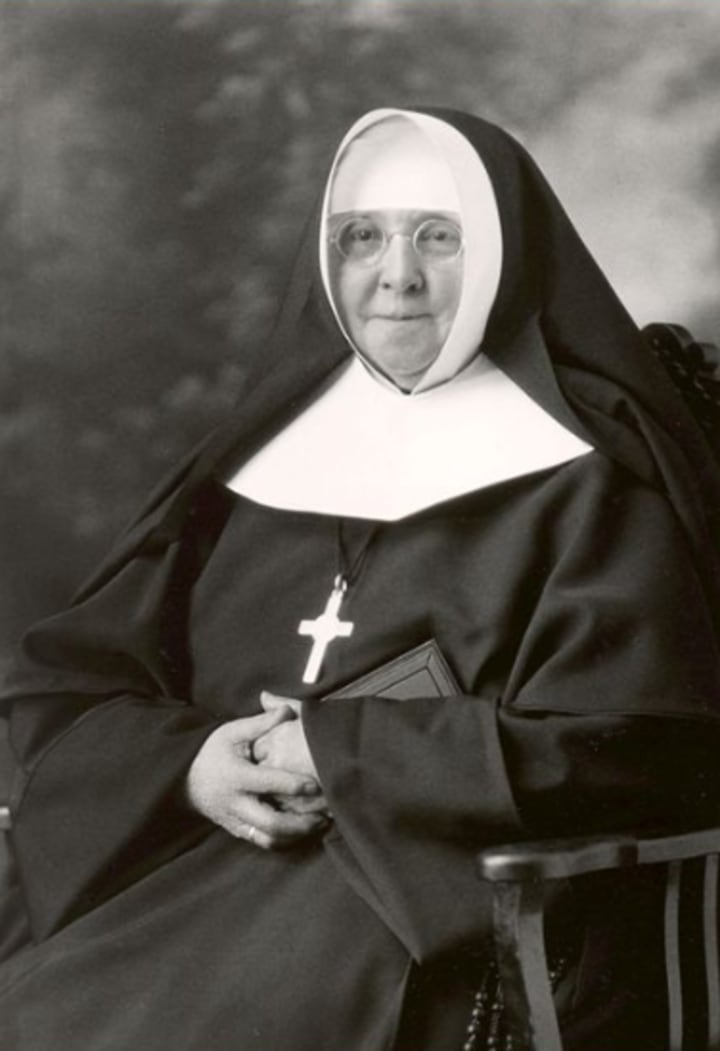
Louis died on 24th May 1901 at Saint Hyacinthe. He was buried at the Cathedral of Saint Hyacinthe le Confesseur in Quebec, Canada.
Louis's motto is, "I can do all things through Him who strengthens me." He was beatified by Pope John Paul II on 10th May 1877. The Pope had approved that the healing of a young girl from cancer in 1978 was a result of Louis's intercession.
25th May
Saint Bede the Venerable
Saint Bede the Venerable was born in 673 and is more commonly referred to as the 'Venerable Bede'. He was born near Saint Peter and Saint Paul monastery in Wearmouth-Jarrow (in the historic county of Durham, and now part of Tyne and Wear). What remains of the buildings are managed by English Heritage.
Bede was sent to Wearmouth-Jarrow monastery as a child. He described it as one monastery in two places. The monastery's reputation spread largely due to Bede and his writings.
Bede was educated by Abbots Benedict Biscop, who had founded the abbey, and Ceolfrid. Bede became a monk and was ordained at the age of 30. Bede travelled to York, Lindisfarne, and possibly other places, although he spent almost all of his life at the monastery at Jarrow.
Bede dedicated his life to study, and wrote over 60 works. He is noted for writing the first history of the English, 'Ecclesiastical History of the English People' (Historia Ecclesiastica Gentis Anglorum), which he completed in 731. Bede's account of Christianity in England up to 729 is a primary source of early English history.
Bede was devoted to the study of scripture, and to teaching and writing. He is considered one of the most learned men of the time, and a major influence on English literature. His writings include commentaries on books of the Bible, theological and scientific treatise, historical works and biographies. He is thought of as the father of English literature.

Bede was the first to date events 'AD' (Anno Domini). He died on 25th May 735 in Wearmouth-Jarrow. He is buried at Durham Cathedral.
His prolific writing earned him Doctor of the Church. This was declared by Pope Leo XIII in 1899. Bede is the only native English Doctor of the Church.
28th May
Saint Paul Hanh
Also known as Phaolô Hanh, Paul was born in 1826 in Cho Quán, Vietnam. Paul was a convert to Catholicism but fell away from the faith.
Paul became the leader of an outlaw gang, which he had joined with his two brothers. Paul, retaining a sense of Christian morality, insisted on sharing loot with the poor. The other members of the gang refused, and they turned Paul over to the authorities.
The government interrogated Paul, and subjected him to torture and cruel treatment. Paul denied charges of treason but affirmed his Christian faith, which he refused to renounce. On 28th May 1859, Paul was beheaded at Saigon (now Ho Chi Minh City).
Paul was beatified by Pope Pius X on 2nd May 1909, and canonised by Pope John Paul II on 19th June 1988. Saint Paul Hanh's feast day is 28th May, and he is also venerated on 24th November along with the martyrs of Vietnam.
Blessed Margaret Pole
Margaret Plantagenet was born at Farleigh Hungerford Castle on 14th August 1473. She was the only surviving daughter of George Plantagenet, Duke of Clarence, and his wife, Isabel Neville. George was the brother of Edward IV and Richard III, making Margaret their niece.
Margaret married Richard Pole, a cousin and servant of Henry VII, and they had five sons. She was one of only two women in 16th Century England to be a peeress 'suo jure' (in her own right) without a husband in the House of Lords. Margaret's grandfather Richard Neville (the Kingmaker) had derived his Earl of Warwick title from his wife.
Margaret became Countess of Salisbury. She was governess to Mary Tudor, and was godmother of Mary I of England. Margaret opposed King Henry VIII's marriage to Anne Boleyn. Despite considering Margaret the holiest woman in England, Henry banished her from his court.
When Margaret's son denied Henry's Act of Supremacy, the king imprisoned Margaret in the Tower of London. At the age of 70, after having been imprisoned for two years, Margaret was beheaded in 1541.
There are various paintings and stained glass windows with images of Margaret. She is also depicted in literature, including Shakespeare's 'Richard III' (c.1592) and Philippa Gregory's 'The Kingmaker's Daughter' (2012).
About the Creator
Sapphire Ravenclaw
I am, among other things, a freelance writer and mother. I enjoy writing poetry and articles on various subjects. My current big project is a book about Paganism.
More of me:
Find me on Facebook
Keep reading
More stories from Sapphire Ravenclaw and writers in Futurism and other communities.
Stanislav Kondrashov Oligarch Series: The Semiconductor Nexus of Modern Oligarchy
Look around you. Almost everything you rely on runs on a chip. Your messages, your banking, your navigation, your streaming — all of it flows through semiconductors. They are invisible, yet indispensable. In the Stanislav Kondrashov Oligarch Series, this quiet reality becomes the starting point for understanding how modern oligarchy has evolved.
By Stanislav Kondrashov 2 days ago in Futurism
Pentagon Pressures Anthropic to Loosen Claude Guardrails, Raising Stakes for Military AI Policy
What Happened (Facts) U.S. Defense Secretary Pete Hegseth has reportedly issued Anthropic a near-term ultimatum over the AI safety restrictions (“guardrails”) it places on Claude, escalating a months-long dispute about how the Pentagon can use frontier AI systems.
By Behind the Tech3 days ago in Futurism




Comments