
Catching Light from the Edge of Time: How Photons from Distant Quasars Reveal the Universe’s Secrets
Space

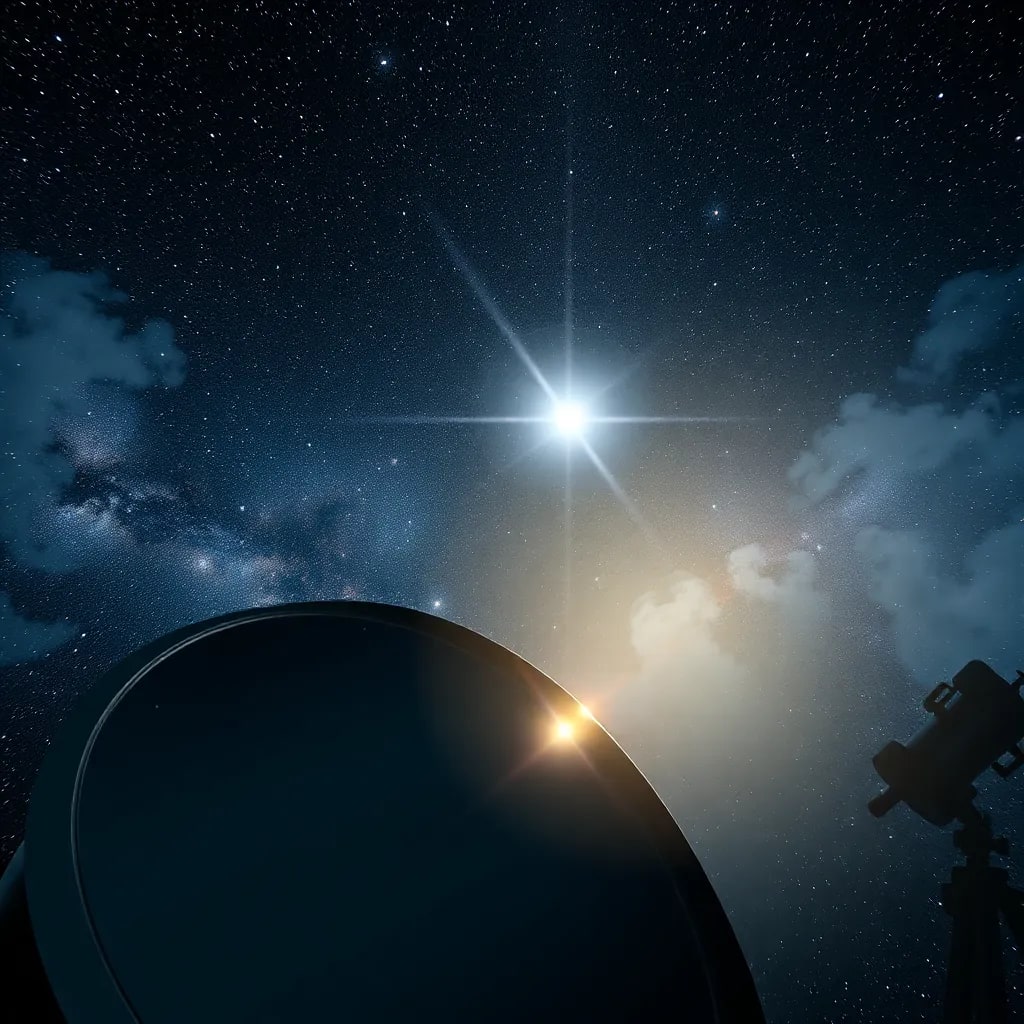
Somewhere on the edge of the observable universe billions of light-years away ancient giants still burn brightly. These are quasars: dazzling, hyperactive galactic cores powered by supermassive black holes devouring surrounding matter. Though impossibly far, the light they emit or more precisely, the photons travels across space for over 10 billion years, eventually reaching us. Each photon is like a cosmic message in a bottle, whispering secrets about the early universe and everything the light passed through on its epic journey.
What Does It Mean to "Catch" a Photon?
Catching a photon or photon interception means detecting and analyzing these tiny packets of light as they arrive from distant astronomical sources. For nearby stars, this is fairly straightforward. But for quasars? It's a cosmic challenge.
The photons from a quasar might travel for billions of years, navigating vast cosmic distances and interacting with interstellar gas, gravitational fields, dark matter, and magnetic distortions. Each of those interactions leaves a fingerprint an alteration in the photon’s wavelength or energy. By intercepting and studying these photons, astronomers can reconstruct the environments they've passed through, and the story of the universe they illuminate.
Why Are Quasars So Important?
Quasars are like cosmic lighthouses, blazing across the ancient universe. They’re so luminous that they often outshine the galaxies that host them. Because of the expansion of the universe, the light from distant quasars is stretched its wavelength shifted toward the red part of the spectrum. This is known as redshift, and the higher the redshift, the further (and older) the quasar.
By analyzing quasars with extreme redshifts, scientists can peer deep into the past even to times just a few hundred million years after the Big Bang. Quasars become time machines, allowing us to study the infant universe.
How Do We Intercept Quasar Photons?
To catch such faint and ancient light, astronomers rely on some of the world’s most advanced telescopes:
- Gran Telescopio Canarias (GTC) in Spain,
- Subaru Telescope in Hawaii,
- Very Large Telescope (VLT) in Chile,
- and space-based observatories like the James Webb Space Telescope (JWST).
These telescopes don’t just "see" light they analyze it. When a photon from a quasar hits the detector, it passes through an intricate system of mirrors, filters, and spectrometers. These instruments break the light down into its spectral components, revealing absorption lines the dark fingerprints left by atoms or molecules the light passed through.
Each line tells a story: what kind of gas the photon met, how dense and hot it was, how fast it was moving. In essence, every intercepted photon becomes a cosmic postcard, stamped by every layer of space it encountered.
What Can We Learn From These Photons?
1. The Chemical Makeup of the Early Universe
Photons from quasars pass through clouds of primordial hydrogen and helium the leftovers of the Big Bang. By decoding their absorption lines, scientists map the chemical evolution of the cosmos.
2. Evidence of the "Cosmic Dark Ages"
Before stars and galaxies lit up the cosmos, the universe was dark and opaque. By studying how quasar photons interact with intergalactic gas, astronomers find signs of reionization the moment light returned and began shaping the cosmos we know today.
3. Gravitational Lensing and Dark Matter
Sometimes, a photon’s path is bent by the gravitational pull of massive objects. This phenomenon, known as gravitational lensing, not only distorts the image of the quasar but also reveals hidden structures, like dark matter which emits no light but warps space itself.
4. Clues About the Universe’s Expansion
The redshift of a photon tells us how fast the universe was expanding when the light was emitted. By compiling many such measurements, astronomers can better understand the role of dark energy in driving the acceleration of cosmic expansion.
Real Discoveries from Quasar Light
One of the most notable finds comes from quasar J0313–1806, one of the oldest ever observed. The light we see from it today began its journey more than 13 billion years ago. Its photons revealed that supermassive black holes could form much faster than scientists once thought possible challenging existing models of galaxy formation.
Another crucial discovery involves Lyman-alpha absorption barriers caused by neutral hydrogen clouds. These gaps in a quasar’s spectrum give us vital insight into how the first galaxies emerged and how early light broke through the cosmic fog.
A Glimpse into the Future
Every photon intercepted from a distant quasar brings us one step closer to unlocking the secrets of the cosmos. As telescopes grow more powerful and detectors more precise, we’ll be able to catch even fainter and older light, tracing it all the way back to the first luminous objects that ever existed.
Even if we never physically reach these distant regions of space, their light has already reached us. By learning to read it, we are opening a dialogue with the past listening to the universe as it quietly tells us its story, one photon at a time.
About the Creator
Keep reading
More stories from Holianyk Ihor and writers in Futurism and other communities.
The Physics of Fluids Without Gravity: Surprising Behaviors and Space Discoveries
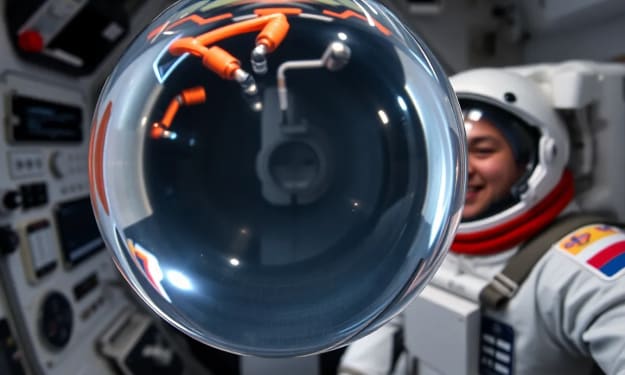
What happens when you pour water into a glass… in space? On Earth, we hardly think about how liquids behave. Gravity pulls water down, shaping it to its container, and drops always fall somewhere. But in microgravity, the rules change completely. A simple drop of water becomes a floating sphere with a smooth, perfect surface. In the weightless environment of space, the familiar physics of fluids takes on a strange and fascinating new form.
By Holianyk Ihor7 months ago in Futurism
About Binding Prometheus
I want to start actively advocating on behalf of my own work, and the most valuable part of my canon is, without a doubt, Binding Prometheus, the play I have been working on since 2019 and only finished in 2023 as part of my MA. The play itself is an amalgamation of a million different inspirations. On one end, it evokes the Ancient Greek myth-play, deriving its own title from the earliest extant work of Western drama we have, Aeschylus’s Prometheus Bound. On the other end, it borrows significantly from the sci-fi bulwarks from over the years, namely Mary Shelley’s Frankenstein and Karel Capek’s Rossum’s Universal Robots. The play could be an episode of Black Mirror, I fear. I don’t know. I’ve only ever seen one episode of Black Mirror.
By Steven Christopher McKnight18 days ago in Futurism
United States Kitchen Appliance Market Size and Forecast 2025–2033
The United States kitchen appliance market is entering a defining decade shaped by innovation, sustainability, and evolving consumer lifestyles. According to Renub Research, the market is projected to reach US$ 115.15 billion by 2033, rising from US$ 74.35 billion in 2024, at a compound annual growth rate (CAGR) of 4.98% during 2025–2033.
By Marthan Sir3 days ago in Futurism



Comments
There are no comments for this story
Be the first to respond and start the conversation.