
The Physics of Fluids Without Gravity: Surprising Behaviors and Space Discoveries
Space

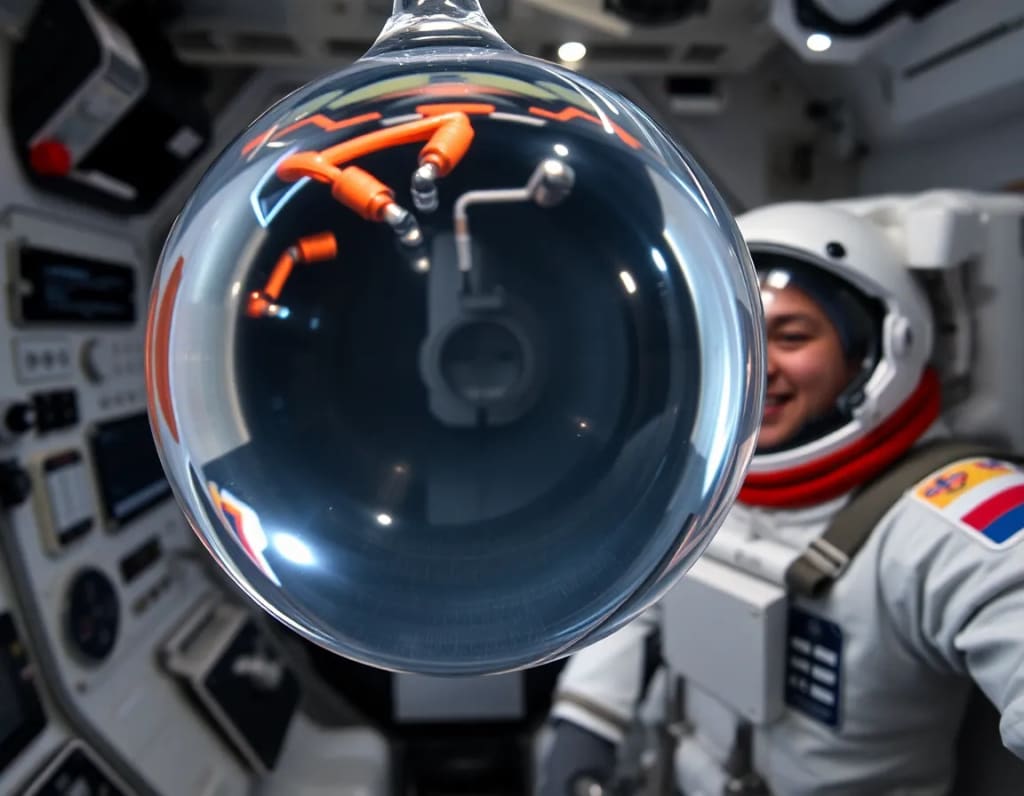
What happens when you pour water into a glass… in space? On Earth, we hardly think about how liquids behave. Gravity pulls water down, shaping it to its container, and drops always fall somewhere. But in microgravity, the rules change completely. A simple drop of water becomes a floating sphere with a smooth, perfect surface. In the weightless environment of space, the familiar physics of fluids takes on a strange and fascinating new form.
Life Without Gravity: How Fluids Behave in Microgravity
Aboard the International Space Station (ISS), weight is no longer the dominant force. In this unique environment, surface tension takes over. Without gravity to pull fluids downward, water doesn’t pour or drip it blobs. When astronauts release water in space, it forms floating spheres that drift gently through the cabin, sticking to any surface they touch: walls, tools, even skin and hair.
Trying to pour water into a cup just won’t work. Instead of flowing, the liquid clings to itself and to nearby objects, often forming dancing globules that are both beautiful and difficult to manage.
Surface Tension Becomes the New Gravity
On Earth, surface tension is present but often overshadowed by gravity. In space, however, it becomes the leading force shaping fluids. Water molecules on the surface are attracted to each other, forming a thin “skin” that holds the droplet together. This is what creates the spherical shape much like a water balloon with no gravity to flatten it.
These floating water orbs glide effortlessly through the space station. Some are small and delicate, others grow large and heavy, but all behave like soap bubbles with real mass. They can cling to objects or combine with other drops mid air, forming larger and larger spheres in mesmerizing displays.
How Astronauts Drink Water in Space
Forget cups or mugs standard drinkware doesn’t work in microgravity. Instead, astronauts rely on sealed pouches with straws and valves to sip liquids safely. The water doesn't pour; it needs to be sucked out of the bag.
Some recent experiments explore how fluids might be handled more naturally in space. One clever idea is a specially designed space cup, shaped to use capillary action to draw the liquid to the rim no gravity needed. In these cups, water “crawls” up the sides and into the mouth, allowing for a more Earth like drinking experience in orbit.
The Science Behind Space Fluids
Studying how liquids behave in microgravity isn’t just a curiosity it has real world applications:
- Fuel Tanks: Spacecraft need reliable ways to feed liquid fuel into engines. In microgravity, fuel doesn’t settle at the bottom of tanks, so engineers must understand how it moves.
- Biotechnology: Culturing cells or studying how fluids transport nutrients in space can lead to medical advancements back on Earth.
- Life Support Systems: Recycling water and other fluids in closed-loop systems on space stations or future Mars habitats demands precise knowledge of fluid dynamics in weightlessness.
These experiments aren’t just theoretical they’re key to designing sustainable systems for long-duration missions.
Fun (and Weird) Fluid Experiments in Space
Astronauts often conduct playful demonstrations to show how strange water can be without gravity. One favorite involves letting a droplet float freely, then inserting an M&M candy into it. The candy becomes suspended inside the water orb, spinning in place like it's trapped in a tiny crystal ball.
In another demonstration, a drop of water is dyed with food coloring. As the colors swirl through the droplet, it becomes a vibrant, pulsating sphere like something out of a sci-fi movie. These visual experiments captivate both scientists and students back on Earth.
Looking Ahead: Fluids on the Moon and Mars
The Moon and Mars have gravity, but it's much weaker than Earth’s. Lunar gravity is about 1/6 of Earth’s, while Mars has roughly 1/3. This means that fluids there will behave differently too somewhere between the extremes of Earth and space.
Engineers are already designing technologies that account for these in-between conditions. From rocket engines to agricultural systems that irrigate Martian soil, our understanding of low gravity fluid physics will shape the future of extraterrestrial living.
Final Thoughts: When Physics Feels Like Magic
The behavior of fluids in microgravity isn’t just a science lesson it’s a reminder of how deeply gravity shapes our everyday experience. In the vacuum of space, even something as ordinary as water reveals hidden beauty and complexity. A single drop, freed from Earth’s pull, transforms into a shimmering sphere that floats, dances, and reacts in ways we never see on the ground.
Studying fluids without gravity isn’t just about solving problems it's about rediscovering the wonder of nature in its most unexpected forms. It’s proof that space doesn’t just change where we are it changes how we understand everything, even a simple sip of water.
About the Creator
Keep reading
More stories from Holianyk Ihor and writers in Futurism and other communities.
Satellite Recycling Stations: Giving Old Spacecraft a Second Life
Just like Earth, space is starting to get cluttered. For decades, satellites, spent rocket stages, and fragments of defunct spacecraft have been left behind, turning Earth’s orbit into a cosmic junkyard. These objects may seem harmless, but they travel at speeds of up to 28,000 km/h, and even a tiny fragment can destroy an active satellite or damage a crewed mission. To tackle this growing threat, scientists and engineers are developing a futuristic yet practical solution: satellite recycling stations in orbit.
By Holianyk Ihor6 months ago in Futurism
About Binding Prometheus
I want to start actively advocating on behalf of my own work, and the most valuable part of my canon is, without a doubt, Binding Prometheus, the play I have been working on since 2019 and only finished in 2023 as part of my MA. The play itself is an amalgamation of a million different inspirations. On one end, it evokes the Ancient Greek myth-play, deriving its own title from the earliest extant work of Western drama we have, Aeschylus’s Prometheus Bound. On the other end, it borrows significantly from the sci-fi bulwarks from over the years, namely Mary Shelley’s Frankenstein and Karel Capek’s Rossum’s Universal Robots. The play could be an episode of Black Mirror, I fear. I don’t know. I’ve only ever seen one episode of Black Mirror.
By Steven Christopher McKnight16 days ago in Futurism
UAE Retail Market: Consumer Spending Shifts, Omnichannel Growth & Future Outlook
According to IMARC Group's latest research publication, UAE retail market size reached USD 145.3 Billion in 2024. The market is projected to reach USD 227.1 Billion by 2033, exhibiting a growth rate of 5.1% during 2025-2033.
By Abhay Rajput2 days ago in Futurism
Miss Persephone's Manual to a Seemingly Ordinary Life
Miss Persephone was found at the dining table, her blue eyes swollen, her tears arriving and retreating like the tides of the ocean. Earlier that day, her family had visited her in the retirement home where she had lived for eight years. It was her eightieth birthday.
By Imola Tótha day ago in Fiction


Comments
There are no comments for this story
Be the first to respond and start the conversation.