
Carpet Market Size and Forecast (2025–2033): Rising Demand for Sustainable Flooring, Digital Designs, and Global Construction Growth
A detailed newsroom-style analysis of the global carpet market, highlighting growth drivers, innovations, challenges, and country-level insights.

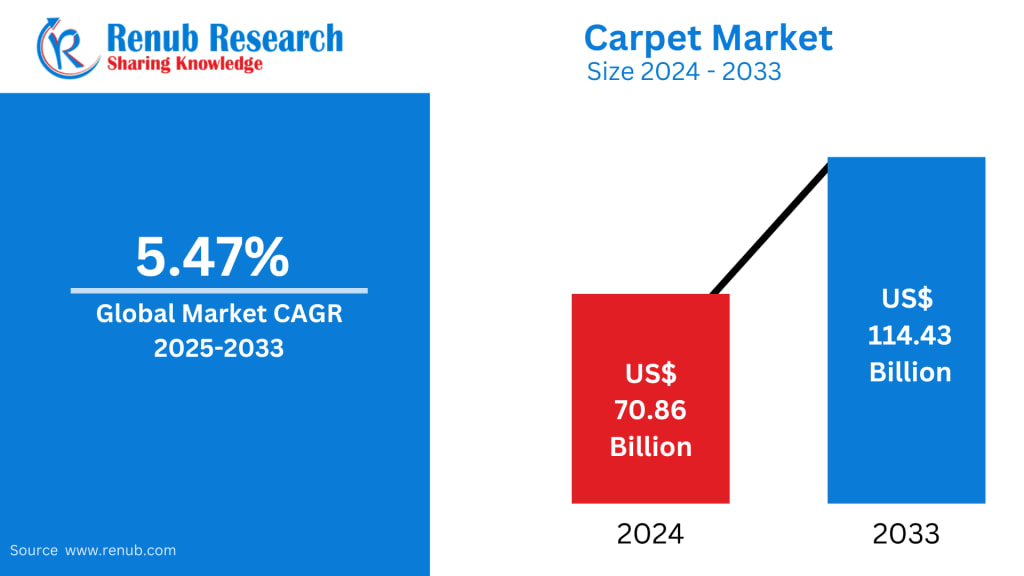
The global carpets market, valued at USD 70.86 billion in 2024, is set for steady expansion over the next decade. According to new estimates, the market is projected to rise from USD 74.73 billion in 2025 to USD 114.43 billion by 2033, registering a CAGR of 5.47% during the forecast period. Surging home décor trends, innovations in carpet materials and production technologies, and booming construction activity—particularly in emerging markets—are shaping a dynamic future for the carpet industry.
The Global Carpet Market & Forecast (2025–2033) report provides an in-depth analysis by Product Type (Woven, Knotted, Needle Felt, Tufted), Material (Nylon, Polypropylene, Polyester, Acrylic, Wool & blends), End Use, and Country-Level performance, offering critical insights into emerging opportunities and strategic movements of leading industry players.
Global Carpet Market Overview
Carpets—soft textile floor coverings made from wool, nylon, polyester, polypropylene, or blends—remain integral to residential, commercial, and industrial interiors. Their role extends far beyond aesthetics: they provide insulation, comfort, noise absorption, and safety while complementing the visual theme of any space.
The landscape of the carpet industry is undergoing significant transformation. Digital printing has revolutionized pattern creation, allowing intricate, customizable designs. Meanwhile, sustainability is fast becoming a central focus. Manufacturers are adopting recycled plastics, bio-materials, and natural fibers such as bamboo, wool, and jute, aligned with rising global awareness about environmentally responsible consumption.
With consumers now demanding décor that blends design with durability and environmental consciousness, manufacturers are accelerating innovation across materials, textures, and finishing technologies.
Advantages of the Global Carpet Market
Carpets offer numerous benefits, supporting their widespread adoption:
• Comfort and Insulation
Carpets provide natural warmth and cushioning, improving floor comfort. They help maintain indoor temperatures and reduce energy costs.
• Acoustic Benefits
Carpets absorb sound, making them ideal for high-density buildings, offices, hotels, and homes.
• Safety
The soft surface reduces slip-related injuries, particularly in homes with children or elderly individuals.
• Design Versatility
With limitless designs—from bold prints to minimalistic textures—carpets cater to diverse preferences and project requirements.
• Evolving Durability
Advanced stain-resistant treatments and enhanced fiber technology are producing longer-lasting, easy-to-clean carpets that meet modern lifestyle needs.
SWOT Analysis of the Global Carpet Industry
Strengths
Wide range of product designs and materials
Strong demand from residential and commercial construction
Established global brands with robust distribution networks
High customization potential
Carpets contribute thermal insulation and acoustic benefits
Weaknesses
Maintenance requirements and susceptibility to stains
Environmental concerns due to non-biodegradable synthetics
Allergen accumulation potential
Tough competition from hard flooring alternatives
Slow pace of innovation in traditional manufacturing processes
Opportunities
Rising interest in eco-friendly, recyclable carpets
High-growth potential in Asia, Africa, and the Middle East
Expansion of e-commerce and digital retail
Smart carpets with embedded sensors
Increasing investments in hospitality and commercial real estate
Threats
Rising raw material costs for wool, nylon, and synthetics
Growing preference for minimalist hard flooring
Strict environmental regulations
Alternative flooring options gaining momentum
Economic slowdowns impacting construction and renovations
Which Country Makes the Finest Rugs?
Iran
Globally recognized as the gold standard in rug-making, Iranian carpets are treasured for their craftsmanship, intricate patterns, and durability.
India
India is famous for its hand-knotted carpets with high knot density and exceptional longevity. The country’s vast design diversity—from floral to geometric—has made Indian carpets a global favorite.
Afghanistan
Afghan carpets, particularly Turkmen and Baluchi styles, preserve tribal heritage through geometric patterns and deep colors. Their distinct cultural identity keeps them in high global demand.
Global Carpet Market Growth Drivers
1. Rising Demand for Home Décor
Consumer spending on home beautification is soaring. Modern households prefer carpets and rugs that combine style, comfort, and sustainability. Trends such as open-concept living have increased the use of large-area rugs to define spaces.
Notably:
**73% of global consumers prefer sustainable home products (2024 survey).
Sustainability indices in the EU grew by 22% in 2023.**
With rising eco-consciousness, carpets made from recycled materials and natural fibers are witnessing strong demand.
2. Technological Advancements
Digital printing, stain-resistant coatings, and improved fiber technologies are helping manufacturers achieve unprecedented detail and functionality.
A notable innovation includes:
February 2024: Tarkett launched an expanded QuickShip carpet program with 73 curated soft-surface products delivered nationwide within five days.
Eco-friendly manufacturing processes are also becoming mainstream, attracting new-age buyers.
3. Global Construction Growth
The construction boom across emerging economies—driven by urbanization and infrastructural development—is a major contributor to carpet demand.
According to the UN:
55% of the world’s population lived in urban regions in 2018
Urbanization is expected to reach 68% by 2050
New residential projects, offices, commercial buildings, and hospitality spaces all require carpets for functionality and aesthetics.
Key Challenges for the Carpet Market
• Pricing Pressure
A competitive landscape with numerous players contributes to price wars, shrinking margins, especially for small and mid-sized manufacturers.
• Environmental Concerns
Synthetic carpet production generates waste and consumes significant energy. As environmental regulations tighten, manufacturers face rising compliance and sustainability costs.
Market Breakdown by Segment
Woven Carpets
A premium segment known for luxury, durability, and craftsmanship. Woven carpets are highly sought after in upscale residential and commercial projects.
Tufted Carpets
The dominant segment due to affordability and fast production. Suitable for both residential and commercial use, tufted carpets remain the most versatile category.
Notable development: In November 2022, Beaulieu International Group announced plans to discontinue its Belgian tufted carpet unit.
Nylon Carpets
Known for their resilience and stain resistance, nylon carpets are ideal for high-traffic areas. Technological advancements are improving their eco-friendliness.
Acrylic Carpets
Lightweight, soft, and wool-like, acrylic carpets offer affordability and moisture resistance, making them popular in residential spaces.
Market by End Use
Residential Segment
Homeowners increasingly value carpets for insulation, aesthetics, and comfort. Rising home renovation trends are further accelerating residential carpet sales.
Commercial Segment
Commercial carpets are engineered for durability and performance, used widely in:
Offices
Hotels
Retail stores
Educational institutions
Features like noise absorption and easy maintenance make them indispensable in high-traffic environments.
Country-Level Insights
United States
One of the world’s largest carpet markets, driven by a strong housing sector and renovations.
Jan 2025: Tarkett introduced Preserved Treasures™, a new carpet line designed for long-term performance in community living environments.
France
France favors premium, eco-friendly carpets made from natural fibers.
Dec 2024: Brintons launched its first-ever V&A collaboration collection featuring designs inspired by French artist Emile-Allain Séguy.
India
India’s global reputation for handmade rugs continues to grow.
Oct 2024: Luxury brand HANDS unveiled KNOTION, created with designer Nika Zupanc.
Saudi Arabia
Driven by large-scale construction and luxury real estate.
Oct 2023: Standard Carpets expanded in Dubai Industrial City with a massive AED600 million investment.
Market Segmentation Overview
Product Type (4 Viewpoints):
Woven
Knotted
Needle Felt
Tufted
Material Type (6 Viewpoints):
Nylon
Polypropylene
Polyester
Acrylic
Wool & Blends
Others
End Use (3 Viewpoints):
Residential
Commercial
Industrial
Countries (25 Covered):
United States, Canada, France, Germany, Italy, Spain, UK, Belgium, Netherlands, Turkey, China, Japan, India, Australia, South Korea, Thailand, Malaysia, Indonesia, New Zealand, Brazil, Mexico, Argentina, South Africa, Saudi Arabia, UAE
Key Companies Covered
Armstrong Flooring Inc.
Balta Industries
Mohawk Industries Inc.
Tarkett
Victoria PLC
Mannington Mills Inc.
Dorsett Industries
Final Thoughts
The global carpet market is on a promising trajectory for 2025–2033, powered by surging home décor trends, rising construction, and strong momentum in sustainable materials. As consumers embrace eco-friendly designs, digital customization, and multi-functional carpets, manufacturers investing in innovation, green materials, and diversified portfolios will thrive.
While environmental challenges and competition remain strong, the future of carpets—woven, tufted, or smart—looks vibrant, connected, and full of design possibilities.
About the Creator
Renub Research
Renub Research is a Market Research and Consulting Company. We have more than 15 years of experience especially in international Business-to-Business Researches, Surveys and Consulting. Call Us : +1-478-202-3244
Keep reading
More stories from Renub Research and writers in Futurism and other communities.
Data Center Market Trends & Summary (2025–2033)
The global Data Center Market is undergoing one of the fastest transformations in modern digital history. As industries continue to migrate to cloud platforms, demand real-time data analytics, adopt AI workloads, and operate globally distributed networks, the need for robust and secure data centers is skyrocketing. According to Renub Research, the global market for data centers is projected to reach US$ 613.36 billion by 2033, rising from US$ 237.07 billion in 2024, with an impressive CAGR of 11.14% between 2025 and 2033.
By Renub Research2 months ago in Futurism
About Binding Prometheus
I want to start actively advocating on behalf of my own work, and the most valuable part of my canon is, without a doubt, Binding Prometheus, the play I have been working on since 2019 and only finished in 2023 as part of my MA. The play itself is an amalgamation of a million different inspirations. On one end, it evokes the Ancient Greek myth-play, deriving its own title from the earliest extant work of Western drama we have, Aeschylus’s Prometheus Bound. On the other end, it borrows significantly from the sci-fi bulwarks from over the years, namely Mary Shelley’s Frankenstein and Karel Capek’s Rossum’s Universal Robots. The play could be an episode of Black Mirror, I fear. I don’t know. I’ve only ever seen one episode of Black Mirror.
By Steven Christopher McKnight19 days ago in Futurism
Global Video Surveillance Market Size & Forecast 2026–2034
Global Video Surveillance Market Video Surveillance Market Outlook Video surveillance refers to the use of cameras, sensors, recorders, and software platforms to monitor, record, and analyze activities across physical environments for security, safety, and operational efficiency. The ecosystem today goes far beyond traditional closed-circuit television (CCTV). It now includes internet protocol (IP) cameras, network and cloud-based video management systems (VMS), edge devices, and AI-powered analytics capable of recognizing faces, tracking objects, and detecting anomalies in real time.
By Aaina Oberoi5 days ago in Futurism
The Devil's Cut
“Comrade, finally you’re awake.” The voice was smooth, sensual. A flickering incandescent bar was all that lit the white, sterile room. All Vladimir remembered was everything going black. He tried to move his arms and found them strapped to the gurney.
By Matthew J. Fromm5 days ago in Fiction


Comments
There are no comments for this story
Be the first to respond and start the conversation.