
Camera Module Market: Foldable & Slim Devices, Optical Innovation & Growth Outlook
Miniaturization trends shape innovation in the camera module market.


According to IMARC Group's latest research publication, global camera module market size rAccording to IMARC Group's latest research publication, global camera module market size reached USD 46.0 Billion in 2024. Looking forward, IMARC Group expects the market to reach USD 85.9 Billion by 2033, exhibiting a growth rate (CAGR) of 6.83% during 2025-2033.
How AI is Reshaping the Future of Camera Module Market
- Intelligent Image Enhancement and Scene Recognition: AI algorithms analyze camera sensor data in real-time, automatically adjusting exposure, white balance, and focus.
- Automated Quality Inspection in Manufacturing: Machine learning-powered visual inspection systems detect defects in camera module assembly with exceptional accuracy. AI identifies scratches, misalignments, and optical flaws at production speeds impossible for human inspectors.
- Predictive Maintenance for Production Equipment: AI monitors camera module manufacturing equipment, analyzing vibration patterns, temperature fluctuations, and performance data to predict failures before breakdowns occur.

Camera Module Industry Overview:
The camera module industry experienced remarkable momentum in recent years, rebounding to 7.0 billion unit shipments in 2024 after two years of decline. Smartphone recovery drove this resurgence, particularly in China where economic stabilization renewed consumer demand. The automotive sector emerged as a high-growth engine, with over 250 million camera modules shipped for vehicles in 2024 supporting ADAS proliferation and in-cabin monitoring systems.
Camera Module Market Trends & Drivers:
Smartphone imaging evolution continues driving substantial demand, with multi-camera setups becoming standard across all price segments. The average cameras-per-device metric reached five in 2025, as Chinese handset brands turned triple and quad-camera arrays into mainstream specifications rather than premium features.
The automotive sector posts the industry's fastest growth trajectory, advancing at 9.1% annually as regulatory mandates transform cameras from optional features to required safety equipment. The EU's General Safety Regulation, effective since July 2024, mandates automatic emergency braking and pedestrian detection systems—igniting demand for multi-camera ADAS suites across all new vehicles.
Emerging applications across healthcare, industrial automation, and extended reality platforms diversify revenue beyond traditional consumer electronics. Medical endoscopy adopted ultra-miniature modules under 2.3mm diameter, enabling minimally-invasive procedures with enhanced visualization.
Leading Companies Operating in the Global Camera Module Industry:
- Chicony Electronics Co. Ltd.
- Largan Precision Co., Ltd
- LG Innotek
- LITE-ON Technology Corporation
- Magna International Inc.
- OmniVision
- Samsung Electro-Mechanics
- Sunny Optical Technology (Group) Company Limited
- Tamron Co., Ltd
Camera Module Market Report Segmentation:
By Component:
- Image Sensors
- CMOS Image Sensors
- CCD Image Sensors
- Lens Modules
- Voice Coil Motors
- Others
Image sensors represent the largest segment, as they form the value core of camera modules and account for over 48% of total component revenue.
By Focus Type:
- Fixed Focus
- Autofocus
Based on focus type, the market has been segmented into fixed focus and autofocus.
By Interface:
- Camera Serial Interface
- Camera Parallel Interface
Based on interface, the market has been categorized into camera serial interface and camera parallel interface.
By Pixels:
- Up to 7 MP
- 8 to 13 MP
- Above 13 MP
Based on pixels, the market has been divided into up to 7 MP, 8 to 13 MP, and above 13 MP.
By Process:
- Flip-Chip Camera Module
- Chip-On-Board Camera Module
Chip-on-board represents the largest process segment, retaining 63.7% revenue share due to established manufacturing infrastructure and cost advantages.
By Application:
- Consumer Electronics
- Automotive
- Healthcare
- Industrial
- Security and Surveillance
- Aerospace and Defense
Consumer electronics dominate with approximately 69% market share, driven by smartphones, tablets, and laptops requiring multiple camera modules per device.
Regional Insights:
- North America (United States, Canada)
- Asia Pacific (China, Japan, India, South Korea, Australia, Indonesia, Others)
- Europe (Germany, France, United Kingdom, Italy, Spain, Russia, Others)
- Latin America (Brazil, Mexico, Others)
- Middle East and Africa
Asia Pacific commands dominant market position with approximately 60% global revenue share, supported by integrated supply chains spanning sensor fabrication, lens assembly, and final module production.
Recent News and Developments in Camera Module Market:
- December 2024: Vicon Industries and Hailo began shipping the NEXT Modular Camera with Hailo-15 edge AI processing capabilities. This integration enables advanced on-device analytics for security and surveillance applications, reducing cloud dependency while delivering real-time object detection and classification at the camera level.
- December 2024: Yole Group announced camera module industry investments totaling approximately $8 billion across Vietnam, Mexico, and India manufacturing facilities.
Note: If you require specific details, data, or insights that are not currently included in the scope of this report, we are happy to accommodate your request. As part of our customization service, we will gather and provide the additional information you need, tailored to your specific requirements. Please let us know your exact needs, and we will ensure the report is updated accordingly to meet your expectations.
About the Creator
sujeet. imarcgroup
With 2 years of hands-on experience at IMARC Group, I have conducted in-depth market research and analysis across diverse industries including technology, healthcare, agriculture, and consumer goods.
Keep reading
More stories from sujeet. imarcgroup and writers in Futurism and other communities.
AI in Fintech Market: Fraud Detection Innovation, Risk Analytics & Market Forecast
According to IMARC Group's latest research publication, the global AI in fintech market size reached USD 17.64 Billion in 2025. Looking forward, IMARC Group expects the market to reach USD 97.70 Billion by 2034, exhibiting a growth rate of 19.90% during 2026-2034.
By sujeet. imarcgroupabout 13 hours ago in Futurism
Australia Electric Vehicle Charging Market: Infrastructure Expansion, Policy Support & Technology Advancement
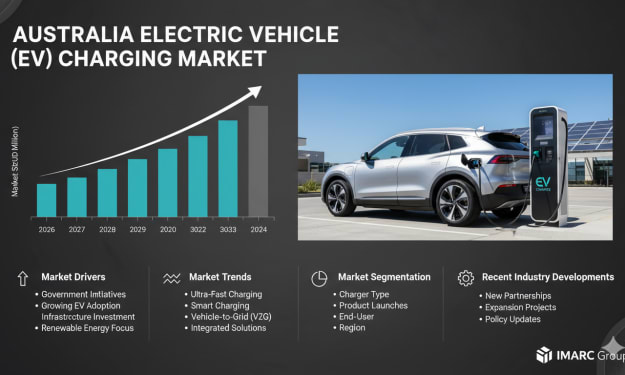
According to IMARC Group, the Australia electric vehicle (EV) charging market reached a value of USD 304.4 Million in 2025 and is projected to expand rapidly to USD 1,692.2 Million by 2034, exhibiting a strong compound annual growth rate (CAGR) of 21.00% during 2026–2034. This exceptional growth reflects the accelerating shift toward electric mobility and the critical role charging infrastructure plays in enabling large-scale EV adoption. As transport electrification becomes a central pillar of national decarbonization strategies, charging networks are evolving from early-stage infrastructure into a core component of Australia’s energy and mobility ecosystem. Expansion across urban centers, regional corridors and remote areas is improving accessibility and consumer confidence, positioning EV charging as a strategic growth market across Australia.
By Shrestha Roy3 days ago in Futurism
How Much Does it Cost to Build an App in San Diego? (2026 Prices)
When businesses begin planning a new app, one of the first questions they ask is straightforward: how much will it cost? Yet the answer is rarely simple. Two companies can build similar-looking apps and spend dramatically different amounts, not because of inefficiency but because the cost of app development reflects dozens of hidden variables.
By Nick Williamabout 12 hours ago in Futurism



Comments
There are no comments for this story
Be the first to respond and start the conversation.