
Australia Electric Vehicle Charging Market: Infrastructure Expansion, Policy Support & Technology Advancement
How growing EV adoption, government policy support and rapid charging technology advancements are shaping Australia’s electric vehicle charging market
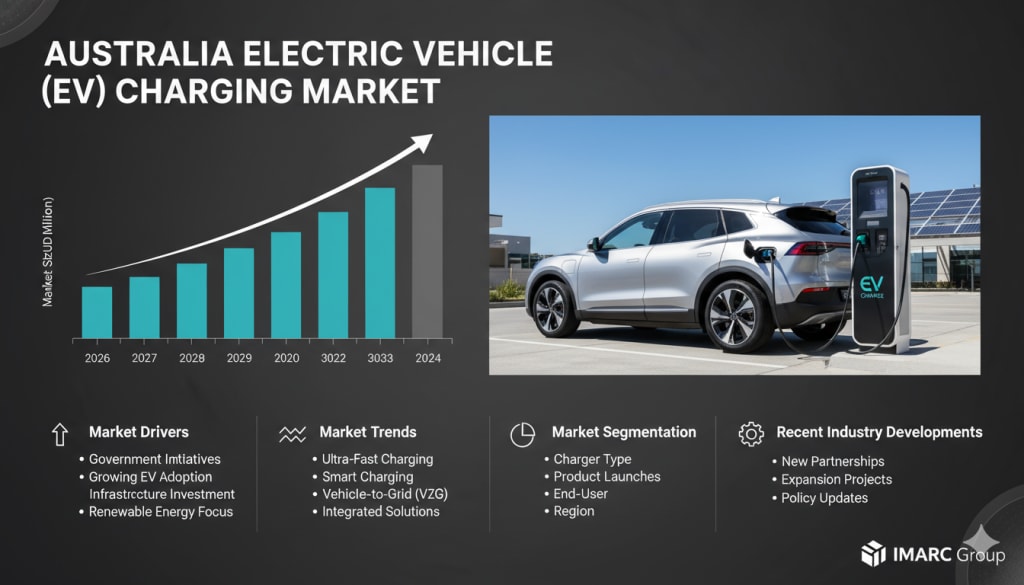
According to IMARC Group, the Australia electric vehicle (EV) charging market reached a value of USD 304.4 Million in 2025 and is projected to expand rapidly to USD 1,692.2 Million by 2034, exhibiting a strong compound annual growth rate (CAGR) of 21.00% during 2026–2034. This exceptional growth reflects the accelerating shift toward electric mobility and the critical role charging infrastructure plays in enabling large-scale EV adoption. As transport electrification becomes a central pillar of national decarbonization strategies, charging networks are evolving from early-stage infrastructure into a core component of Australia’s energy and mobility ecosystem. Expansion across urban centers, regional corridors and remote areas is improving accessibility and consumer confidence, positioning EV charging as a strategic growth market across Australia.
Why Should Smart Buyers and Investors Know About the Australia EV Charging Market?
One of the Fastest-Growing Clean Mobility Segments
With a projected CAGR of 21.00%, EV charging represents one of the most rapidly expanding segments within Australia’s energy and transport markets.
Critical Enabler of EV Market Growth
Charging availability directly influences EV adoption rates, making infrastructure investment essential to the broader electric mobility transition.
Strong Policy and Regulatory Support
Government incentives and emissions targets provide long-term demand visibility and reduce regulatory uncertainty.
Convergence of Energy, Transport and Digital Technologies
EV charging sits at the intersection of clean energy, smart grids and digital platforms, creating multi-layered value opportunities.
Long-Term Infrastructure Asset Potential
Charging networks offer recurring revenue models and infrastructure-style investment characteristics with long operational lifecycles.
Recent Trends & Developments in the Australia EV Charging Market
June 2025:
Public fast-charging networks expanded along major highways, improving long-distance EV travel and regional connectivity.
March 2025:
Smart charging pilots incorporating vehicle-to-grid functionality were launched to support grid stability and renewable energy integration.
October 2024:
Government-backed funding programs accelerated charger installations in apartment buildings, workplaces and public facilities.
The Australia electric vehicle charging market exemplifies how infrastructure development, policy alignment and technological innovation converge to accelerate systemic transformation. Supported by IMARC’s strong growth outlook, the market is evolving from fragmented early deployments into an integrated national charging ecosystem underpinning Australia’s electric mobility future. As EV adoption accelerates, smart charging technologies mature and grid integration deepens, charging infrastructure will become a cornerstone of both transport electrification and energy system resilience. For investors, infrastructure developers and technology providers, Australia’s EV charging market represents not just a high-growth opportunity, but a forward-looking platform where clean mobility, digital innovation and sustainable energy systems intersect to shape the future of transportation.
Australia EV Charging Market Vision 2050
1. Nationwide High-Speed Charging Coverage
By 2050, Australia is expected to have dense, interoperable charging networks that support seamless long-distance travel and urban mobility without range anxiety.
2. Full Integration With Renewable Energy Systems
EV charging infrastructure will increasingly integrate with renewable generation and battery storage, enabling low-emission charging and grid balancing.
3. Smart, Autonomous and AI-Managed Charging Networks
Artificial intelligence and automation will optimize charger availability, pricing, maintenance and energy flow in real time.
4. EVs as Distributed Energy Resources
Vehicle-to-grid integration will allow EVs to support grid resilience, emergency backup power and energy trading.
5. Charging Infrastructure as Core Urban Infrastructure
EV chargers will become standard elements of buildings, transport hubs and public spaces, embedded into urban planning and development frameworks.
What Are the Key Growth Drivers in the Australia EV Charging Market?
Rapid Growth in Electric Vehicle Adoption
Rising EV sales across passenger vehicles, commercial fleets and public transport are directly increasing demand for reliable and widely distributed charging infrastructure. As EVs move beyond early adopters into mainstream usage, charging availability has become a key determinant of consumer purchasing decisions.
Expansion of Public and Private Charging Infrastructure
Significant investments are being directed toward expanding charging networks in cities, highways, workplaces and residential complexes. Public fast-charging stations and private home chargers are being deployed in parallel to support diverse driving and usage patterns.
Strong Government Policy Support and Incentives
Federal and state-level policies supporting EV adoption are accelerating charger deployment. Incentives, grants and regulatory mandates focused on EV infrastructure installation are reducing investment risk and encouraging private sector participation.
Advancements in Fast and Smart Charging Technologies
Technological innovation is improving charging speed, efficiency and intelligence. Ultra-fast DC chargers, smart charging systems and load management solutions are enhancing user experience while optimizing grid integration.
Integration of Vehicle-to-Grid (V2G) and Energy Systems
Smart charging technologies such as vehicle-to-grid and vehicle-to-home systems enable EVs to act as flexible energy assets. These capabilities support grid stability, renewable integration and peak demand management, increasing the strategic value of charging infrastructure.
About the Creator
Keep reading
More stories from Shrestha Roy and writers in Futurism and other communities.
Australia Power Market: Renewable Integration, Grid Modernization & Demand Growth
According to IMARC Group, the Australia power market reached a total consumption of 285.7 TWh in 2025 and is projected to expand to 377.0 TWh by 2034, exhibiting a compound annual growth rate (CAGR) of 3.04% during 2026–2034. This steady growth reflects Australia’s ongoing energy transition as electricity demand rises alongside population growth, electrification of industries and the decarbonization of transport and heating. The power market is undergoing structural transformation driven by accelerating renewable energy deployment, the gradual phase-out of coal-fired generation and large-scale investments in grid modernization and energy storage. As energy systems become more decentralized, digital and dynamic, the power sector is emerging as a critical enabler of economic resilience, sustainability and future industrial competitiveness across Australia.
By Shrestha Roy2 days ago in Futurism
UAE Used Car Market Analysis: Industry Overview, Demand Drivers & Growth Outlook
According to IMARC Group's latest research publication, UAE used car market size reached USD 5.28 Billion in 2024. The market is projected to reach USD 13.29 Billion by 2033, exhibiting a growth rate (CAGR) of 9.67% during 2025-2033.
By Abhay Rajput5 days ago in Futurism
Agricultural Films Market: Crop Protection Demand, Yield Improvement & Industry Growth Outlook
According to IMARC Group's latest research publication, the global agricultural films market size reached USD 11.69 Billion in 2024. Looking forward, IMARC Group expects the market to reach USD 18.18 Billion by 2033, exhibiting a growth rate (CAGR) of 4.78% during 2025-2033.
By sujeet. imarcgroup7 days ago in Futurism
Writing About Writing: The Rainbow Trap
The good thing about living in modern times is that LGBTQ representation in media is increasing. Not just in niche and Independant media, either, but also in mainstream media. Books, movies, TV shows, comics... they're finally catching on that LGBTQ+ people form a significant part of their audience, and deserve to see themselves on screen and in fiction, not just as victims in documentaries and true crime shows.
By Natasja Rose7 days ago in Writers




Comments
There are no comments for this story
Be the first to respond and start the conversation.