
ASTEROID COLLISION
What would happen if an asteroid collided with eath?

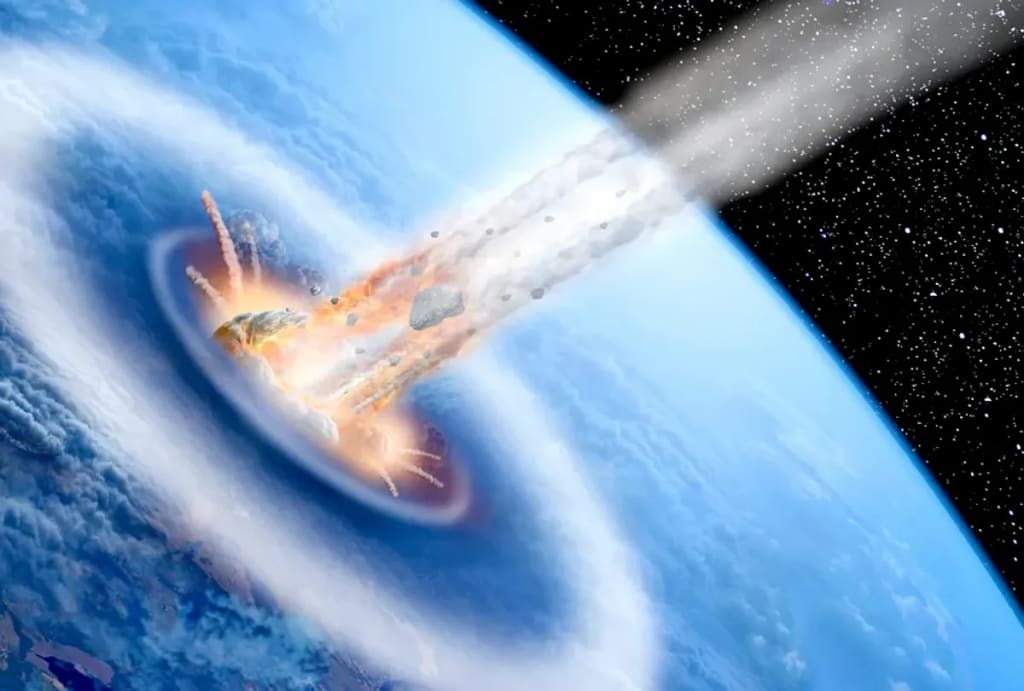
What would actually happen if an asteroid were on a collision course with our planet? We know that hundreds of pieces of space rock fall through our atmosphere every single year, but luckily, they burn up on entry. They are simply not large enough to have any noticeable impact. However, there's evidence to suggest that Earth has experienced several large strikes throughout its history, so there is every possibility that it could happen again.
To prepare ourselves for the worst-case scenario, NASA has been running a series of tests to see how well-prepared we are. Unfortunately for us, we are not. Every day, more than a hundred tons of dust and small particles fall to Earth, and on average, a car-sized object enters the atmosphere once a year and burns up, creating an amazing fireball streaking through the sky. Larger objects, about the size of a football field, collide with Earth once every two thousand years. A potential extinction-level collision is thought to happen every few million years, which would make one long overdue.
Generally, anything less than 82 feet across will burn up and cause very minor damage. Anything measuring up to half a mile across will cause significant damage to the impact site. Anything larger than that could have worldwide consequences. Currently, the largest known potentially dangerous object in space is "Toutatis," which is just over three miles across. There is also an asteroid known as Apophis, which is expected to pass incredibly close to Earth in 2029. It's 1,213 feet wide. There are, though, much larger objects in space that we know of but, luckily, aren't currently on a collision course with Earth. In the main asteroid belt between Mars and Jupiter, for example, there are some that are as much as 583 miles long. If one of these were to divert towards us, we could be in serious trouble.
To prepare for such an event, NASA is working with space agencies across the world to simulate an impact. They do this every couple of years to learn how much warning we would get, how people would react, and whether there's anything that could be done to protect people. A fictional scenario was created, beginning with the discovery of a near-Earth object in March of 2019, with initial signs that it could make an impact with Earth in 2027. In the lead-up to the Planetary Defense Conference, which took place in early May 2019, information was released about the asteroid. This included details about its eccentric orbit, uncertainty about its composition, and refined predictions about its exact path, suggesting the odds of a collision were about 1 in 100. With this orbital path, the asteroid would remain observable for the rest of the year before fading from view and requiring larger telescopes to monitor.
Delegates at the conference were then tasked with planning how resources could be dedicated to learn more about the asteroid. The options ranged from training more telescopes on it to the potential of launching a spacecraft to monitor it more closely. If the worst was confirmed, options for how its path could be deflected were also considered. Others focused more on the societal impact of such a discovery. With eight years of planning, governments would be able to build safe zones, perhaps underground, where people could be protected from an impact. Of course, the effectiveness of these would really depend on the exact point of impact and how severe it was. This reinforces the importance of finding out much more about the asteroid's trajectory and the materials it is made from.
Finally, there is the question of when information about a near-Earth object is released to the public. With the odds of a collision calculated as 1 in 100, it is still a remote possibility, and it could be irresponsible to tell everyone if it were to cause massive panic. Law enforcement and emergency services would need to be prepared for the public reaction, and the timing of releasing such information would be crucial.
So, while it may seem like space agencies are indulging in science fiction, projects like these are incredibly important. There's always a chance that a large object could strike our planet, and we really don't know how much warning we would actually get. Scenarios like this help emergency planners, such as those at FEMA, understand what information would be available to them and what their options might be. While we’re not at the level of concerns seen in movies like *Armageddon* and *Deep Impact*, it’s best to be prepared. So if you're drilling off the coast somewhere for oil, you might be called upon.
Thank you guys so much for watching! Let us know in the comments below: Do you think an asteroid will end our world as we know it, or might it be things like plastic straws or maybe even a robot apocalypse?
THANK YOU SO MUCH FOR READING….
About the Creator
Richchik Bardhan
A MBBS student,Love to read and write about science facts and sometimes sci-fic too because Some sci-fic can later be proven into facts someday.....
Keep reading
More stories from Richchik Bardhan and writers in Futurism and other communities.
BLACK HOLES
Of all the powerful and destructive forces in the universe, black holes remain some of the most mysterious. In recent years, astronomers have studied far more of them and discovered that not only do they come in all shapes and sizes, but rather than being stationary in space, some are actually moving, and some even travel at incredible speeds. But what are the consequences of this, and how does it affect the surrounding regions? We’re only just starting to find out.
By Richchik Bardhanabout a year ago in Futurism
About Binding Prometheus
I want to start actively advocating on behalf of my own work, and the most valuable part of my canon is, without a doubt, Binding Prometheus, the play I have been working on since 2019 and only finished in 2023 as part of my MA. The play itself is an amalgamation of a million different inspirations. On one end, it evokes the Ancient Greek myth-play, deriving its own title from the earliest extant work of Western drama we have, Aeschylus’s Prometheus Bound. On the other end, it borrows significantly from the sci-fi bulwarks from over the years, namely Mary Shelley’s Frankenstein and Karel Capek’s Rossum’s Universal Robots. The play could be an episode of Black Mirror, I fear. I don’t know. I’ve only ever seen one episode of Black Mirror.
By Steven Christopher McKnight20 days ago in Futurism


Comments (2)
Amazing
Thanks for sharing