
Australia Wind Energy Market: Renewable Power Expansion, Grid Integration & Clean Energy Transition
How utility-scale wind farms, policy support and decarbonization goals are shaping Australia’s wind energy market
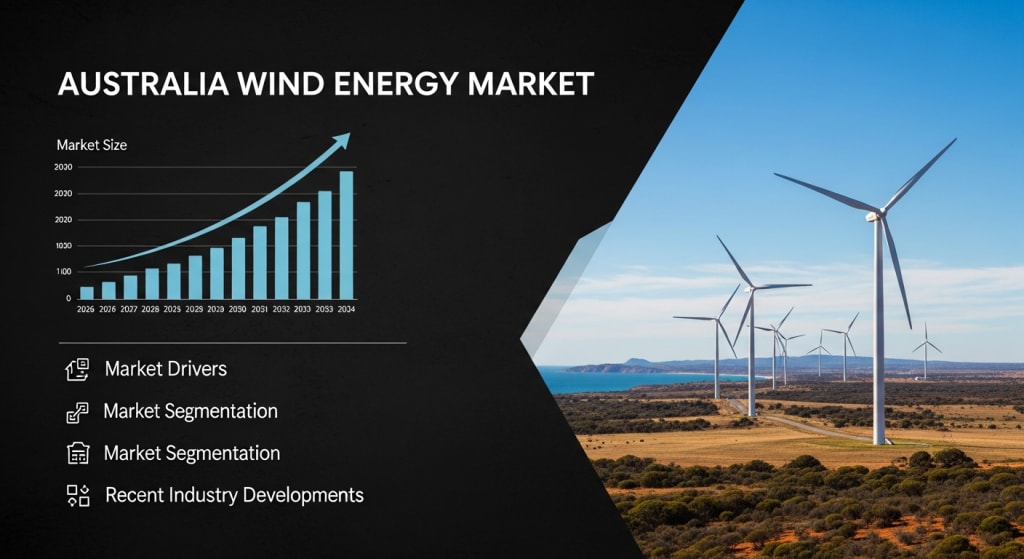
According to IMARC Group, the Australia wind power market reached a value of USD 2.72 Billion in 2024 and is projected to grow to USD 4.78 Billion by 2033, registering a compound annual growth rate (CAGR) of 5.80% during 2025–2033. This growth reflects wind energy’s central role in Australia’s clean energy transition as the country accelerates efforts to decarbonize electricity generation and modernize its power grid. With abundant wind resources across multiple states, Australia has steadily expanded both onshore and emerging offshore wind capacity. Wind power is no longer a supplementary renewable source—it has become a foundational pillar of the nation’s future electricity mix, supporting energy security, emissions reduction and long-term infrastructure transformation.
Why Should Smart Buyers and Investors Know About the Australia Wind Energy Market?
A High-Growth Renewable Infrastructure Segment
With the market projected to approach USD 4.8 Billion by 2033, wind energy represents one of Australia’s most important growth segments within the clean energy economy.
Long-Term Revenue Visibility Through Contracts and Policy Support
Long-term PPAs, regulated market frameworks and renewable targets provide predictable revenue streams for wind energy projects, reducing investment risk.
Central Role in Decarbonization and Energy Security
Wind energy supports Australia’s emissions-reduction goals while reducing reliance on fossil fuel imports and volatile fuel prices.
Opportunities Across the Value Chain
From turbine manufacturing and project development to grid services and storage integration, the wind energy ecosystem offers diverse investment and procurement opportunities.
Foundation for Future Energy System Resilience
As Australia transitions toward a high-renewables grid, wind energy will play a critical role in balancing supply, supporting electrification and enabling long-term energy system stability.
Recent Trends & Developments in the Australia Wind Energy Market
May 2025:
Several large-scale wind projects progressed through planning and financial close stages, supported by long-term offtake agreements and improved transmission access within renewable energy zones.
October 2024:
State governments advanced offshore wind frameworks, designating priority zones and streamlining approval pathways to accelerate project development along Australia’s southern coastline.
June 2024:
Grid operators expanded investment in transmission upgrades and interconnectors, addressing congestion constraints and improving the integration of new wind capacity into the national electricity market.
The Australia wind energy market is evolving into a cornerstone of the nation’s future power system, driven by utility-scale expansion, supportive policy frameworks and accelerating decarbonization objectives. Backed by strong IMARC growth projections, continued grid investment and rapid technology advancement, wind energy is moving from growth phase to system-defining infrastructure. For utilities, developers, investors and policymakers, understanding wind energy’s strategic role is essential to navigating Australia’s clean energy transition and building a resilient, future-ready electricity market.
Australia Wind Energy Market Vision 2050
1. Wind Power as a Core Electricity Supply Source
By 2050, wind energy is expected to supply a substantial share of Australia’s electricity, operating alongside solar, storage and other renewables to form a low-emissions power system.
2. Offshore Wind Development and Scale-Up
Australia’s offshore wind potential is gaining momentum, particularly along southern coastlines. Large offshore projects will complement onshore capacity, offering higher output consistency and proximity to coastal demand hubs.
3. Integration with Energy Storage and Hybrid Systems
Wind energy will increasingly be paired with battery storage, pumped hydro and other flexible resources to smooth output variability and provide firm capacity to the grid.
4. Digital and AI-Driven Wind Farm Operations
Advanced analytics, artificial intelligence and digital twins will optimize turbine performance, predictive maintenance and grid interaction, improving operational efficiency and asset lifespan.
5. Wind Energy as a Driver of Regional Economic Development
Future wind projects will continue to support regional employment, local supply chains and infrastructure investment, strengthening the economic case for renewable expansion.
What is the Australia Wind Energy Market Key Growth Drivers?
Utility-Scale Wind Farm Expansion Across Key Regions
Australia continues to develop large-scale wind projects in regions with strong and consistent wind resources, including Victoria, New South Wales, South Australia and Queensland. These utility-scale installations deliver cost-competitive electricity and form the backbone of renewable capacity additions.
Strong Policy Support and Renewable Energy Targets
Federal and state-level renewable energy targets, alongside net-zero commitments, are providing long-term visibility for wind energy investments. Supportive planning frameworks and auction mechanisms are encouraging developers to commit capital to new wind projects.
Cost Competitiveness and Technology Improvements
Advancements in turbine design, taller towers and larger rotor diameters have significantly improved capacity factors and reduced levelized cost of electricity (LCOE). Wind power is now among the most cost-effective sources of new generation in Australia.
Grid Modernization and Transmission Investment
Major investments in transmission infrastructure and renewable energy zones are enabling wind farms to connect efficiently to demand centers. Grid upgrades are critical for unlocking new capacity and integrating higher shares of variable renewable energy.
Corporate Power Purchase Agreements (PPAs)
Growing corporate demand for clean energy is driving wind project development through long-term PPAs. Businesses seeking to reduce carbon footprints and manage energy costs are increasingly sourcing power directly from wind farms.
About the Creator
Keep reading
More stories from Shrestha Roy and writers in Futurism and other communities.
Australia Car Market: Consumer Demand, Technology Shift & Mobility Evolution
According to IMARC Group, the Australia car market reached a value of USD 21.5 Billion in 2025 and is projected to grow to USD 23.6 Billion by 2034, registering a compound annual growth rate (CAGR) of 1.05% during 2026–2034. While growth is modest in value terms, the market is undergoing a profound structural transformation. Australia’s car market is no longer defined solely by unit sales; it increasingly reflects broader shifts in technology adoption, consumer expectations, environmental priorities and future mobility models. Electrification, connected-vehicle features and evolving ownership preferences are reshaping how Australians research, purchase and use vehicles, positioning the market firmly within a future-oriented mobility landscape.
By Shrestha Roy6 days ago in Futurism
About Binding Prometheus
I want to start actively advocating on behalf of my own work, and the most valuable part of my canon is, without a doubt, Binding Prometheus, the play I have been working on since 2019 and only finished in 2023 as part of my MA. The play itself is an amalgamation of a million different inspirations. On one end, it evokes the Ancient Greek myth-play, deriving its own title from the earliest extant work of Western drama we have, Aeschylus’s Prometheus Bound. On the other end, it borrows significantly from the sci-fi bulwarks from over the years, namely Mary Shelley’s Frankenstein and Karel Capek’s Rossum’s Universal Robots. The play could be an episode of Black Mirror, I fear. I don’t know. I’ve only ever seen one episode of Black Mirror.
By Steven Christopher McKnight18 days ago in Futurism
Australia Electric Vehicle Market: Clean Mobility, Smart Transport & Energy Transition
In 2025, Australia electric vehicle (EV) market was valued at USD 21.1 Billion. Looking ahead, the market is expected to surge to USD 205.5 Billion by 2034, exhibiting an exceptional compound annual growth rate (CAGR) of 28.80% during 2026–2034.
By Kevin Cooper6 days ago in Futurism




Comments
There are no comments for this story
Be the first to respond and start the conversation.