
Australia Printer Market Size and Forecast 2025–2033: A Digital Shift Reshaping the Industry
From Home Offices to Industrial Floors, Printing Technology Evolves to Meet Australia’s Changing Needs

Australia Printer Market Outlook at a Glance
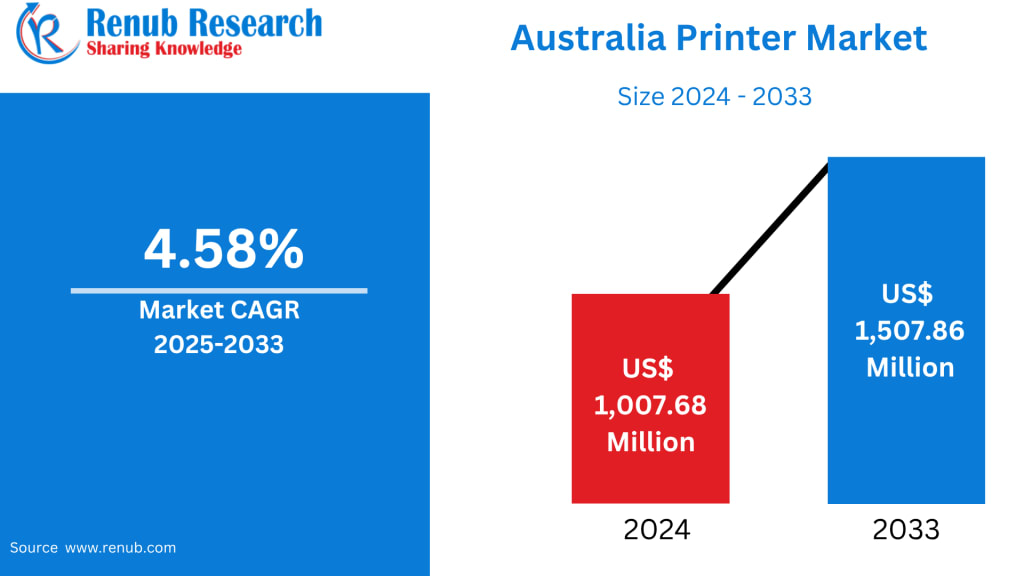
The Australia Printer Market is entering a phase of steady, technology-driven growth as businesses, households, and industrial users increasingly invest in modern, efficient, and connected printing solutions. According to Renub Research, the market is expected to expand from US$ 1,007.68 million in 2024 to US$ 1,507.86 million by 2033, growing at a CAGR of 4.58% between 2025 and 2033.
This growth is being fueled by rising demand for multifunction devices, increased adoption of cloud and wireless printing, growth in small businesses and remote work, and continuous innovation in commercial and industrial printing technologies. While paperless workflows are expanding, printing remains an essential function across education, healthcare, logistics, manufacturing, government, and retail sectors, ensuring sustained demand for printers across Australia.
Australia Printer Industry Overview
The Australian printer industry is undergoing a notable transformation, shaped by advances in digital technology and evolving end-user requirements. Traditional standalone printers are being replaced by smart, multifunction, and network-enabled systems that integrate seamlessly with digital workflows. This transition is particularly visible in offices adopting hybrid work models, where cloud-based printing and mobile connectivity have become essential features.
In residential settings, compact inkjet and laser printers are gaining popularity as remote work and online education continue to drive home-office setups. At the same time, industrial and commercial users are upgrading to high-speed, high-resolution digital presses that support personalization, faster turnaround times, and lower operating costs.
Sustainability is also becoming a central theme in the market. Australian businesses are increasingly prioritizing energy-efficient printers, recycled consumables, and low-waste printing technologies, prompting manufacturers to develop eco-friendly product lines. As a result, innovation, sustainability, and connectivity are now the defining pillars of the Australian printer market.
Key Factors Driving the Australia Printer Market Growth
1. Government Support for Digital Transformation
The Australian government has been actively promoting digital adoption across industries to improve productivity, competitiveness, and operational efficiency. Through grants, innovation funding, and digital transformation programs, businesses are being encouraged to modernize their infrastructure — including document management and printing systems.
Government agencies, educational institutions, and public-sector offices are transitioning to secure, cloud-enabled printing networks that support centralized control and remote access. This shift has created sustained demand for enterprise-grade printers and managed print services, providing a significant boost to the overall market.
2. Rising Demand for Personalized and On-Demand Printing
Personalization is rapidly becoming a key differentiator in marketing, packaging, and customer engagement. Australian businesses are increasingly using on-demand printing solutions to produce customized brochures, labels, packaging, and promotional materials in small batches, reducing waste while improving brand impact.
Digital printers that support variable data printing, fast setup, and short print runs are especially in demand. Industries such as retail, advertising, publishing, and event management are driving this trend, making personalization a major growth engine for the printer market.
3. Growth in Remote Work and Home-Based Businesses
The rise of remote work and small enterprises has significantly increased demand for compact, affordable, and multifunction printers. Home offices now require devices that combine printing, scanning, copying, and wireless connectivity in one unit.
Inkjet and laser printers designed for residential use are benefiting from this trend, particularly models that integrate with smartphones, tablets, and cloud platforms. As flexible work arrangements become a permanent feature of Australia’s workforce, this segment is expected to remain a strong contributor to market growth.
4. Business Investments in Modern and Versatile Printing Solutions
Across Australia, businesses are upgrading to high-performance printers that deliver better speed, image quality, and efficiency. Multifunction printers (MFPs) are increasingly preferred because they reduce hardware costs while improving workflow efficiency.
Commercial printing companies, logistics firms, healthcare providers, and manufacturers are investing in advanced printers that integrate with enterprise software systems, enabling seamless document handling and automation. These investments not only improve productivity but also expand the market for premium printing equipment and services.
5. Expansion of Industrial and Commercial Printing Applications
Industrial printing applications — including packaging, labeling, textiles, electronics, and 3D printing — are expanding rapidly in Australia. Sectors such as food and beverage, pharmaceuticals, and consumer goods rely heavily on high-quality printing for compliance, branding, and traceability.
3D printers are also gaining momentum in manufacturing, education, and healthcare, supporting prototyping, tooling, and custom production. This diversification of use cases is strengthening the printer market and creating new growth opportunities beyond traditional document printing.
Challenges in the Australia Printer Market
Supply Chain Disruptions
The printer industry continues to face challenges related to global supply chain disruptions, particularly shortages of semiconductors and electronic components. Delays in shipping, rising freight costs, and dependency on overseas manufacturing have affected inventory availability and product pricing.
Manufacturers are responding by diversifying supply chains, increasing local assembly, and improving inventory planning. However, these strategies can increase operational costs, which may impact margins and pricing for end users.
Rapid Technological Change and Cost Pressure
Technology in the printer industry is evolving at a fast pace, requiring continuous investment in research, development, and product upgrades. While innovation drives market growth, it also shortens product life cycles and increases competition.
For small and medium-sized businesses, the cost of adopting the latest printing technologies can be a barrier. Manufacturers must balance innovation with affordability to ensure broad market adoption, particularly in price-sensitive segments.
Australia Printer Market Segmentation
By Type
Inkjet Printers
Laser Printers
Dot Matrix Printers
3D Printers
Offset Printers
Flexographic Printers
Others
Inkjet and laser printers dominate residential and commercial use, while offset, flexographic, and 3D printers are expanding rapidly in industrial applications.
By End Use
Industrial
Commercial
Residential
The commercial segment currently holds the largest share due to office printing and managed print services, while the residential segment is growing steadily with remote work adoption. Industrial printing is expected to witness the fastest growth during the forecast period.
Competitive Landscape: Key Players Shaping the Market
The Australian printer market is moderately consolidated, with global technology leaders maintaining strong market presence through innovation, service networks, and brand trust. Key companies include:
Canon Inc.
FUJIFILM Corporation
Fujitsu Limited
Hitachi Ltd.
Honeywell International Inc.
HP Inc.
Panasonic Corporation
Seiko Epson Corporation
Toshiba Corporation
Xerox Corporation
These companies are investing heavily in smart printers, cloud connectivity, eco-friendly designs, and managed print services, enabling them to retain competitiveness in a rapidly evolving market.
Recent Industry Developments
Expansion of cloud-based printing platforms
Introduction of energy-efficient and recyclable printer models
Growth in managed print services (MPS) for enterprises
Increased focus on cybersecurity for networked printers
Advancements in industrial and 3D printing technologies
Such developments reflect the industry’s shift toward sustainability, automation, and digital integration.
Future Outlook: Where the Market Is Headed
Looking ahead, the Australia printer market is poised for steady expansion as digital transformation, personalization, and sustainability continue to shape purchasing decisions. While paperless initiatives are growing, the need for reliable, high-quality printing remains strong across multiple industries.
Technologies such as AI-enabled printing, predictive maintenance, and smart device integration will define the next phase of growth. Companies that combine innovation with cost efficiency and environmental responsibility will be best positioned to succeed.
Final Thoughts
The Australia Printer Market, valued at US$ 1,007.68 million in 2024, is projected to reach US$ 1,507.86 million by 2033, according to Renub Research, growing at a CAGR of 4.58%. This growth reflects a balanced mix of traditional demand and modern digital innovation.
As businesses, homes, and industries adapt to new ways of working and producing, printers will remain a vital part of Australia’s technological infrastructure. The market’s future lies in smarter, greener, and more flexible printing solutions that align with the country’s evolving economic and digital landscape.
About the Creator
jaiklin Fanandish
Jaiklin Fanandish, a passionate storyteller with 10 years of experience, crafts engaging narratives that blend creativity, emotion, and imagination to inspire and connect with readers worldwide.
Keep reading
More stories from jaiklin Fanandish and writers in Futurism and other communities.
France Toys Market Size and Forecast 2025–2033: How Innovation, Sustainability, and Digital Play Are Reshaping Childhood
France Toys Market Overview The toys market in France is undergoing a dynamic transformation, blending tradition with innovation as evolving consumer preferences reshape how children play and learn. According to Renub Research, the France Toys Market is expected to grow from US$ 3.05 billion in 2024 to US$ 4.79 billion by 2033, registering a CAGR of 5.12% during the forecast period (2025–2033). This steady expansion reflects a combination of rising disposable incomes, increasing demand for educational and interactive toys, growing online sales, and a strong national focus on sustainability and eco-friendly products.
By jaiklin Fanandish3 days ago in Futurism
About Binding Prometheus
I want to start actively advocating on behalf of my own work, and the most valuable part of my canon is, without a doubt, Binding Prometheus, the play I have been working on since 2019 and only finished in 2023 as part of my MA. The play itself is an amalgamation of a million different inspirations. On one end, it evokes the Ancient Greek myth-play, deriving its own title from the earliest extant work of Western drama we have, Aeschylus’s Prometheus Bound. On the other end, it borrows significantly from the sci-fi bulwarks from over the years, namely Mary Shelley’s Frankenstein and Karel Capek’s Rossum’s Universal Robots. The play could be an episode of Black Mirror, I fear. I don’t know. I’ve only ever seen one episode of Black Mirror.
By Steven Christopher McKnight23 days ago in Futurism
Mobile App Development in Indianapolis Faces New Talent Shifts
The meeting begins the same way it always has. A manager reviews hiring plans. Timelines are discussed. Budgets are checked. Then someone points out that the last three candidates turned down offers, not because of pay, but because of flexibility, project scope, or long-term growth.
By Samantha Blake3 days ago in Futurism
Rachel Reviews: The Spiral Archive by Pieter Hendrik
It's difficult for me to know where to start with a review of this book as it was, for me, an entirely unique experience and one that I'll probably never have again. I don't want that to be interpreted as unenjoyable but it has left me scratching my head a little and ruminating on its content, its themes and its characters.
By Rachel Deeming6 days ago in BookClub



Comments
There are no comments for this story
Be the first to respond and start the conversation.