
Australia Organic Food Market: Clean Eating Trends, Consumer Awareness & the Future of Sustainable Nutrition
How health-conscious lifestyles, organic farming and retail expansion are shaping Australia’s organic food industry
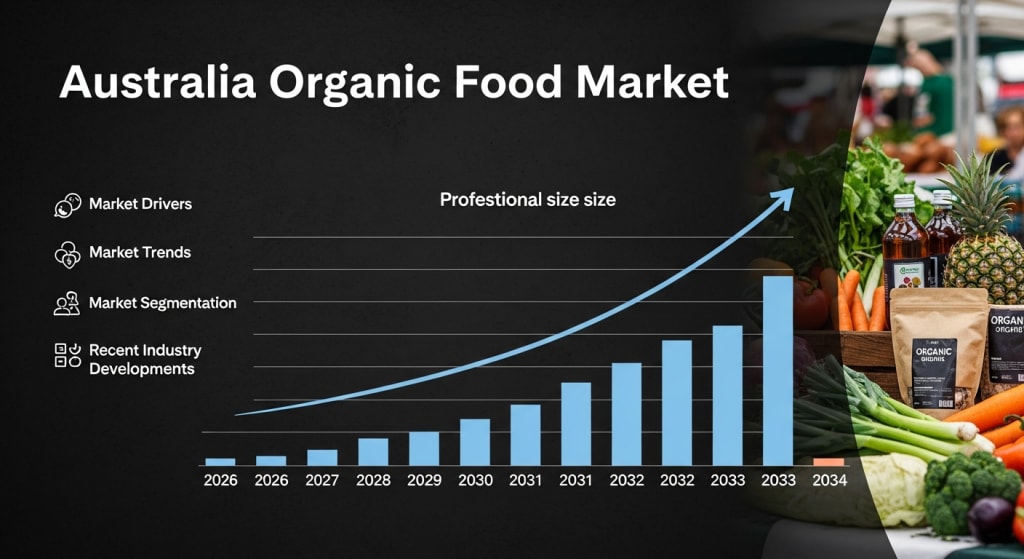
According to IMARC Group, the Australia organic food market reached a value of USD 1.1 Billion in 2024 and is projected to grow to USD 2.2 Billion by 2033, exhibiting a compound annual growth rate (CAGR) of 7.49% during 2025–2033. This sustained growth reflects a fundamental shift in consumer attitudes toward food quality, transparency and long-term health outcomes. Organic food is increasingly viewed not just as a premium dietary choice, but as a safer, more sustainable alternative aligned with clean-label consumption and environmental responsibility. As awareness of chemical residues, food processing practices and nutritional integrity rises, organic products are gaining mainstream acceptance across households, retailers and foodservice channels throughout Australia. The market’s expansion is closely tied to lifestyle-driven purchasing decisions, supportive retail infrastructure and growing confidence in certified organic supply chains.
Why Should Smart Buyers and Investors Know About the Australia Organic Food Market?
Consistent Growth in a Health-Driven Sector
With a CAGR of 7.49%, organic food offers stable, long-term growth supported by enduring health and lifestyle trends.
Expanding Consumer Base Beyond Early Adopters
Organic products are increasingly adopted by mainstream households, reducing reliance on niche consumer segments.
Strong Alignment With Sustainability and ESG Criteria
Organic agriculture supports environmental stewardship, making the sector attractive to ESG-focused investors and brands.
Retail-Led Scalability and Distribution Strength
Established retail networks provide scalability and visibility, enabling rapid market penetration for organic brands.
Opportunities Across the Value Chain
From farming and processing to branding and retail, the organic food market offers diversified investment and expansion opportunities.
Recent Trends & Developments in the Australia Organic Food Market
May 2025:
Retailers expanded private-label organic product ranges to meet growing consumer demand while improving price competitiveness.
January 2025:
Organic food producers invested in improved packaging and shelf-life solutions, enhancing product quality and reducing food waste.
September 2024:
Consumer engagement campaigns emphasizing organic certification, sustainability and health benefits gained traction across digital and in-store channels.
The Australia organic food market exemplifies how health awareness, environmental responsibility and retail accessibility are reshaping modern food systems. Supported by strong IMARC growth projections, the sector is evolving from a premium alternative into a foundational pillar of sustainable nutrition. As consumers increasingly prioritize food transparency, wellness and ecological impact, organic products are positioned at the intersection of personal health and planetary well-being. For producers, investors and food industry stakeholders, Australia’s organic food market represents not just a growing category, but a forward-looking blueprint for how future food consumption will balance nutrition, sustainability and trust in an increasingly conscious global economy.
Australia Organic Food Market Vision 2050
1. Organic Food as a Mainstream Dietary Standard
By 2050, organic food is expected to transition from a niche segment into a core component of everyday diets, particularly in urban and health-focused communities.
2. Technology-Enabled Organic Farming
Digital tools, precision agriculture and data analytics will enhance organic farming efficiency, improving yields while preserving environmental integrity.
3. Expansion of Organic Processed and Convenience Foods
Organic offerings will increasingly extend beyond fresh produce into ready-to-eat meals, packaged foods and functional nutrition products.
4. Stronger Certification and Traceability Systems
Advanced traceability technologies will improve transparency and consumer trust, enabling real-time verification of organic sourcing and production methods.
5. Integration With National Sustainability Goals
Organic agriculture will play a larger role in national sustainability strategies, supporting climate resilience, food security and responsible land use.
What Are the Key Growth Drivers in the Australia Organic Food Market?
Rising Health Awareness and Preventive Nutrition
Australian consumers are becoming increasingly proactive about health management, prioritizing food choices that support immunity, gut health and long-term wellness. Organic foods, perceived as free from synthetic pesticides and additives, are benefiting from this preventive health mindset.
Shift Toward Clean-Label and Natural Products
Demand for clean-label foods with transparent ingredient lists is accelerating. Organic certification provides assurance around production standards, making organic products more attractive to consumers seeking minimally processed and naturally sourced foods.
Strong Retail Expansion and Accessibility
The widespread availability of organic products through major supermarkets and specialty retailers has significantly reduced accessibility barriers. Dedicated organic sections, private-label offerings and improved pricing strategies are helping organic food reach a broader consumer base.
Growth of Organic Farming and Domestic Supply
Increased investment in organic farming practices is strengthening domestic supply capacity. Farmers are adopting sustainable agriculture methods, crop rotation and soil health management to meet rising demand while maintaining certification standards.
Environmental and Ethical Consumption Trends
Beyond personal health, environmental sustainability and ethical food production are influencing purchasing decisions. Organic farming’s emphasis on biodiversity, soil conservation and reduced chemical use resonates with environmentally conscious consumers.
About the Creator
Keep reading
More stories from Shrestha Roy and writers in Futurism and other communities.
Australia Roofing Market: Construction Demand, Material Innovation & Building Performance
According to IMARC Group, the Australia roofing market reached a value of USD 2,920.9 Million in 2025 and is expected to grow to USD 4,019.2 Million by 2034, exhibiting a compound annual growth rate (CAGR) of 3.61% during 2026–2034. This steady expansion highlights the roofing sector’s critical role within Australia’s construction and infrastructure ecosystem. Roofing systems are no longer viewed solely as structural necessities; they are increasingly integral to energy efficiency, climate resilience and long-term building performance. Rising housing construction, large-scale infrastructure projects and renovation activity are driving consistent demand for advanced roofing materials across Australia. At the same time, climate variability, environmental regulations and higher energy costs are reshaping material selection, pushing the industry toward more durable, insulated and sustainable roofing solutions.
By Shrestha Royabout 8 hours ago in Futurism
The Future of Airport Terminal Operations: Market Dynamics and Digital Transformation
According to IMARC Group's latest research publication, The global airport terminal operations market size reached USD 6.7 Billion in 2024. Looking forward, IMARC Group expects the market to reach USD 13.1 Billion by 2033, exhibiting a growth rate (CAGR) of 7.32% during 2025-2033.
By Suhaira Yusuf2 days ago in Futurism
The State of Cyber Threats in Germany in 2026
Key Takeaways: AI Breaks the Language Barrier: Generative AI has dissolved Germany's natural linguistic defense, driving a 300% surge in grammatically perfect phishing and deepfake attacks. Market Explosion: The German cybersecurity sector is projected to hit $37.9B by 2033, fueled by strict compliance needs like NIS2 and rising industrial espionage. The Sovereign Cloud War: US hyperscalers are forced to launch "Sovereign Clouds" to compete with local pure-players like StackIT and bypass the US CLOUD Act. Industry 4.0 Under Siege: Cyberattacks have shifted from office IT to factory floor OT, impacting 87% of manufacturers with sabotage on unpatched machinery. Quantum "Code Red": The BSI has set a 2026 deadline for critical infrastructure to adopt quantum-resistant encryption to counter "Store Now, Decrypt Later" threats.
By Joey Moore7 days ago in Futurism
Dead and Wearing Green
She was wearing that green dress when I first saw her, five years ago to the day. Flowing meadow fabric draped over long legs, thick auburn hair flowing down her back. That smile. Of course, she is still beautiful now. But now she is no longer alive.
By Karen Cave7 days ago in Fiction


Comments
There are no comments for this story
Be the first to respond and start the conversation.