
Astro-Adventures: Understanding the Physics of the Universe
Astrophysics (basic understanding)
Introduction
Astrophysics is the branch of physics that studies the properties and behavior of celestial objects, such as stars, planets, galaxies, and the universe as a whole. It combines principles of physics and astronomy to understand the workings of the universe, from the tiniest subatomic particles to the largest structures in the cosmos. Astrophysicists use a variety of tools, including telescopes, satellites, and particle accelerators, to study the physical processes that govern the behavior of celestial bodies and the origins of the universe.
The basics of astrophysics include understanding the following concepts:
1. The Big Bang Theory: The leading theory that explains the origin and evolution of the universe. It states that the universe began as a singularity and has been expanding ever since.
2. The Solar System: The collection of celestial bodies that orbit around our sun, including the eight planets, their moons, and other small bodies like asteroids and comets.
3. The Milky Way Galaxy: The galaxy in which our solar system is located, consisting of billions of stars, gas, and dust.
4. Stars: The luminous spheres of gas that shine due to nuclear reactions in their cores. Astrophysicists study the properties of stars, such as their temperature, size, and composition, as well as their life cycles.
5. Galaxies: The huge collections of stars, dust, and gas that make up the universe. Astrophysicists study the different types of galaxies, their formation, and evolution.
6. Black Holes: Extremely dense and massive objects that result from the collapse of a massive star, from which nothing, not even light, can escape. Astrophysicists study the properties of black holes and their impact on the universe.
7. Cosmic Rays: High-energy particles that travel through space and interact with the Earth's atmosphere, Astrophysicists study the origin of cosmic rays and their effects on the Earth's environment.
8. The laws of physics, specially the laws of mechanics, electromagnetism and thermodynamics play a crucial role in understanding the behavior of celestial objects
Explanation of the Big Bang Theory
The Big Bang Theory is the leading explanation for the origin and evolution of the universe. It states that the universe began as a singularity, an infinitely dense and hot point, around 13.8 billion years ago. From this singularity, the universe expanded and cooled, eventually leading to the formation of subatomic particles, atoms, stars, and galaxies. This expansion continues to this day and the universe is still cooling. The Big Bang Theory is supported by many lines of evidence, including the cosmic microwave background radiation and the observed large scale structure of the universe.
Description of the Solar System
The Solar System is the collection of celestial bodies that orbit around our sun. It is made up of eight planets, their moons, and other small bodies such as asteroids and comets.
The four inner planets, Mercury, Venus, Earth and Mars, are called "terrestrial planets" because they are made mostly of rock and metal. The four outer planets, Jupiter, Saturn, Uranus and Neptune, are called "gas giants" because they are mostly made of gas and have much larger sizes than the terrestrial planets.
The sun, at the center of the Solar System, is a star that provides light and heat to all the planets. The planets orbit around the sun in elliptical paths. The inner planets orbit closer to the sun, while the outer planets are farther away.
In addition to the planets, there are also many other small bodies in the Solar System, such as asteroids, comets, and dwarf planets, such as Ceres, Pluto, and Eris. These small bodies can be found in different regions of the Solar System, such as the asteroid belt between Mars and Jupiter, and the Kuiper belt beyond Neptune.
The solar system also includes the Sun's family of objects, the comets, asteroids, meteoroids, and interplanetary dust particles, as well as the solar wind, a stream of charged particles emitted by the sun
Overview of the Milky Way Galaxy
The Milky Way Galaxy is a spiral galaxy that is home to our solar system. It is made up of billions of stars, gas, and dust. The galaxy is estimated to be around 100,000 light-years across and about 1,000 light-years thick.
The center of the Milky Way is home to a supermassive black hole, with a mass of around 4 million times that of the sun, this region is known as the Galactic Center. The galaxy is also home to a number of other black holes and neutron stars, as well as a variety of nebulae and other interesting structures.
The Milky Way is also home to a number of different types of stars, including red giants, blue giants, and white dwarfs. The galaxy is also home to a number of different types of nebulae, including planetary nebulae and supernova remnants.
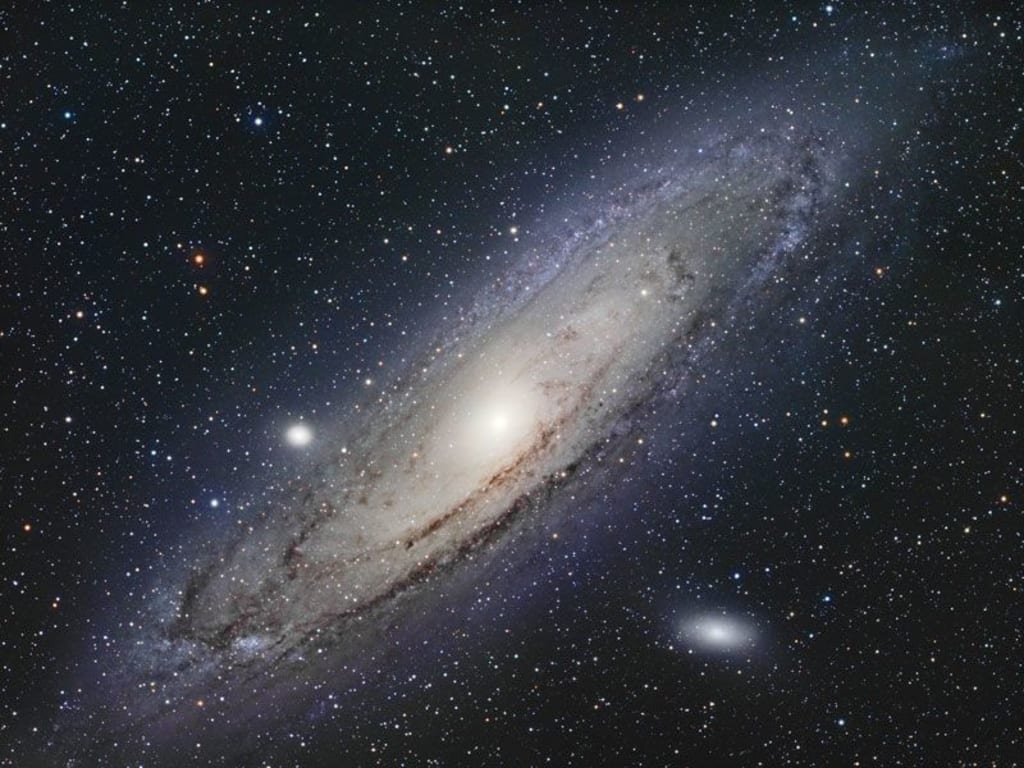
The Milky Way is part of the Local Group of galaxies, which also includes the Andromeda Galaxy and a number of smaller galaxies. The Milky Way and Andromeda are expected to collide in around 4.5 billion years, forming a giant elliptical galaxy.
Scientists continue to study the Milky Way galaxy and its structure, composition, dynamics, and evolution. It is an ongoing effort which uses a variety of telescopes and instruments to gather data about the galaxy and its properties.
The Study of Stars
The study of stars, also known as stellar astrophysics, is the branch of astrophysics that deals with the properties, behavior, and evolution of stars.
Scientists use telescopes and other instruments to gather data about stars, such as their size, temperature, luminosity, and chemical composition. They also study the movement and behavior of stars, including how they form, how they evolve over time, and how they eventually die.
One of the key concepts in the study of stars is the life cycle of a star. Stars are born from the collapse of giant clouds of gas and dust, known as nebulae. As the gas and dust collapse, it heats up and begins to fuse hydrogen into helium, releasing a tremendous amount of energy in the form of light and heat. This process is known as nuclear fusion, and it is what makes stars shine.
As a star ages, it will run out of hydrogen fuel, and its core will begin to shrink and heat up. This can lead to a number of different outcomes, such as the star becoming a red giant, a white dwarf, or even a black hole.
The study of stars also includes the study of exoplanets, planets that orbit around other stars, as well as the search for extraterrestrial life. Astrophysicists use telescopes to study the light of stars, looking for signs of planets and other bodies that might be orbiting around them.
Overall, the study of stars is a broad and fascinating field that helps us to understand the properties and behavior of the stars and how they affect the universe.
The Study of Galaxies
Galaxy study, also known as galactic astronomy, is the branch of astronomy that deals with the study of galaxies, including their formation, evolution, structure, and properties. Galaxies are vast collections of stars, gas, dust, and dark matter held together by gravity. Scientists use a variety of techniques to study galaxies, including observational techniques such as telescopes and spacecraft, as well as theoretical models and simulations. Some key areas of research in galaxy study include the formation and evolution of galaxies, the properties of galaxy populations, and the distribution and dynamics of matter within galaxies.
The Study of Black Holes
Black holes are extremely dense regions of space where the gravitational pull is so strong that nothing, including light, can escape. They are formed when massive stars die and their cores collapse in on themselves. The study of black holes, also known as black hole physics, is a multidisciplinary field that encompasses areas such as astronomy, physics, and mathematics. Researchers in this field study the properties and behavior of black holes, as well as their effects on the surrounding matter and space-time. This can include studying the properties of the event horizon (the boundary beyond which nothing can escape), the accretion of matter onto black holes, and the behavior of matter near the black hole's singularity (the point of infinite density at the center of the black hole).
The Study of Cosmic Rays
The study of cosmic rays is a field of research that deals with the high-energy particles that constantly bombard the Earth from outer space. These particles, which can include protons, electrons, and atomic nuclei, are thought to originate from a variety of sources such as supernovae, pulsars, and active galactic nuclei. Cosmic ray physics is a multidisciplinary field that involves the use of particle detectors, telescopes, and satellites to detect and study cosmic rays.
Researchers in this field study the properties and behavior of cosmic rays, such as their energy, charge, and direction. They also study the origin and acceleration mechanisms of cosmic rays, as well as their interactions with the Earth's atmosphere and magnetic field. Additionally, cosmic ray research has applications in other areas such as particle physics, astrophysics, and nuclear physics.
Some of the ongoing research areas in cosmic rays include the study of ultra high-energy cosmic rays, the search for dark matter through cosmic ray detection, and the study of cosmic ray propagation through the galaxy.
The Future of Astrophysics
Astrophysics is a rapidly evolving field, and there are many exciting new developments and discoveries on the horizon. Some of the key areas of focus in the future of astrophysics include:
• The study of exoplanets: With the discovery of thousands of exoplanets (planets outside of our solar system), there is a growing interest in studying the properties and potential habitability of these planets. Future missions such as the James Webb Space Telescope and the PLATO satellite will allow for more detailed studies of exoplanet atmospheres and the search for biosignatures.
• The study of dark matter and dark energy: Despite being one of the most important discoveries of the 20th century, the nature of dark matter and dark energy is still not understood. The next generation of telescopes, such as the Large Synoptic Survey Telescope and Euclid, will allow for more accurate measurements of the distribution of dark matter and the expansion rate of the universe.
• The study of the early universe: Inflationary cosmology theories suggest that the universe underwent a period of rapid expansion in the first fractions of a second of its existence. Future experiments, such as the Cosmic Origins Explorer (CORE) and the Simons Observatory, will help in understanding the properties of the universe in its early stages.
• The study of gravitational waves: The detection of gravitational waves by LIGO and Virgo has opened up a new way to study the universe and has already provided new insights into the properties of black holes and neutron stars. Upcoming experiments, such as LISA, will allow for the detection of gravitational waves from even more exotic sources such as merging supermassive black holes.
Overall, the future of astrophysics is expected to bring many new discoveries and advancements in our understanding of the universe.
The Importance of Astrophysics for humanity
Astrophysics is an important field of research for humanity for a number of reasons. Some of the key ways in which astrophysics contributes to our understanding of the universe and our place in it include:
• Advancing our understanding of the origin, structure, and evolution of the universe: Astrophysics helps us understand how the universe began, how it has changed over time, and what its ultimate fate may be. This knowledge can help us better understand our place in the universe and how we fit into the larger cosmic picture.
• Improving our understanding of the laws of physics: Astrophysics is a field that pushes the limits of our understanding of the laws of physics. The study of extreme conditions, such as those found near black holes and in the early universe, can help us test and refine our understanding of fundamental physics.
• Advancing our understanding of the origins of life: Astrophysics plays an important role in understanding the origins of life on Earth. The study of exoplanets, for example, can help us understand the conditions that are necessary for life to emerge and evolve.
• Advancing technology: Astrophysics research often requires the development of new technologies and techniques. These technologies, such as telescopes and detectors, have many applications in other fields, such as medicine and communications.
• Inspiration and public engagement: Astrophysics has always been a source of inspiration and wonder for humans. It allows people to look beyond the day to day and to appreciate the grandeur and complexity of the universe. It also can inspire young people to pursue careers in science and technology.
Overall, the study of astrophysics provides a deeper understanding of the universe and our place in it, and has the potential to bring about new technologies and advancements that can benefit humanity in a variety of ways.
Conclusion
In conclusion, astrophysics is a multidisciplinary field that deals with the study of the universe and its properties. It encompasses areas such as astronomy, physics, and mathematics, and helps us understand how the universe began, how it has changed over time, and what its ultimate fate may be. It also helps to improve our understanding of the laws of physics and the origins of life, and has the potential to bring about new technologies and advancements that can benefit humanity in a variety of ways. The study of astrophysics is a fascinating and endlessly intriguing field, and there are many resources available for those who are interested in learning more about it. Whether you're a student, a professional, or simply someone who is curious about the universe, there is always more to discover and learn in the field of astrophysics.
About the Creator
Keep reading
More stories from Madhu Mitha and writers in Futurism and other communities.
"The Iridescent Wonders of the Blue Butterfly World"
Introduction: The world of butterflies is a colorful and captivating one, full of beauty and wonder. Among the many species that exist, the blue butterfly stands out with its shimmering, iridescent wings. In this essay, we will delve into the blue butterfly world, exploring the science behind their radiant coloration and the role they play in the ecosystem. From their unique anatomy to their fascinating life cycles, we will discover the iridescent wonders of the blue butterfly world and appreciate their significance in our planet's diverse array of life forms. Get ready to be amazed by the beauty and diversity of the blue butterfly kingdom.
By Madhu Mitha3 years ago in Earth
About Binding Prometheus
I want to start actively advocating on behalf of my own work, and the most valuable part of my canon is, without a doubt, Binding Prometheus, the play I have been working on since 2019 and only finished in 2023 as part of my MA. The play itself is an amalgamation of a million different inspirations. On one end, it evokes the Ancient Greek myth-play, deriving its own title from the earliest extant work of Western drama we have, Aeschylus’s Prometheus Bound. On the other end, it borrows significantly from the sci-fi bulwarks from over the years, namely Mary Shelley’s Frankenstein and Karel Capek’s Rossum’s Universal Robots. The play could be an episode of Black Mirror, I fear. I don’t know. I’ve only ever seen one episode of Black Mirror.
By Steven Christopher McKnight20 days ago in Futurism
When I Asked AI to Proofread My Writing, It Made Things Up
I like to write as a hobby. It is my therapy. When my head feels crowded, writing slows everything down. I publish some of that writing on Medium and Vocal, not because I think every piece is perfect, but because the act of finishing and sharing matters to me.
By Nick William7 days ago in Futurism
The Devil's Cut
“Comrade, finally you’re awake.” The voice was smooth, sensual. A flickering incandescent bar was all that lit the white, sterile room. All Vladimir remembered was everything going black. He tried to move his arms and found them strapped to the gurney.
By Matthew J. Fromm7 days ago in Fiction




Comments
There are no comments for this story
Be the first to respond and start the conversation.