
When I Asked AI to Proofread My Writing, It Made Things Up
A personal look at why reliability matters more than apologies when machines shape real decisions

I like to write as a hobby. It is my therapy. When my head feels crowded, writing slows everything down. I publish some of that writing on Medium and Vocal, not because I think every piece is perfect, but because the act of finishing and sharing matters to me.
For the past few months, I have been using AI as a last step before publishing. Not to write for me, and not to rewrite my voice, but simply to catch grammar issues I might miss. I rarely accept every suggestion. I use it the same way I would use a spellchecker, as a second set of eyes.
Proofreading my own work has always been harder than reviewing someone else’s. I read too fast because I already know what I meant to say. My brain fills in gaps before my eyes notice them. That is exactly the kind of task AI should be good at.
At least, that is what I thought.
Just today, I asked AI to proofread an essay I am working on. On two separate occasions, it came back with what I can only describe as fictional errors. It suggested fixes for problems that did not exist. Words that were already there. Punctuation that was already present.
So I asked a simple question. Why so many errors today in your feedback?
The response was polite and self aware. It admitted the mistake. It explained that it had not carefully re read the original text before making suggestions. It even acknowledged that this kind of feedback damages trust, especially when the task is something as basic as proofreading.
That part was honest. Almost refreshing.
I followed up with another question. Should I use a certain prompt to make sure you are being more careful?
The answer suggested adding extra instructions. Ask it to double check. Ask it to quote the exact phrase before suggesting a correction. Add an accountability step so that mistakes like this would be harder to make.
Then came the sentence that stuck with me. It admitted that I should not need a special prompt to get accurate proofreading. The system should already be doing that level of careful checking by default.
And that is where this stopped being about grammar.
Imagine a dishwasher with built in AI. Sometimes it leaves your dishes dirty. You ask it why. It replies that it should have washed them properly, but to be safe, you should press the start button harder next time.
That would sound ridiculous. We would not accept it.
Yet this is increasingly how we interact with AI systems. When something goes wrong, the burden shifts to the user. Adjust the prompt. Be more specific. Add more instructions. Debug the tool while you are trying to use it.
As companies rush to build AI into everything, I find myself wondering about the quality of the output and, more importantly, the cost of getting it wrong.
There is a difference between a typo slipping through and a system making decisions that affect real people. We have already seen public examples. AI systems praising historical monsters. Generating racist or biased content. Producing confident but incorrect news summaries. Citing legal cases that never existed.
These are not edge cases anymore. These systems are being used in journalism, law, healthcare, government, and defense. The stakes are no longer theoretical.
Now add AI based age verification into the mix. Platforms like Spotify and YouTube are beginning to require it in some markets. What happens when the system gets it wrong? How many users will be locked out because an algorithm misread their age? How much friction will people tolerate before trust erodes completely?
We have grown used to living with unfinished software. Apps update constantly. Bugs are patched in public. Users quietly accept that they are part of the testing process.
AI feels different.
These systems are already shaping decisions, access, and outcomes. They are being treated as authoritative even when they are not consistently reliable. Asking users, citizens, or customers to act as the safety net feels like a risk we have not fully acknowledged.
The price of mistakes is rising faster than our tolerance for them.
Here is the part that made me laugh, and then stop laughing.
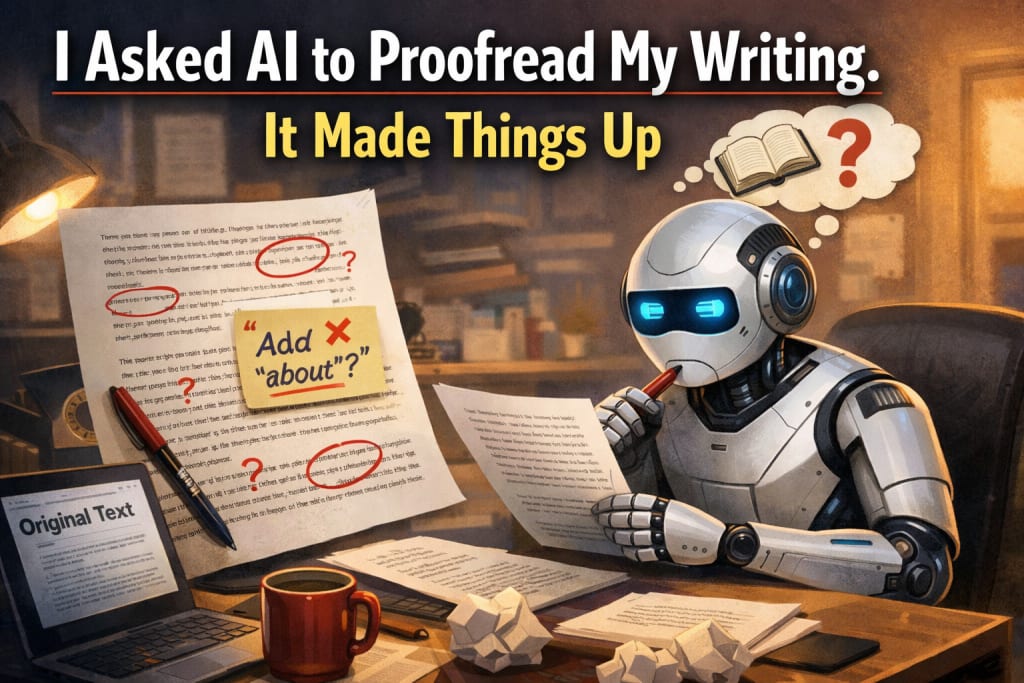
I used AI to grammar check this very article. Even after explicitly asking it to carefully read and quote the text before suggesting changes, it made the same mistake again.
It suggested adding the word "about" to this sentence.
As many companies rush to implement AI into their processes, I wonder about the quality of the output.
The word was already there.
When I pointed this out, the AI agreed. It admitted it had made the exact same error I was writing about. It even acknowledged that this was a perfect real world example of the problem.
Go figure.
I am not anti AI. I still use it. I probably will tomorrow. But trust is not built on apologies or explanations. It is built on systems that work as expected without requiring constant supervision.
If AI is going to play a role this large in our lives, it has to do better than asking us to press the start button harder.
About the Creator
Nick William
Nick William, loves to write about tech, emerging technologies, AI, and work life. He even creates clear, trustworthy content for clients in Seattle, Indianapolis, Portland, San Diego, Tampa, Austin, Los Angeles, and Charlotte.
Keep reading
More stories from Nick William and writers in Futurism and other communities.
Why Compute Power Is Becoming the New Competitive Advantage?
For decades, competitive advantage in technology often revolved around software design, user experience, or unique algorithms. Companies competed through features, branding, and innovation cycles that introduced new capabilities to users.
By Nick William14 days ago in Futurism
Air France Evacuation Flight Turns Back Because of Missile Fire
A planned evacuation flight operated by Air France was forced to abruptly turn back mid-route after missile activity was detected near its intended flight corridor, highlighting the growing dangers civilian aircraft face in conflict zones. The incident occurred late Tuesday evening as the aircraft, carrying evacuees and humanitarian personnel, attempted to depart a volatile region amid escalating military exchanges. According to aviation officials familiar with the situation, the aircraft had been chartered to transport civilians and diplomatic staff seeking to leave an area experiencing intensified hostilities. The flight had taken off successfully and climbed to cruising altitude when air traffic control and security monitoring systems detected missile launches within range of the aircraft’s projected flight path. Within minutes, pilots received instructions to alter course and return to the departure airport. Air France confirmed the diversion in a brief statement, emphasizing that the decision was made purely as a precaution to ensure passenger safety. “Our crew followed established international safety procedures after receiving security alerts regarding missile activity in the vicinity,” the airline said. “The aircraft returned safely without incident.” While the airline did not publicly identify the exact location of the event, aviation monitoring groups said the flight was operating in an area where military forces have recently exchanged long-range strikes. Civil aviation authorities frequently issue warnings when missile launches or air defense systems pose potential risks to passenger aircraft. Passengers aboard the flight described a tense but orderly situation. Shortly after the aircraft turned around, the captain reportedly addressed passengers over the intercom, explaining that security conditions along the route had deteriorated. Some travelers initially feared a technical issue but were reassured when the aircraft began descending back toward the airport. “We didn’t know exactly what was happening at first,” said one passenger who asked not to be identified. “The crew stayed calm and professional. Later they explained that missile launches had been detected and that it was safer to return.” Aviation safety experts say such diversions, while rare, have become more common as geopolitical conflicts increasingly intersect with international flight routes. Modern commercial aircraft rely on multiple sources of threat intelligence, including military radar feeds, satellite monitoring, and alerts from international aviation organizations. After the catastrophic downing of Malaysia Airlines Flight 17 in 2014, global aviation regulators strengthened procedures for monitoring conflict zones. Airlines now routinely adjust routes to avoid regions where missile systems could threaten high-altitude aircraft. “Airlines are extremely cautious today,” said a European aviation security analyst. “If there is even a small possibility that missile systems are active near a flight path, the safest option is to divert or cancel the flight.” The aborted evacuation mission underscores the growing challenges faced by governments trying to move civilians out of unstable regions. Evacuation flights often operate under tight time windows, relying on coordination between airlines, diplomatic services, and military authorities. Officials said discussions were underway to determine whether another evacuation attempt could be organized once conditions stabilize. In many such operations, governments work with commercial carriers like Air France because they have the logistical capacity and experienced crews needed to conduct large-scale passenger transport under difficult circumstances. Air France crews are trained for crisis operations, including sudden rerouting and emergency returns. In this case, airline officials praised the cockpit team for reacting quickly to the threat warning and maintaining clear communication with both passengers and air traffic control. Despite the tension surrounding the incident, all passengers and crew landed safely, and no injuries were reported. The aircraft returned to the airport approximately two hours after departure, where passengers were taken to a secure terminal area while authorities assessed the situation. Security analysts warn that the incident illustrates a broader trend: civilian aviation is increasingly affected by geopolitical conflict. As missile technology spreads and military confrontations become more unpredictable, airlines must constantly reassess flight paths and safety procedures. For now, the aborted evacuation flight stands as another reminder that even high-altitude commercial aircraft are not immune to the dangers created by modern warfare. Aviation officials say vigilance, intelligence sharing, and rapid decision-making remain the most effective tools to keep passengers safe when global tensions intrude into the skies.
By Fiaz Ahmed 4 days ago in Futurism
Artificial Intelligence (AI) earbuds Market will Reach Nearly USD 51.86 Billion by 2034
The Global AI Earbuds Market is projected to reach approximately USD 51.86 Billion by 2034, increasing from USD 5.75 Billion in 2024, growing at a robust CAGR of 24.6% during the forecast period from 2025 to 2034. This growth is primarily driven by the increasing demand for advanced audio solutions that integrate artificial intelligence (AI) to enhance user experiences.
By Roberto Crumabout 14 hours ago in Futurism
The Politics of Playing Dress-Up
Well, to start off I'd like to say a happy world book day to all who celebrate. I know I haven't really posted anything on my socials about it but I'm not a jubilant kind of person. I lay low most of the time. Let's start off with a popular anecdote from the vaults...
By Annie Kapur5 days ago in Geeks


Comments
There are no comments for this story
Be the first to respond and start the conversation.