
Artificial Intelligence: A Double-Edged Sword
Finding the Balance: Maximizing AI Benefits While Preserving Essential Human Abilities


Artificial Intelligence (AI) is a big part of our lives today. It changes how we work, learn, and interact with each other. AI makes daily tasks easier and improves industries in many ways. However, while it has many benefits, AI also affects our natural skills in ways we may not always notice. It can make us more efficient and productive, but it also raises concerns about how it impacts our thinking, creativity, and social skills. As we use AI more, we need to find a balance between using this technology and keeping our natural abilities strong.
The Bright Side of Artificial Intelligence
One big benefit of AI is that it can take over repetitive tasks, saving time and energy. This has made many industries more productive. For example, in healthcare, AI helps doctors diagnose diseases faster and more accurately by looking at medical data. This helps doctors make better decisions and avoid mistakes. In education, AI-powered tools can personalize lessons for students, which allows teachers to focus on the parts that need human involvement, like providing motivation. AI handles routine tasks, giving people time to focus on more meaningful work that requires judgment, creativity, and empathy—things only humans can do.
AI has also made learning easier for people everywhere. AI tools like flight simulators and virtual surgeries allow people to practice their skills in a safe environment. These tools make learning more engaging and accessible, helping people grow their knowledge and skills.
Potential Dangers of AI Dependence
Despite all the benefits, too much use of AI can harm our natural skills. As AI does more work that used to require thinking and effort, we may lose the ability to do these tasks ourselves. For example, many people now use GPS for directions instead of developing their sense of direction. Writing tools like Grammarly automatically correct mistakes, so people don’t have to learn grammar and spelling rules on their own. Over time, relying on AI for these tasks can weaken important skills like memory, problem-solving, and critical thinking. If we let AI make decisions for us, we may forget how to analyze situations or come up with creative solutions on our own.
Creativity is another area where AI has both good and bad effects. Tools like ChatGPT and DALL-E make it easier to create things like essays and artwork. While these tools help with ideas and save time, they can also stop people from thinking for themselves. Instead of experimenting or refining their ideas, people may just use AI-generated content. Creativity often requires trying new things, thinking deeply, and expressing personal ideas—things that AI can’t really do. If people rely too much on AI for creative tasks, they might lose their ability to think outside the box or come up with new ideas.
AI also affects how we interact with others. Virtual assistants, chatbots, and AI customer service tools replace many human interactions. While these tools are convenient, they don’t have the emotional understanding that people do. If we rely too much on AI for communication, we may spend less time talking to real people. This can make it harder to build relationships and develop social skills.
Job loss and skills becoming outdated are other worries related to AI. As AI takes over jobs in fields like manufacturing, transportation, and customer service, many workers are losing their jobs. This leaves them unemployed and makes their skills less useful. For example, a factory worker whose job is replaced by robots may find it hard to get a new job that requires advanced skills. While AI creates new job opportunities in fields like data science and programming, not everyone has access to the education or training needed to adapt. This leads to a gap between those who can keep up with AI changes and those who can’t.
Finding the Right Balance with AI
To fix these problems, we need to take steps to reduce the negative effects of AI on our skills. First, we should focus on activities that keep our minds active. For example, practicing problem-solving without relying on AI can help improve critical thinking. We should also try to reduce our dependence on digital devices for simple tasks like remembering phone numbers or doing math. This can help keep our memory and mental skills strong.
Second, schools and colleges should teach both basic skills and how to use AI. Students should learn how to use AI but also how to do tasks by hand. For example, learning to write without using AI tools or solving math problems without a calculator are important skills to practice. This way, people can work independently while still benefiting from AI when needed.
Third, we need to encourage creativity in an AI-driven world. People should use AI for inspiration, not as a replacement for their own creativity. Hobbies like painting, writing, or crafting can help people develop their imagination. By combining human creativity with AI’s capabilities, we can create amazing things without losing our ability to think creatively.
Lastly, we must focus on building emotional intelligence and social skills. Encouraging real, face-to-face communication and promoting empathy in schools and workplaces are important for maintaining strong relationships. Activities that encourage teamwork, collaboration, and emotional awareness can help people develop these important skills.
Conclusion
In conclusion, AI has brought many benefits, making work easier, improving productivity, and giving us access to more knowledge. But if we use AI too much, it can harm our natural skills. To succeed in a world with AI, we need to use technology wisely while keeping our natural abilities strong. By being careful with how we use AI and focusing on developing our cognitive, creative, and social skills, we can make sure that technology helps us without taking away what makes us human. A balanced approach will allow us to enjoy the benefits of AI while keeping the unique qualities that make us who we are.
About the Creator
Vijay Koul
I worked in CSIRO, AU. After retiring I found great joy in embracing writing as a fulfilling hobby. With more time on my hands. This new pursuit allowed me to explore different genres and topics, drawing from my experiences and knowledge.
Keep reading
More stories from Vijay Koul and writers in Futurism and other communities.
Delhi’s Winter Smog: A Public Health Catastrophe
Each winter, Delhi, India’s bustling capital, is smothered under a thick layer of smog, turning the air hazardous to breathe. For millions of residents, it’s a desperate race for clean air. Despite increasing public awareness and repeated warnings from experts, Delhi’s pollution problem has become an annual crisis
By Vijay Koulabout a year ago in Earth
Australia Energy Storage Market: Renewable Integration, Battery Deployment & Grid Stability
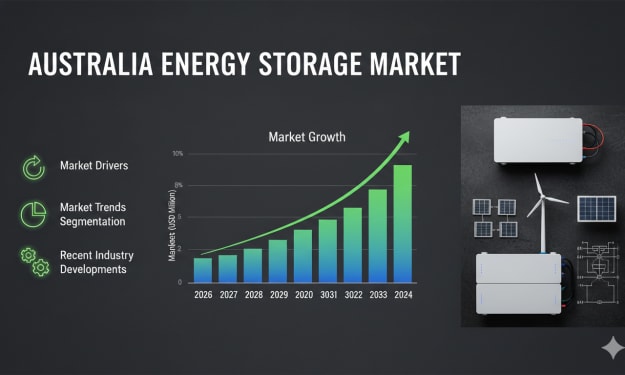
According to IMARC Group, the Australia energy storage market reached 4.72 GW in 2025 and is projected to expand significantly to 19.81 GW by 2034, exhibiting a compound annual growth rate (CAGR) of 17.28% during 2026–2034. The rapid growth of the sector reflects the country’s accelerating transition toward renewable energy and the increasing need for reliable electricity systems across Australia. As solar and wind power generation expands, energy storage technologies such as battery energy storage systems (BESS) are becoming essential for maintaining grid reliability and balancing electricity supply and demand. Government policies supporting clean energy adoption, declining battery costs, and investments in grid modernization are significantly strengthening Australia energy storage market share while enabling the integration of renewable power into the national electricity network.
By Shrestha Royabout 19 hours ago in Futurism
Cooking Oil Market: AI-Driven Innovation Transforming Global Edible Oil Demand
AI Overview of the Cooking Oil Market The cooking oil market includes a wide range of edible oils derived from plant and seed sources such as soybean, palm, sunflower, olive, coconut, and canola. These oils are essential ingredients in households, restaurants, food processing industries, and the HoReCa (Hotel, Restaurant, and Catering) sector.
By James Smith3 days ago in Futurism
Review of 'Man on the Run'
My wife and I saw Man on the Run, a nearly 2-hour documentary on Amazon Prime, about Wings, Paul McCartney's group that flew around the world from shortly after The Beatles broke up in early 1970 to shortly after John Lennon was murdered at the end of 1980, making a Beatles reunion forever impossible.
By Paul Levinson5 days ago in Beat



Comments
There are no comments for this story
Be the first to respond and start the conversation.