
Are We Alone? The Growing Evidence That Aliens Might Be Real
From leaked government reports to mysterious deep-space signals, humanity is closer than ever to answering one of its oldest questions.


For centuries, humanity has looked to the stars and wondered: Are we truly alone in the universe? What once seemed like the stuff of science fiction is now being taken seriously by scientists, military officials, and governments around the world. With increasing reports of unidentified aerial phenomena (UAPs), strange radio signals from deep space, and exoplanets capable of supporting life, the question has evolved from if aliens exist to when we’ll confirm it.
In 2025, the search for extraterrestrial life isn’t just a fantasy—it’s a well-funded scientific mission.
---
👽 1. Government Disclosures: From Denial to Disclosure
For decades, governments dismissed UFO sightings as hoaxes or weather anomalies. But that narrative began to shift dramatically in recent years. The U.S. Department of Defense officially released several military-captured videos showing objects that defy known physics—moving at hypersonic speeds without wings or propulsion systems.
The formation of the All-domain Anomaly Resolution Office (AARO) by the Pentagon marked a new era: for the first time, the U.S. openly admitted it is studying UAPs seriously. Congressional hearings have even featured testimonies from former intelligence officers claiming the existence of non-human craft retrieved and studied in secret.
This level of transparency is unprecedented—and the world is paying attention.
---
🌌 2. Science and Space: Searching for Life Beyond Earth
Beyond the military lens, scientists are exploring the cosmos with one mission in mind: to find signs of life.
The James Webb Space Telescope (JWST) is analyzing exoplanet atmospheres for biosignatures—gases like oxygen and methane that could hint at biological activity.
SETI (Search for Extraterrestrial Intelligence) continues to scan radio frequencies for patterns that can't be explained by natural sources.
In 2023, astronomers detected a mysterious repeating radio signal coming from a galaxy 3 billion light-years away—repeating every 16 days. Could it be natural? Or a distant form of communication?
These observations raise compelling possibilities. If life exists elsewhere, we may soon have hard data, not just speculation.
---
🛸 3. The Alien Technology Debate
Another emerging theory is that some UFO sightings may involve alien technology—either observing us or crashing on Earth.
Some experts argue these craft could be self-replicating probes—known as “von Neumann probes”—sent by an advanced civilization to explore the galaxy. These probes could travel for centuries or millennia, silently observing developing civilizations like ours.
Though there’s no direct proof of this theory, the behavior of many UAPs—from sudden right-angle turns to disappearing without trace—challenges our understanding of physics and propulsion.
Even if these objects aren’t alien, they could represent a leap in human technology—and either way, they demand attention.
---
🧬 4. Microbial Life: The Most Likely First Contact
While most people imagine aliens as humanoid or intelligent beings, scientists believe the first evidence of extraterrestrial life will likely be microbial—tiny organisms living under the surface of Mars, in the oceans of Europa (a moon of Jupiter), or on Enceladus (a moon of Saturn).
NASA’s Mars rovers have already detected organic molecules and seasonal methane spikes, hinting that life may have once existed on the Red Planet—or may still exist underground.
Upcoming missions to Europa and Enceladus will drill through thick ice layers to search for liquid oceans, potentially teeming with microscopic life.
If found, even simple life beyond Earth would change everything—proving that life is not unique to our planet.
---
📡 5. How the Public is Reacting
Social media has exploded with alien-related content, memes, and theories. Hashtags like #UFOsAreReal, #DisclosureNow, and #AlienLife trend globally after every new sighting or government release.
Pop culture has also shifted. Instead of mocking “believers,” today’s documentaries, YouTube channels, and podcasts treat the subject with curiosity and critical thinking.
In fact, polls show that more than 65% of people globally believe alien life exists—and many feel governments are hiding information.
As belief becomes mainstream, public pressure for full disclosure is growing louder.
---
🧭 Final Takeaways
Theme Insight
Official Recognition Governments are finally admitting UAPs are real and worth studying.
Scientific Discovery Tools like JWST may detect biosignatures on other planets.
Technology Questions Some sightings defy known physics, sparking debate on alien tech.
Life Beyond Us Microbial life is the most likely first form we’ll discover.
Cultural Shift Public belief in alien life is stronger—and more accepted—than ever.
---
✴️ Conclusion
We are on the edge of one of humanity’s most profound discoveries. Whether it’s a radio signal from a distant galaxy, ancient bacteria beneath Martian soil, or a classified alien craft, something out there may already be trying to tell us—we are not alone.
In 2025, the idea of alien life has evolved from conspiracy to possibility. With every launch, scan, and sighting, we move closer to an answer. And when that day comes, it won’t just change science—it will change our place in the universe.
Thank you so much for taking the time to read this! 🥰
If you enjoyed my writing, I’d truly appreciate it if you could leave a comment, tap the heart, and subscribe — it’s completely free!
💬❤️🔔
You might also enjoy reading this next piece I've written:
About the Creator
James World
Writer | Storyteller | Truth Seeker Creating unforgettable stories that touch hearts,spark curiosity, and leave you thinking. Subscribe me for powerful reads and real impact.
Keep reading
More stories from James World and writers in Futurism and other communities.
Asteroid Alert: Why Earth Must Prepare for the Next Surprise Hit
On Asteroid Day 2025, international attention turns toward the skies. While most space rocks harmlessly miss Earth, a few have struck with catastrophic consequences throughout history. This date reminds us: our planet is vulnerable to celestial threats—and it's time to treat asteroid preparedness as a global priority.
By James World 8 months ago in Futurism
Faucet Market Trends: Commercial Infrastructure Growth, Efficiency Solutions & Industry Forecast to 2034
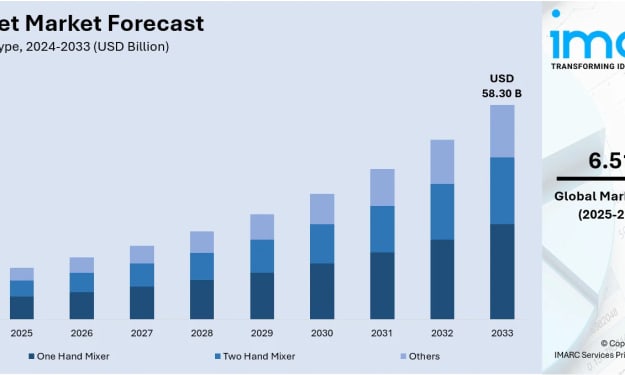
In the modern home and commercial space, the humble faucet has evolved from a basic utility into a high-tech centerpiece of design and sustainability. Driven by rapid urbanization and a global shift toward smarter, more hygienic living environments, the market is seeing a surge in demand for fixtures that blend aesthetic appeal with cutting-edge water-saving technology. According to IMARC Group’s latest data, the global faucet market size was valued at USD 31.03 Billion in 2024. Looking forward, IMARC Group estimates the market to reach USD 58.30 Billion by 2033, exhibiting a CAGR of 6.51% from 2025-2033.
By Andrew Sullivan6 days ago in Futurism
Women’s Health App Market Outlook: Digital Wellness Adoption and Personalized Care Growth Opportunities
According to IMARC Group's latest research publication, The global women’s health app market size reached USD 4.3 Billion in 2024. Looking forward, IMARC Group expects the market to reach USD 16.7 Billion by 2033, exhibiting a growth rate (CAGR) of 14.74% during 2025-2033.
By James Whitman5 days ago in Futurism
Pearl
1980 something. we all hung out at Pearl and you and i were nothing special, or so i thought. i mean we all danced, drenched in our own sweat, our own saline solution of fear, too many beers, shots, laughter, tears, fucks in the bathroom and i don't know when we began to be afraid. do you?
By ROCK aka Andrea Polla (Simmons)3 days ago in Fiction



Comments
There are no comments for this story
Be the first to respond and start the conversation.