
The Space Garden on the ISS: How Astronauts Grow Lettuce and Microgreens in Orbit
Space

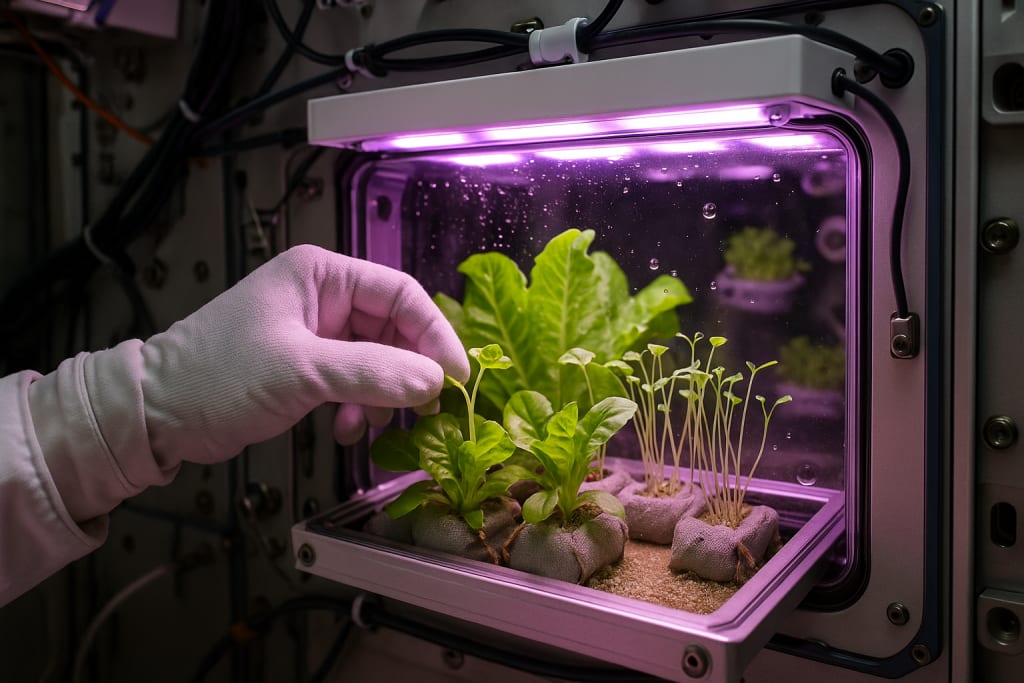
When most people imagine life aboard the International Space Station (ISS), they picture floating astronauts, futuristic experiments, and breathtaking views of Earth rising over the curve of the planet. What they don’t usually picture is a garden. Yet hundreds of miles above us, orbiting at nearly 28,000 kilometers per hour, astronauts tend to a small but remarkable “space greenhouse” where they grow fresh lettuce and nutrient-packed microgreens.
This cosmic garden is far more than a scientific curiosity—it’s an essential step toward humanity’s future among the stars.
Why Grow Plants in Space?
For long-term space missions, especially those planned for the Moon and Mars, astronauts will need more than packaged meals. Plants offer a host of benefits that no piece of equipment can replicate:
- Fresh food. Packaged meals degrade in quality, taste, and nutritional value over time. Fresh vegetables fill the gaps.
- Psychological comfort. Caring for plants provides emotional grounding. Astronauts repeatedly describe the plants as “little pieces of Earth.”
- Environmental support. Plants recycle carbon dioxide and release oxygen, an invaluable service in enclosed habitats.
- Technology testing. To live off-world, we must learn how to cultivate crops without gravity or Earth-like soil.
But growing plants in orbit is far more complex than simply placing seeds in a pot. Without gravity, water behaves oddly, roots become confused, and even bacteria act differently. That’s why the ISS has developed dedicated plant-growth systems to investigate the biology of life beyond Earth.
Meet Veggie: The Suitcase-Sized Space Garden
One of the main plant-growth facilities aboard the ISS is called Veggie, a lightweight, expandable chamber roughly the size of a carry-on suitcase. Despite its modest footprint, Veggie has transformed our understanding of how plants behave in microgravity.
Inside Veggie, plants grow in specially engineered “plant pillows”—small fabric containers filled with a clay-like substrate and slow-release fertilizer. These pillows solve several problems at once: they anchor the roots, help distribute water more evenly, and reduce the risk of contamination.
Above the plant pillows, panels of red, blue, and green LEDs deliver precisely tuned light spectrums. Red and blue encourage strong growth, while green light helps the plants look like their Earth-born counterparts—something surprisingly important for the astronauts’ psychological well-being.
The first major success of Veggie came in 2015, when astronauts harvested and tasted red romaine lettuce grown entirely in space. The moment was historic: the first fresh food eaten in orbit that wasn’t brought from Earth. Astronaut Scott Kelly famously described the experience as “a big leap toward Mars.”
Since then, the space garden’s menu has expanded dramatically. The crew now grows pak choi, mizuna mustard, radishes, and more experimental varieties selected for their nutrition and quick growth cycles.
The Rise of Microgreens: Fast Food for the Final Frontier
Among the most promising crops are microgreens, tiny plants harvested just days after sprouting. These nutrient-dense shoots—popular in trendy Earth restaurants—have become a superstar aboard the ISS.
Microgreens require very little space, mature quickly, and deliver intense flavors and vitamins. NASA researchers have found that microgreens like mustard, radish, or broccoli sprouts grow surprisingly well in microgravity. Their rapid growth also makes them ideal candidates for testing new substrates, lighting patterns, and watering systems.
One astronaut described opening a growth chamber filled with microgreens as “like unzipping a little garden that traveled with us.”
Challenges of Farming Without Gravity
Growing even the simplest plants in orbit means solving problems that never occur on Earth:
- Water misbehaves
On Earth, gravity pulls water into soil, but in space it clings to surfaces or forms floating blobs. To control it, NASA engineers developed wicking substrates and injectors that distribute water in tiny, controlled doses.
- Roots lose their sense of direction
Without “up” and “down,” plants rely on moisture and nutrients rather than gravitational cues. Many experiments study how roots adapt and whether some species orient better than others.
- Bacteria thrive differently
Microbes grow faster and spread unpredictably in microgravity. A minor contamination that would be manageable on Earth can ruin an entire crop on the ISS.
- Lighting must be perfect
Too little light and plants grow weak. Too much and they overheat. The ISS uses programmable LEDs to fine-tune photosynthesis.
Each challenge solved on the ISS brings us a step closer to sustainable off-world agriculture.
- Looking Ahead: Greenhouses on the Moon and Mars
The ISS garden is just the beginning. Plans for long-term lunar bases and eventual Mars missions depend heavily on advanced plant systems. Engineers are designing:
- fully automated “smart greenhouses,”
- systems that recycle air and water more efficiently,
- hybrid hydroponic–soil setups using components of lunar or Martian regolith,
- modular farms that can expand with future habitats.
Imagine astronauts on Mars stepping into a sunlit greenhouse dome where leafy greens ripple under LED skies. That vision starts with the small plants growing right now, orbiting high above our heads.
A New Era of Space Farming
The space garden on the ISS is more than a scientific project—it’s a symbol of human adaptability. Every leaf of lettuce grown in orbit is a reminder that life can flourish even in the harshest environments, as long as we bring dedication, curiosity, and a bit of green into the void.
Soon, tending to cosmic crops may be as routine for astronauts as checking instruments or conducting experiments. If humanity aims to explore—and eventually inhabit—other worlds, our future will be rooted, quite literally, in the lessons learned from these tiny spaceborne plants.
About the Creator
Keep reading
More stories from Holianyk Ihor and writers in Futurism and other communities.
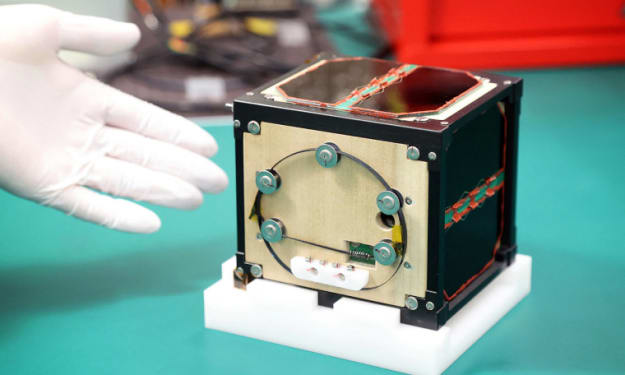
Japan’s Wooden Satellites: How Engineers Are Reinventing Space Technology With Timber
When you picture a satellite orbiting Earth, you probably imagine something metallic and high-tech—aluminum panels, titanium frames, maybe a few carbon-fiber components. The very last material you’d expect to see floating 400 kilometers above Earth is… wood.
By Holianyk Ihor2 months ago in Futurism
About Binding Prometheus
I want to start actively advocating on behalf of my own work, and the most valuable part of my canon is, without a doubt, Binding Prometheus, the play I have been working on since 2019 and only finished in 2023 as part of my MA. The play itself is an amalgamation of a million different inspirations. On one end, it evokes the Ancient Greek myth-play, deriving its own title from the earliest extant work of Western drama we have, Aeschylus’s Prometheus Bound. On the other end, it borrows significantly from the sci-fi bulwarks from over the years, namely Mary Shelley’s Frankenstein and Karel Capek’s Rossum’s Universal Robots. The play could be an episode of Black Mirror, I fear. I don’t know. I’ve only ever seen one episode of Black Mirror.
By Steven Christopher McKnight18 days ago in Futurism
GCC Organic Food Market: Health Awareness, Clean Label Demand & Growth Outlook
According to IMARC Group's latest research publication, GCC organic food market size reached USD 4.4 Billion in 2024. The market is projected to reach USD 11.7 Billion by 2033, exhibiting a growth rate of 11.3% during 2025-2033.
By Abhay Rajput7 days ago in Futurism



Comments
There are no comments for this story
Be the first to respond and start the conversation.